
Kiełbasa Oławska
Also known as Olawska, Oławska sausage
Lower Silesia, Poland
Overview
Kiełbasa Oławska is a Polish all-pork cooked-smoked sausage with a deliberately layered grain. Large pieces of lean pork dominate the slice, smaller medium-fat pieces fill the spaces, and finely comminuted connective pork creates the bind. Black pepper, garlic and a restrained caraway note sit beneath a light-brown smoked casing.
Where it's from
The cut
Identity and terminology
Oławska is the feminine adjectival form derived from Oława, the Lower Silesian town, and kiełbasa means sausage. The source's unaccented Olawska loses the Polish letter ł and is retained only as a search alias. The available evidence supports a named Polish technical assortment, not an EU protected designation and not automatic equivalence with every sausage made in Oława today.
Composition and characteristics
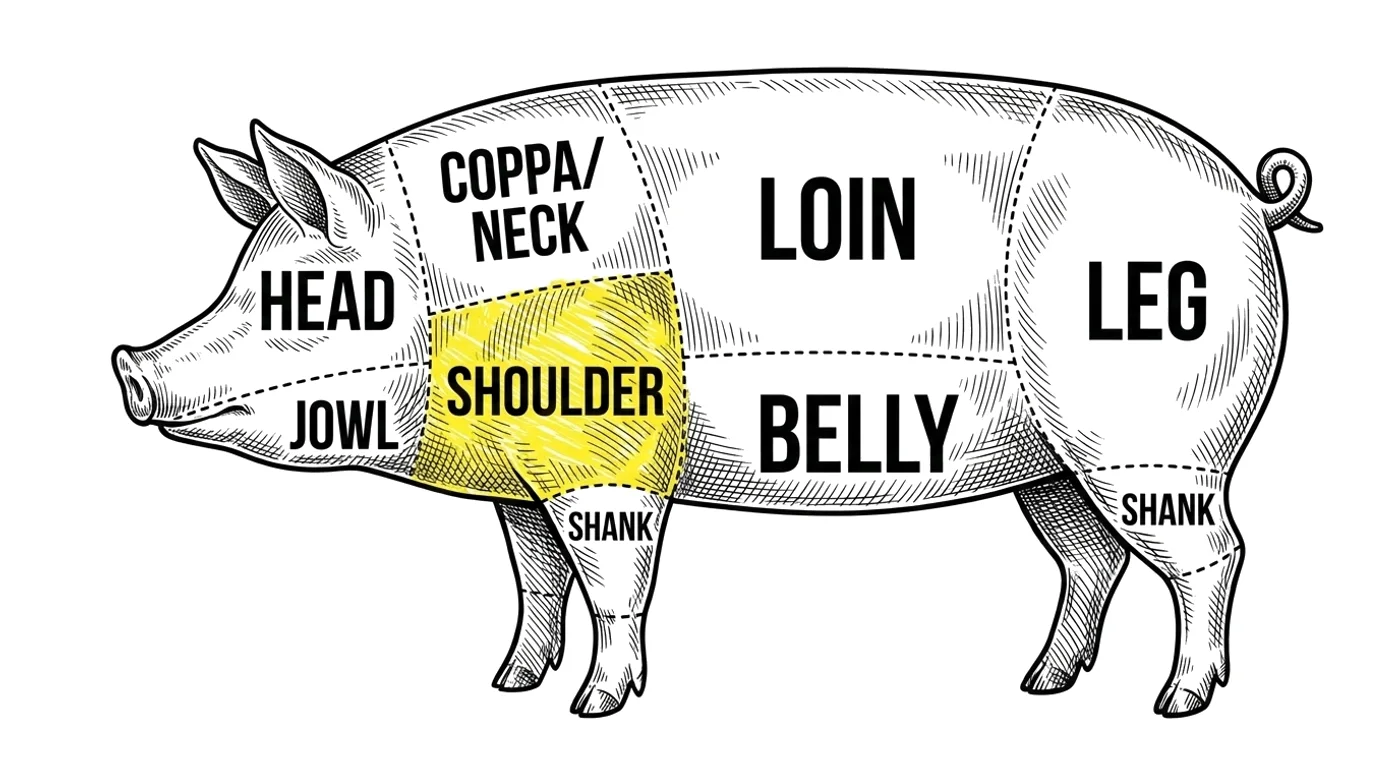
Four pork fractions define the product more accurately than a generic lean-to-fat ratio. Lean ham or shoulder gives the conspicuous coarse particles; medium-fat shoulder supplies succulence; shank trim contributes collagen and binding protein; firm back fat creates small pale points. The seasoning is savoury rather than hot. Caraway should register as a background regional accent, not overwhelm the garlic and smoke.
Production and process
Each pork class is ground separately. The connective-rich fraction is fine-cut with chilled liquid, cure and spices to make a sticky matrix, while the lean fraction remains conspicuously coarse. After mixing, the sausage is filled into substantial hog casing, cured cold, smoked and cooked. The finished links may be paired. Drying can firm the surface, but yield alone cannot establish shelf stability.
History and regional forms
Polish state trade and technical documents from the post-war period record a large organised repertoire of named sausage assortments and production norms. Oławska belongs to that technical naming culture. Oława itself is a much older settlement at the meeting of regional river and trade routes, but the town's age does not prove that this exact industrial formula is medieval or continuous from early local butchery.
Use, storage and related products
Slice Oławska for rye bread, mustard, horseradish and pickled cucumber, or warm thicker pieces gently. Its coarse lean structure gives a meatier bite than emulsified luncheon sausage. Keep the home-made product refrigerated after smoking and cooking. It should remain distinct from uncooked regional fresh kielbasa and from unrelated protected Polish names whose specifications impose their own compositions and certification systems.
Recipe and cure
This is not a finished recipe. It is a window into how this meat is traditionally cured. Before you follow any process, run it through one of our curing calculators so the salt, cure and timings are right and safe for your own batch.
Make this — the measured Curesmith version →“Make this” opens the same cure as a measured recipe, scaled to your batch.
- Meat
- Pork shoulder or ham
- Cut
- Pork shoulder or ham
- Salt (%)
- 1.8
- Curing salt
- Cure #1 as specified in the recipe
- Fermented
- No
- Starter or mould
- None; this product is not fermented
- Smoked
- Yes
- Maturation
- Refrigerate at 0–4°C; use within 4 days or freeze promptly
- Basis
- per 1,000 g pork shoulder or ham
- Style
- coarse Polish all-pork smoked and cooked sausage
Ingredients
- Pork shoulder or ham100% · 1000 g
- Pork shoulder25% · 250 g
- Pork shank15% · 150 g
- Pork back fat15% · 150 g
- Fine salt1.8% · 27.5 g
- Cure #1, 6.25% sodium nitrite0.25% · 4 g
- Ground black pepper0.2% · 3 g
- Ground caraway0.05% · 0.8 g
- Fresh garlic, crushed0.3% · 4.5 g
- Crushed ice1.5% · 23 g
Method
- Separate the four pork fractions, weigh accurately and chill to 0–2°C.
- Grind each fraction to its specified size and rechill.
- Fine-cut the shank trim with cure, spices, garlic and ice until tacky.
- Mix lean and medium-fat pork with salt, then incorporate fat and the fine bind evenly.
- Fill hog casings, form paired links and refrigerate 8–12 hours.
- Dry the casing and apply moderate hot smoke until evenly coloured.
Safety. Classify the pork accurately, measure cure against the full pork block, complete the cook, chill promptly and do not infer shelf stability from smoke or partial drying.