
Kiełbasa Opolska
Also known as Opolska, Opole sausage
Opole Silesia, Poland
Overview
Kiełbasa Opolska is a broad Polish cooked-smoked sausage combining several pork and beef classes with a modest blood fraction. It is not a cereal blood pudding. Coarse lean pork and visible fat sit in a darker fine binding matrix made from beef, connective pork and blood. Pepper, garlic and cardamom support a brown smoked exterior and a deep reddish-brown slice.
Where it's from
The cut
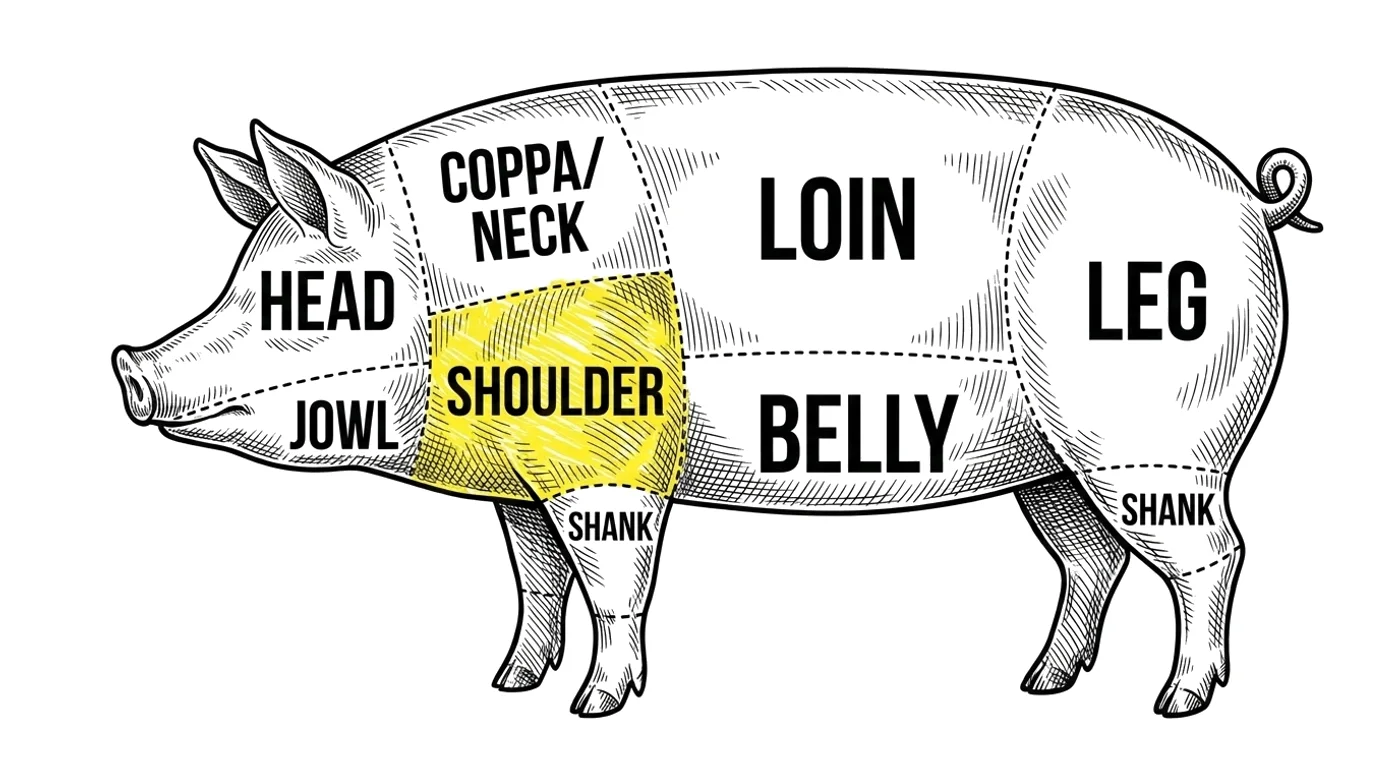
Identity and terminology
Opolska is the Polish feminine adjective for Opole or the Opole region. The name is geographic in ordinary language, but the checked evidence does not make this formula an EU protected geographical indication. It must also be separated from Krupniok śląski and other Silesian blood sausages, which have their own offal, cereal, casing and regional identities.
Composition and characteristics
The architecture is unusually detailed: lean pork stays coarse, semi-fat pork is medium ground, beef and connective-rich pork become the fine binder, hard fat supplies pale inclusions, and food-grade blood colours and enriches that matrix. Unlike a soft kaszanka, there are no groats. Unlike ordinary smoked kielbasa, blood is intentional rather than an undeclared processing aid.
Production and process
The meat classes are prepared separately before the beef and connective fraction is fine-cut with seasoning and chilled liquid. Cold blood is blended through the complete mixture without whipping in air. A large casing accommodates the mixed grain and requires careful centre-temperature measurement. Refrigerated curing, moderate smoking, full cooking and rapid chilling produce a sliceable ready-to-eat chub.
History and regional forms
The formula belongs to Poland's documented post-war technical sausage repertoire. Its source note associates blood or filler use with shortages after the Second World War, but that explanation is not treated as a complete origin history without a corroborating specification. Opole is one of Poland's oldest chartered cities and the centre of a culturally mixed Silesian region; the city context explains the adjective, not a protected production boundary.
Use, storage and related products
Serve thin slices cold with bread, mustard, horseradish or pickles, or warm pieces gently so the fat softens without breaking the slice. The blood component gives a fuller mineral character than Oławska and many standard smoked links. Only inspected food-grade blood with a controlled cold chain is acceptable. The finished broad sausage remains refrigerated and needs clean handling after cooking.
Recipe and cure
This is not a finished recipe. It is a window into how this meat is traditionally cured. Before you follow any process, run it through one of our curing calculators so the salt, cure and timings are right and safe for your own batch.
Make this — the measured Curesmith version →“Make this” opens the same cure as a measured recipe, scaled to your batch.
- Meat
- Lean pork shoulder
- Cut
- Lean pork shoulder
- Salt (%)
- 1.8
- Curing salt
- Cure #1 as specified in the recipe
- Fermented
- No
- Starter or mould
- None; this product is not fermented
- Smoked
- Yes
- Maturation
- Refrigerate at 0–4°C; use within 4 days or freeze promptly
- Basis
- per 1,000 g lean pork shoulder
- Style
- broad Polish pork, beef and blood cooked-smoked sausage
Ingredients
- Lean pork shoulder100% · 1000 g
- Medium-fat pork shoulder100% · 1000 g
- Lean beef chuck50% · 500 g
- Medium-fat beef chuck trim100% · 1000 g
- Pork shank50% · 500 g
- Pork back fat50% · 500 g
- Fresh food-grade defibrinated pork blood50% · 500 g
- Fine salt1.8% · 90 g
- Cure #1, 6.25% sodium nitrite0.25% · 12.5 g
- Ground black pepper0.15% · 7.5 g
- Fresh garlic, crushed0.1% · 5 g
- Ground cardamom0.2% · 1.5 g
- Crushed ice3.5% · 175 g
Method
- Use only inspected food-grade blood kept at 3°C or below; weigh it into a sanitised covered vessel.
- Chill and grind each named meat and fat class separately to its specified size.
- Fine-cut beef and shank trim with salt, Cure #1, spices, garlic and ice until tacky.
- Combine coarse pork, fat and fine bind, then mix in the cold blood evenly without aeration.
- Fill the broad casing firmly, tie and refrigerate 8–12 hours.
- Dry the casing and apply moderate hot smoke until brown.
Safety. Use only inspected cold food-grade blood, include it in cure calculations, probe the centre of the broad chub, chill rapidly and prevent post-cook contamination.