
Kiełbasa Podkarpacka
Also known as Podkarpacka, Kiełbasa podkarpacka pieczona półtrwała
Podkarpackie, Poland
Overview
Kiełbasa Podkarpacka is a broad Polish smoked and baked sausage with unusually large lean pork pieces held by a fine beef binder. A smaller semi-fat pork fraction adds succulence without turning the slice into a fine emulsion. The cross-section is strongly meat-forward, while pepper, nutmeg and smoke remain restrained enough to preserve the flavour of the large pork pieces.
Where it's from
The cut
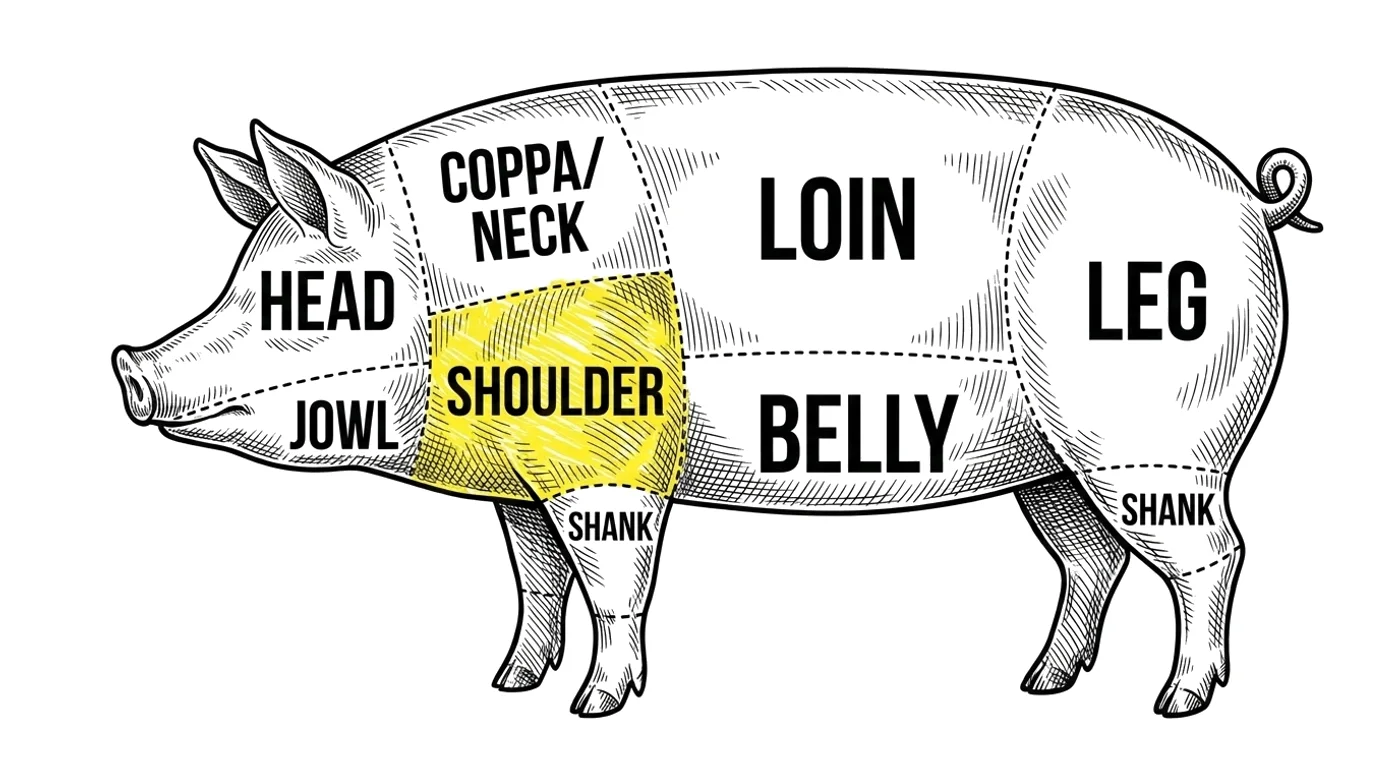
Identity and terminology
Podkarpacka is the Polish feminine adjective meaning from or associated with the Subcarpathian region. The longer source description, pieczona półtrwała, identifies a baked semi-durable form. It is a technical product name, not an automatic collective title for every sausage made in Podkarpackie and not one of Poland's currently registered EU protected meat-product names.
Composition and characteristics
Lean pork dominates and is cut into chunks rather than minced. Semi-fat pork fills smaller spaces, and lean beef is finely comminuted with a modest liquid addition to create the adhesive matrix. This architecture differs from a salami mosaic because the meat is cooked rather than fermented, and from Krakowska because the spice balance and regional technical identity are different.
Production and process
Pork is mixed until tacky without destroying the large pieces. The beef binder is fine-cut cold and distributed as a thin coating. A very broad fibrous casing demands firm air-free stuffing, measured surface drying and central temperature probing. Smoke precedes the baking or poaching step. Rapid chilling follows, because the home branch does not rely on drying for release.
History and regional forms
The 1964 Polish state trade regulation lists Podkarpacka among established semi-durable sausage assortments, placing the name firmly in the organised post-war technical canon. Podkarpackie now maintains many separately named traditional meat products, but the checked ministry list does not make this generic technical formula equivalent to any one of them. Historical classification and modern regional registration must stay distinct.
Use, storage and related products
Slice the fully chilled chub thinly for bread, horseradish and pickled vegetables, or warm thicker pieces gently. Its large pork sections give a pronounced cured-meat bite. The source suggestion to store it in a cool room until it dries is not adopted: without a controlled drying programme and verified water activity, the home-made sausage remains refrigerated.
Recipe and cure
This is not a finished recipe. It is a window into how this meat is traditionally cured. Before you follow any process, run it through one of our curing calculators so the salt, cure and timings are right and safe for your own batch.
Make this — the measured Curesmith version →“Make this” opens the same cure as a measured recipe, scaled to your batch.
- Meat
- Pork ham or shoulder in 30–40 mm pieces
- Cut
- Pork ham or shoulder in 30–40 mm pieces
- Salt (%)
- 1.8
- Curing salt
- Cure #1 as specified in the recipe
- Fermented
- No
- Starter or mould
- None; this product is not fermented
- Smoked
- No
- Maturation
- Refrigerate at 0–4°C; use within 4 days or freeze promptly
- Basis
- per 1,000 g pork ham or shoulder in 30–40 mm pieces
- Style
- Polish broad semi-durable-style pork sausage with fine beef bind
Ingredients
- Pork ham or shoulder in 30–40 mm pieces100% · 1000 g
- Semi-fat pork shoulder in 15–20 mm pieces15% · 150 g
- Beef chuck20% · 200 g
- Crushed ice3% · 40 g
- Fine salt1.8% · 24 g
- Cure #1, 6.25% sodium nitrite0.24% · 3.5 g
- Ground black pepper0.2% · 2.5 g
- Ground nutmeg0.05% · 0.7 g
Method
- Cut pork to the stated sizes, grind beef through 3 mm, mix the complete animal block with salt and Cure #1 and refrigerate 24 hours.
- Fine-cut the cured beef with pepper, nutmeg and crushed ice until tacky.
- Work the large pork pieces until sticky, then coat them evenly with the beef bind.
- Fill the broad fibrous casing firmly and close securely without trapped air.
- Dry the casing in warm moving air without smoke until the surface is tack-free.
- Apply moderate hot smoke until the casing is evenly coloured.
Safety. Cure under refrigeration, preserve the coarse pork pieces, probe the centre of the broad chub, chill rapidly and do not infer shelf stability from passive drying.