
Kiełbasa Podlaska
Also known as Podlaska, Podlasie sausage
Podlasie, Poland
Overview
Kiełbasa Podlaska is a Polish cooked-smoked sausage whose slice combines several deliberately different textures. Coarse lean pork and medium-ground semi-fat pork form most of the body, a small hard-fat fraction gives pale points, and finely worked beef fills the spaces as a darker binding matrix. Garlic and pepper remain restrained beneath the smoke, making this a meat-led regional technical style rather than a heavily spiced speciality.
Where it's from
The cut
Identity and terminology
Podlaska is the feminine adjectival form of Podlasie, the historical region in north-eastern Poland. The source's unqualified title therefore identifies regional association, but it does not by itself prove a protected geographical designation. A 1950 Polish state specification names Kiełbasa Podlaska directly, while today's ministry register contains several separately named Podlaskie products. Those modern entries must not be collapsed into this historical technical identity.
Composition and characteristics
The product is defined by four raw-material classes rather than a single generic mince. Lean pork supplies large particles, semi-fat pork supplies juiciness, hard back fat gives clean points and beef with some connective tissue becomes the fine bind. The finished link should show a heterogeneous but coherent cross-section. Garlic, black pepper, salt and smoke support the meat without masking the regional cut pattern.
Production and process
Each fraction is ground separately to preserve its role. Beef is fine-cut cold with ice, curing salt and seasoning; pork is mixed until tacky; fat enters last to avoid smear. The mixture is packed into medium hog casings, refrigerated for cure development, surface-dried, smoked and cooked until the centre reaches 71°C. Rapid chilling fixes the texture and limits growth during passage through the cooling range.
History and regional forms
Polish state standards recorded Podlaska in the organised post-war sausage canon, but the region's cured-meat culture is broader and older than any single formula. The contemporary Traditional Products List for Podlaskie includes products such as Kiełbasa z Ejszeryszek and Kumpiak podlaski. Their named histories demonstrate regional continuity while also showing why this general technical sausage cannot borrow their individual identities or claims.
Use, storage and related products
Serve Podlaska cold in slices with rye bread, mustard, horseradish or pickled vegetables, or warm a link gently without drying it. Its coarse-and-fine architecture separates it from smooth parówki and from large-chunk Krakowska. A home-made batch remains refrigerated. Smoke and historical naming do not establish shelf stability, certification or permission to use the name of any protected regional product.
Recipe and cure
This is not a finished recipe. It is a window into how this meat is traditionally cured. Before you follow any process, run it through one of our curing calculators so the salt, cure and timings are right and safe for your own batch.
Make this — the measured Curesmith version →“Make this” opens the same cure as a measured recipe, scaled to your batch.
- Meat
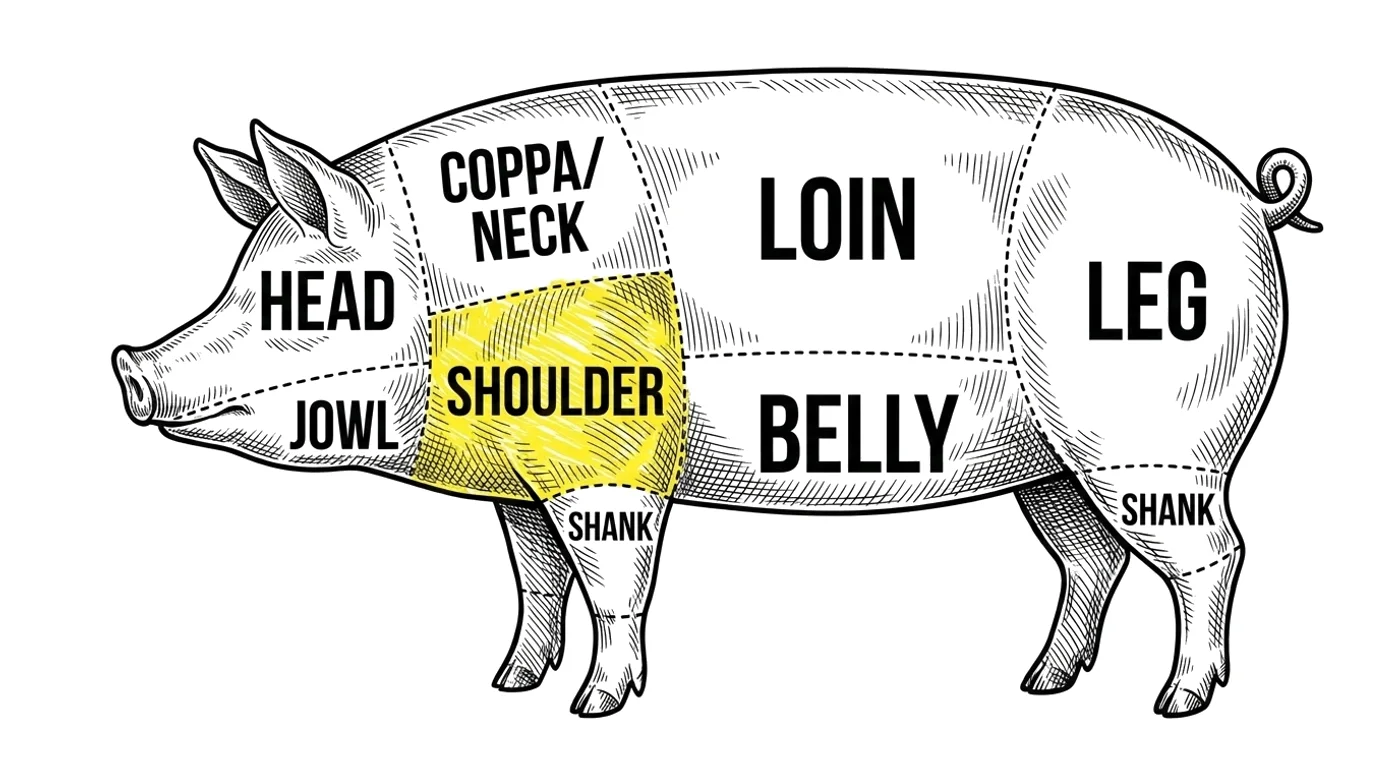
- Pork shoulder
- Cut
- Pork shoulder
- Salt (%)
- 1.8
- Curing salt
- Cure #1 as specified in the recipe
- Fermented
- No
- Starter or mould
- None; this product is not fermented
- Smoked
- Yes
- Maturation
- Refrigerate at 0–4°C; use within 4 days or freeze promptly
- Basis
- per 1,000 g pork shoulder
- Style
- Polish coarse pork sausage with fine beef bind, hot-smoked and cooked
Ingredients
- Pork ham40% · 400 g
- Pork shoulder100% · 1000 g
- Beef chuck with some connective tissue50% · 500 g
- Pork back fat10% · 100 g
- Crushed ice3% · 60 g
- Fine salt1.8% · 36 g
- Cure #1, 6.25% sodium nitrite0.25% · 5 g
- Ground black pepper0.15% · 3 g
- Fresh garlic, crushed0.15% · 3 g
Method
- Trim, weigh and chill all animal materials and equipment to 0–2°C.
- Grind lean pork through 12 mm, semi-fat pork and back fat through 8 mm, and beef through 3 mm.
- Fine-cut beef with ice, Cure #1, pepper and garlic; mix pork with salt until tacky, then combine all fractions evenly.
- Stuff firmly into 32–36 mm hog casing, remove air pockets and refrigerate 8–12 hours.
- Apply moderate hot smoke until the casing is evenly brown.
- Poach, steam or finish in the smokehouse until the cold point reaches 71°C.
Safety. Cure at 3–5°C, keep the beef bind cold, verify the final cook, chill rapidly and keep refrigerated.