
Kiełbasa Popularna
Also known as Popular Sausage, Popularna
Poland
Overview
Kiełbasa Popularna is a historical Polish cooked-smoked sausage designed around economical raw-material use without abandoning a recognisable meat structure. Medium-ground semi-fat pork forms the visible body, while connective pork and beef are worked into a fine binding phase. The result is a moist ring with a brown casing, a pink mixed-grain slice and a direct pepper-and-garlic flavour.
Where it's from
The cut
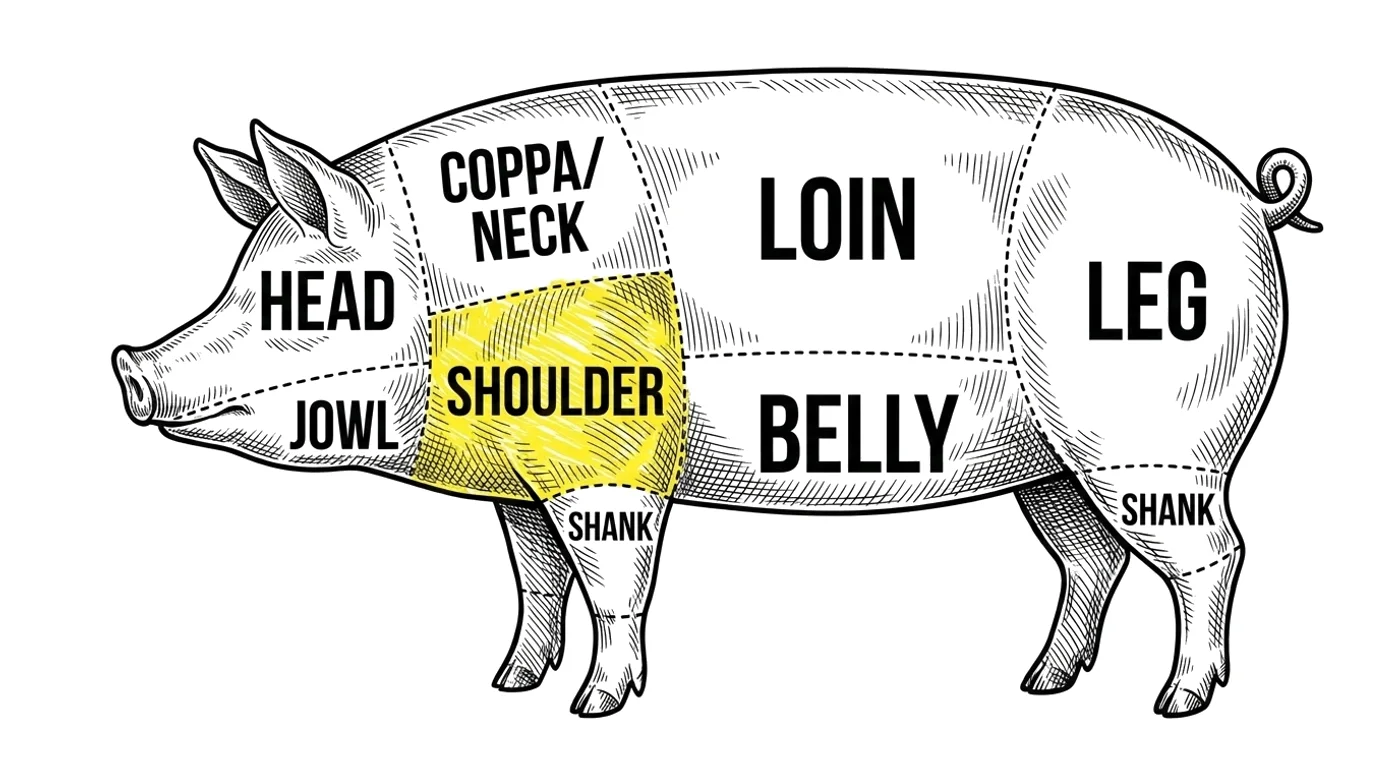
Identity and terminology
Popularna is the feminine form of popularny, meaning popular or commonly used. In this context it is a fixed technical name, not a current popularity ranking and not a generic label for any inexpensive sausage. Polish regulatory records from the 1940s and 1950s identify Kiełbasa Popularna by composition, giving the name a documentary identity even though it is not a protected geographical designation.
Composition and characteristics
The classic architecture balances a substantial semi-fat pork fraction with a smaller beef-and-connective-pork binder. Fine comminution converts collagen-rich material into a functional matrix, while the larger pork particles preserve bite. Salt, curing salt, pepper and garlic provide a simple flavour profile. The product's identity lies less in rare spices than in its deliberate class-based use of meat and the contrast between coarse body and fine bind.
Production and process
The pork is ground at a medium plate and mixed with salt until tacky. Beef and connective pork are ground finely and emulsified cold with ice, cure and spices. Combining the two phases produces a stable mixture that is stuffed in rings, cured cold, surface-dried, smoked and cooked. Modern home production ends with measured lethality, rapid cooling and refrigeration rather than relying on undocumented passive drying.
History and regional forms
Popularna belongs to the period when Polish standards organised sausages by input class, processing method, expected yield and durability. Earlier legislation even set indicative proportions for popularna alongside zwyczajna and krakowska. That evidence explains the product's economical character without reducing it to low quality. It was designed as an accessible cooked sausage with controlled composition, not simply whatever trimmings happened to be available.
Use, storage and related products
Serve Popularna sliced with bread and mustard, warmed with cabbage or potatoes, or browned gently in a pan. Its fine binder makes it softer than an all-coarse kielbasa, while the medium pork grain keeps it distinct from emulsified luncheon sausage. The home branch remains refrigerated. No protected status is claimed, and historical descriptions of extra drying do not justify ambient storage without validated water activity.
Recipe and cure
This is not a finished recipe. It is a window into how this meat is traditionally cured. Before you follow any process, run it through one of our curing calculators so the salt, cure and timings are right and safe for your own batch.
Make this — the measured Curesmith version →“Make this” opens the same cure as a measured recipe, scaled to your batch.
- Meat
- Pork shoulder
- Cut
- Pork shoulder
- Salt (%)
- 2
- Curing salt
- Cure #1 as specified in the recipe
- Fermented
- No
- Starter or mould
- None; this product is not fermented
- Smoked
- Yes
- Maturation
- Refrigerate at 0–4°C; use within 4 days or freeze promptly
- Basis
- per 1,000 g pork shoulder
- Style
- historical Polish economical cooked-smoked sausage
Ingredients
- Pork shoulder100% · 1000 g
- Pork shank15% · 150 g
- Beef chuck50% · 500 g
- Crushed ice9.1% · 150 g
- Fine salt2% · 33.5 g
- Cure #1, 6.25% sodium nitrite0.24% · 4 g
- Ground black pepper0.2% · 3.5 g
- Fresh garlic, crushed0.15% · 2.5 g
Method
- Trim, weigh and chill all animal materials and equipment to 0–2°C.
- Grind semi-fat pork through 8 mm and connective pork and beef through 3 mm.
- Fine-cut connective pork and beef with ice, Cure #1, pepper and garlic; mix pork with salt until tacky and combine.
- Stuff firmly into 36–40 mm hog casing or beef round, remove air pockets and refrigerate 8–12 hours.
- Surface-dry and hot-smoke to a uniform brown before the final cook.
- Poach, steam or finish in the smokehouse until the cold point reaches 71°C.
Safety. Keep all fractions cold, calculate cure on the full animal block, verify the cook, cool rapidly and reject ambient storage without water-activity validation.