
Overview
Kiełbasa Śląska is a Polish cooked sausage formed as short links in a continuous coil, hot-smoked and then scalded. Its interior combines clearly visible coarse pork with a finely worked collagen-rich pork phase that binds the slice. The flavour is restrained and savoury, led by pepper, garlic and coriander, with marjoram appearing in some formulas. A light brown natural casing, juicy pork texture and mixed particle size are more characteristic than heavy garlic, chilli or prolonged drying.
Where it's from
The cut
Identity and terminology
Śląska is the feminine adjectival form of Śląsk, the Polish name for Silesia. The title means Silesian sausage, but the modern retail name alone does not prove manufacture in a defined Silesian territory. Historical Polish material lists kiełbasa śląska as a named non-durable sausage alongside zwyczajna, bieszczadzka, mazowiecka and służewiecka. No PDO, PGI or TSG designation is assigned, and the article does not treat one archival formula as a current legal specification.
Composition and characteristics
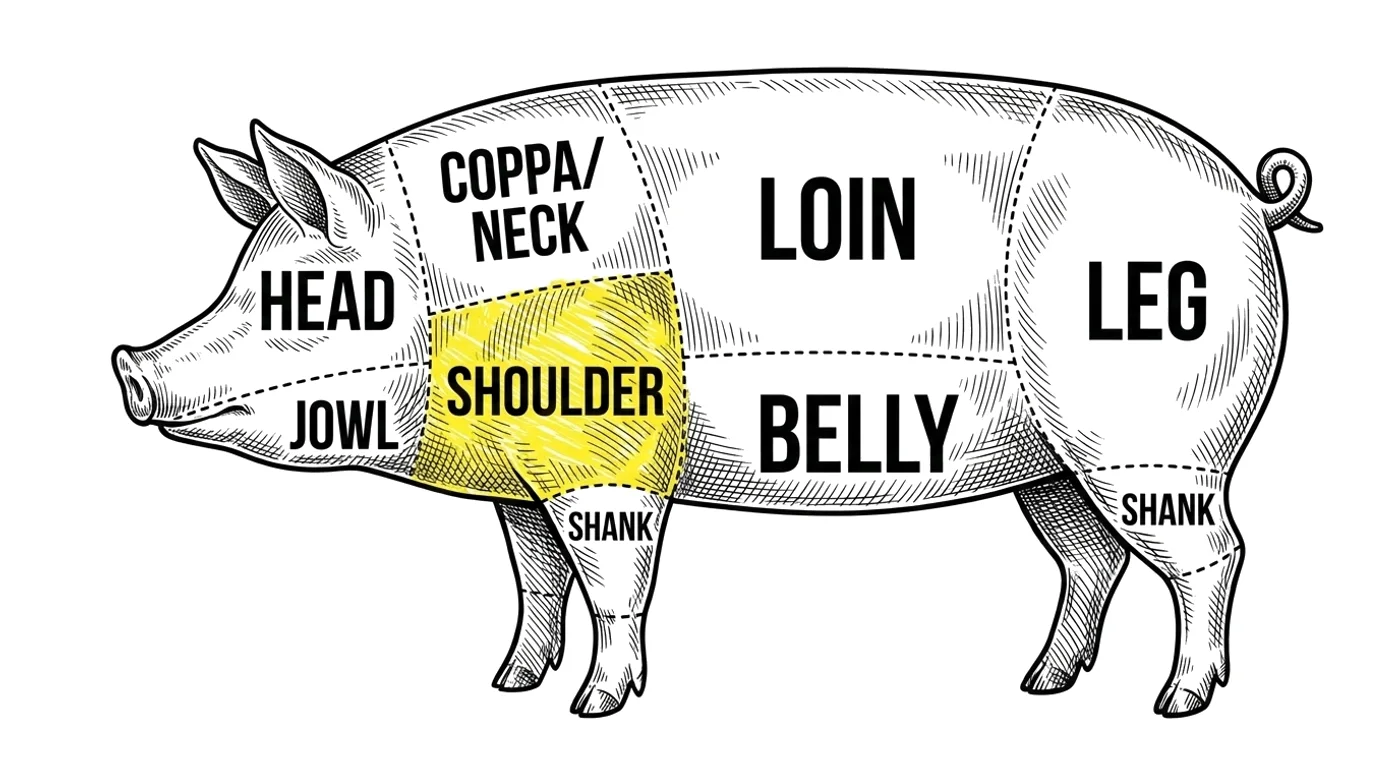
Three pork textures create the defining body. Lean pork is kept relatively coarse, semi-fat pork is ground slightly finer, and connective shoulder trim is reduced to a smooth binding paste with ice. That construction produces a visible meat pattern without the loose crumble of a fresh sausage. The cured cut face should be pink-red and evenly seasoned, with no grey centre. Garlic is controlled; coriander adds a faint citrus note, while marjoram moves the aroma towards familiar Polish cooked sausage.
Production and process
Each pork fraction is chilled and comminuted separately before coarse pieces are mixed with curing salt and the fine binding phase. The sausage is stuffed into a medium hog casing and divided into short links while remaining connected as a coil. Controlled surface drying allows smoke to adhere evenly. Hot smoke develops colour and aroma, gentle scalding completes the cook, and rapid cooling protects juiciness and safety. The finished product is refrigerated rather than dried to shelf stability.
History and regional forms
The Silesian name sits within Poland's detailed industrial sausage vocabulary, where towns and regions often became product adjectives. The archival classification proves established usage by the mid-twentieth century but not an exclusive birthplace, continuous local custody or protected recipe. Silesia spans a historically complex region shaped by Polish, Czech and German borders, so claims of a single inventor or ancient formula would be unsound. Modern śląska sausages vary in species, fat and additives.
Use, storage and related products
Warm the links in hot water without boiling, grill briefly, or serve them cold after full cooking and chilling. Mustard, horseradish, bread and pickled vegetables are natural accompaniments. Kiełbasa Śląska differs from coarse Krakowska through its shorter linked form and softer texture, from parówki through its visible pork structure, and from Schlesische Bratwurst because that German fresh sausage is uncured and sold for cooking. Store opened portions under refrigeration.
The recipe for this product is in preparation and will be published once it has been verified.
Safety. Maintain separate grinds, weigh cure on the full pork block, do not rely on smoke colour for lethality, and chill promptly after scalding.