
Kiełbasa Szynkowa (Polish Ham Sausage)
Also known as Polish ham sausage, Kiełbasa szynkowa, Ham Sausage-Polish
Poland
Overview
Kiełbasa szynkowa is the Polish ham-sausage family recognised by conspicuous lean pork pieces held inside a finer binding mass. Szynka means ham, and in this context points to high-quality lean leg meat and its cured colour rather than slices of a finished ham. The sausage is typically made in a broad casing and cooked after smoking, producing a firm cylinder for cold slicing. The source recipe uses eighty-five per cent lean pork and fifteen per cent jowl or fatty trimmings.
Where it's from
The cut
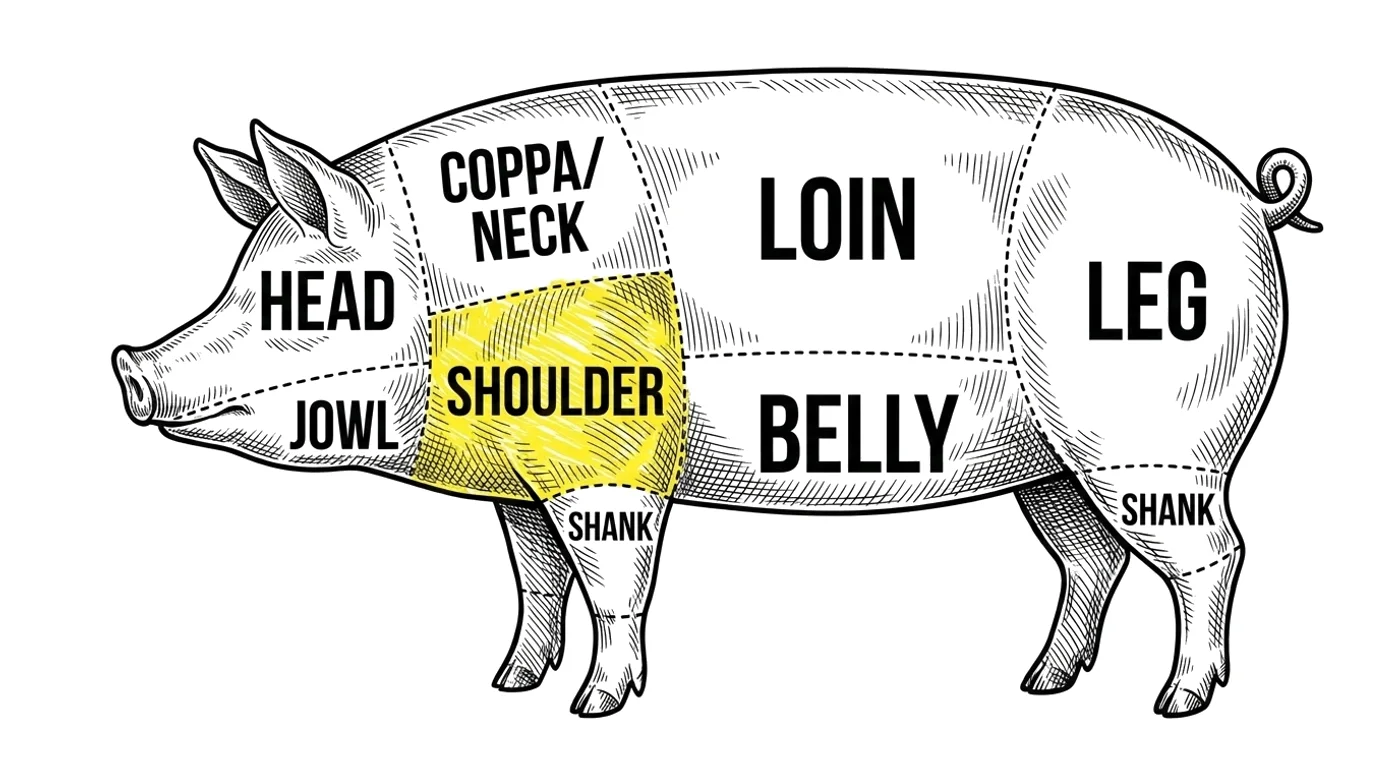
Identity and terminology
The generic words kiełbasa szynkowa do not designate one protected geographical product. Poland's traditional-products register contains named local forms, including Kiełbasa szynkowa z Markowej and a Sława turkey-and-pork form, each with its own composition and history. Those regional names should remain separate. The batch article covers the broad pork ham-sausage identity and does not absorb poultry versions, beef ham sausage or products whose town qualifier establishes a materially different tradition.
Composition and characteristics
Lean pork leg dominates the cut face. In the executable branch, most leg is cut into 20–30 mm pieces, while a smaller shoulder fraction and pork jowl are ground fine to create the matrix. Pepper, coriander and nutmeg provide a restrained Polish cooked-sausage profile. The broad beef bung or fibrous casing produces a dense pink slice with pale fine bind around darker, clearly recognisable lean pieces. Excess water or an overworked matrix would blur this defining mosaic.
Production and process
The lean and binding fractions cure cold with salt and Cure #1 before assembly. Fine shoulder and jowl are mixed with ice water until cohesive, then the large leg pieces are folded through without breaking them down. After firm stuffing and surface drying, the sausage is hot-smoked and poached gently to 71°C. A large casing may need well over an hour, so probe temperature controls release. Water cooling begins the chill, which must continue under the full two-stage programme.
History and regional forms
Polish standards and trade classifications have long treated ham sausage as a recognised high-value cooked-sausage group. Its expense came from the large share of lean leg meat and the labour needed to preserve visible pieces. Regional ministry records describe ham sausages made for holidays and special occasions, when better pork cuts were available. That background explains both the product's name and its formal, large-diameter presentation without requiring a single invented town of origin.
Use, storage and related products
Serve chilled slices with rye bread, horseradish, mustard, pickled cucumber or beetroot. Thick slices can be warmed gently but should not be fried hard enough to dry the lean pieces. Store at 0–4°C and freeze only when necessary, since freezing may loosen the mosaic. Compared with German fine Schinkenwurst, the Polish product is visibly coarse; compared with Krakowska, its name and meat arrangement place greater emphasis on ham-like lean chunks.
Recipe and cure
This is not a finished recipe. It is a window into how this meat is traditionally cured. Before you follow any process, run it through one of our curing calculators so the salt, cure and timings are right and safe for your own batch.
Make this — the measured Curesmith version →“Make this” opens the same cure as a measured recipe, scaled to your batch.
- Meat
- Lean pork leg, cut into 20–30 mm pieces
- Cut
- Lean pork leg, cut into 20–30 mm pieces
- Salt (%)
- 1.8
- Curing salt
- Cure #1 as specified in the recipe
- Fermented
- No
- Starter or mould
- None; this product is not fermented
- Smoked
- Yes
- Maturation
- Refrigerate at 0–4°C; use within 4 days or freeze promptly
- Basis
- per 1,000 g lean pork leg, cut into 20–30 mm pieces
- Style
- cured, hot-smoked and cooked Polish large-piece pork sausage
Ingredients
- Lean pork leg, cut into 20–30 mm pieces100% · 1000 g
- Lean pork shoulder for binding mass20% · 200 g
- Pork jowl20% · 200 g
- Ice water6.1% · 85.5 g
- Fine salt1.8% · 25.5 g
- Cure #1, 6.25% sodium nitrite0.25% · 3.5 g
- Black pepper0.21% · 3 g
- Ground coriander0.21% · 3 g
- Ground nutmeg0.1% · 1.5 g
Method
- Cut the leg meat, grind the binding shoulder and jowl, and chill all fractions to 0–2°C.
- Dissolve Cure #1 in a little ice water and distribute it with the salt across every meat fraction.
- Fine-mix shoulder and jowl with the remaining water and spices, then fold in the cured leg pieces until evenly suspended.
- Fill the large casing tightly, remove air pockets, tie and lace securely.
- Dry the surface, then hot-smoke at 50–65°C until the casing is light brown.
- Poach at 75–78°C until the cold point of the large sausage reaches 71°C.
Safety. Cure all fractions under refrigeration, build a stable fine bind, probe the large casing to 71°C and complete rapid cooling.