
Kiełbasa Wawelska
Also known as Wawelska Sausage, Vavelska
Małopolskie, Poland
Overview
Kiełbasa Wawelska is a large-calibre Polish sausage built around visible lean pork pieces held in a fine beef binder with a modest back-fat fraction. The controlled branch is cured, smoked and baked or chamber-cooked, giving a brown casing and a compact pink slice with clear pork mosaics rather than an emulsified interior. Pepper, allspice, nutmeg and garlic create a warmer aromatic profile than many everyday Polish smoked links. It is a moist cooked product and remains refrigerated.
Where it's from
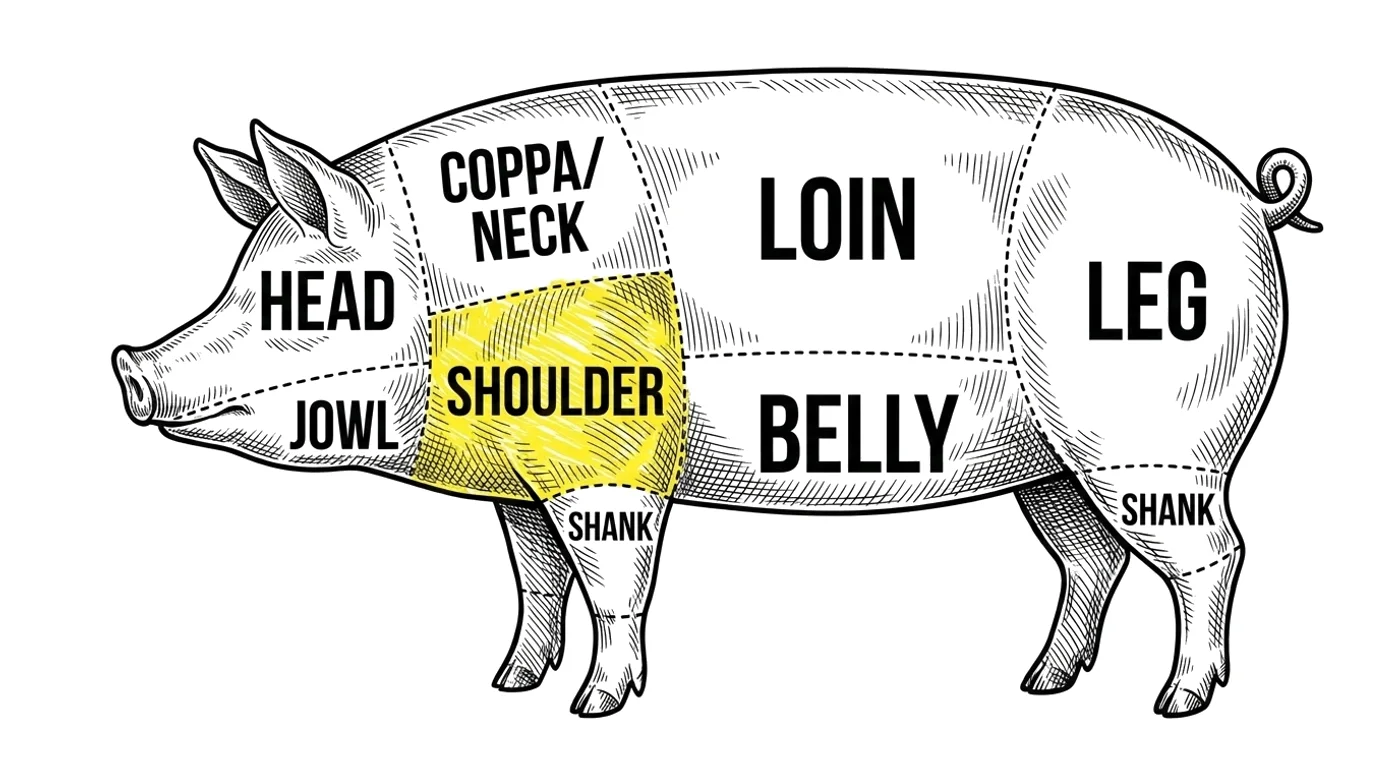
The cut
Identity and terminology
Wawelska is the feminine adjective from Wawel, the historic fortified hill and royal complex in Kraków. The English-source spelling Vavelska is a transliteration error and is not retained as the canonical title. Polish technical classifications record Wawelska as its own named sausage, but that historical listing is not evidence of a current EU geographical indication. The Atlas therefore preserves the Polish identity without implying certification, exclusive Kraków production or a protected recipe.
Composition and characteristics
The composition is pork-led. Large lean cubes supply the dominant bite, finely reduced collagen-rich beef gives soluble-protein bind, and firm fat cut at a medium plate provides small pale inclusions. The slice should show distinct meat structure but remain cohesive when cut. Black pepper is the principal spice; allspice and nutmeg sit behind it, while garlic is restrained. Grey centres, smeared fat, loose cubes, excessive purge or a greasy casing indicate curing, temperature or mixing faults.
Production and process
Pork is cut and chilled before the fractions are processed separately. Beef is ground fine and worked with ice to create the binding phase; pork is mixed with salt and accurately weighed Cure #1 until adhesive, and fat is folded in last. The filled broad casing is dried under controlled cool air, smoked progressively and heated until the measured centre is fully cooked. Rapid chilling follows. The historical optional warm-smoke drying step is not treated as shelf-stability validation.
History and regional forms
Wawel supplies one of Poland's most powerful Kraków place references, and the sausage name belongs to the twentieth-century Polish tradition of named standard products alongside Krakowska, Warszawska and other city-linked identities. A name alone, however, does not establish a single inventor or uninterrupted household recipe. The evidence supports a bounded technical sausage with Polish cultural meaning. Modern commercial versions may alter casing, spice and lean-to-fat balance while still requiring truthful composition and process labelling.
Use, storage and related products
Serve Wawelska in medium slices with rye bread, mustard, horseradish or pickled vegetables, or warm thicker pieces gently. It differs from Krakowska through its specific meat distribution and spice architecture and from Warszawska through the latter's semi-fat pork binder, larger fat share, paprika and coriander. The controlled version is neither fermented nor dried to a measured water activity. Keep the baton chilled, protect cut faces and freeze portions not needed promptly.
The recipe for this product is in preparation and will be published once it has been verified.
Safety. Use the corrected Polish title, distribute Cure #1 through the full animal block, cook to 71°C, cool rapidly and reject the unvalidated ambient-storage option.