
Kiełbasa Wczasowa Pieczona
Also known as Camp Sausage, Kiełbasa wczasowa
National standard-era product, Poland
Where it's from
The cut
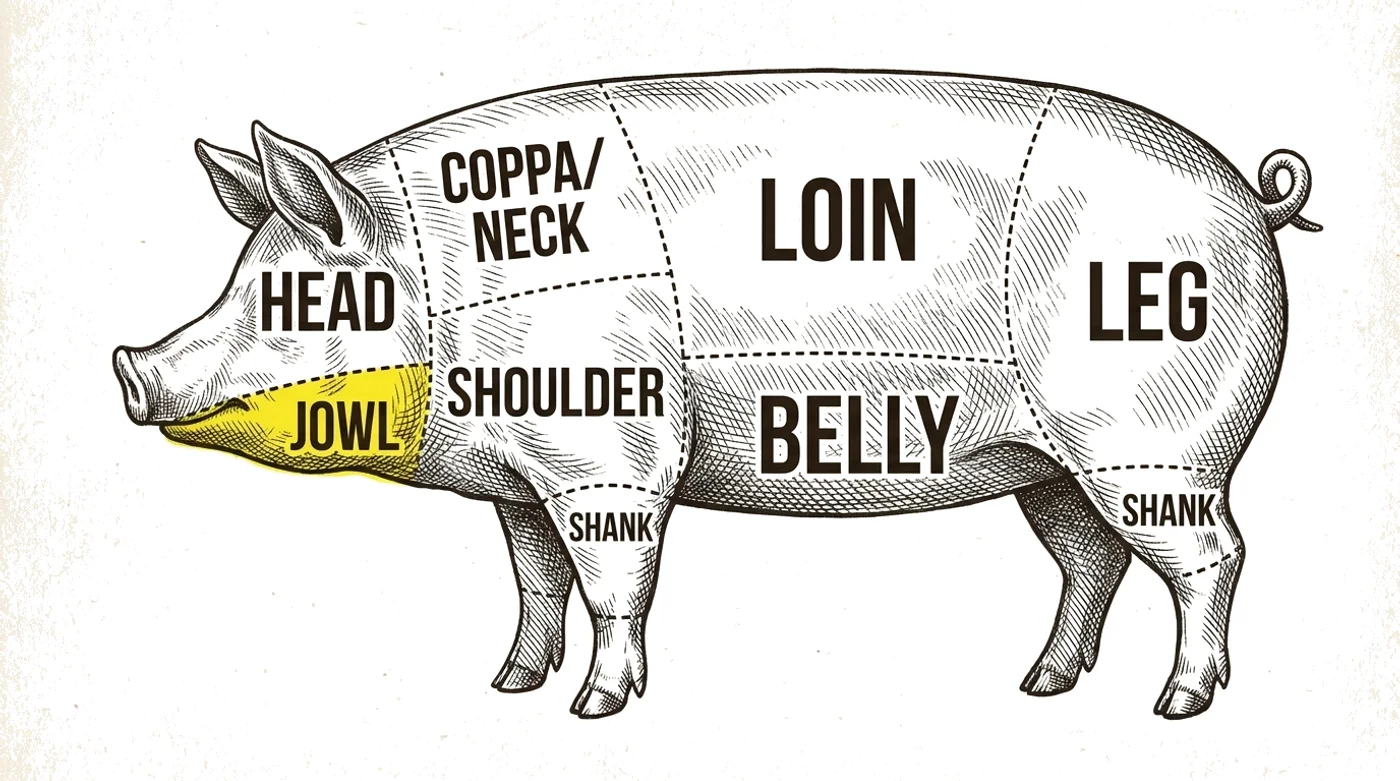
Identity and name
Kiełbasa Wczasowa Pieczona is a Polish smoked and baked sausage made from pork, beef, lungs, heart, jowl and a fine binding fraction of skin or connective trimmings. Wczasowa derives from wczasy, organised holidays or vacation stays, and is best rendered as holiday-camp sausage rather than the vague English Camp Sausage. Pieczona identifies the baked finish.
Standard-era setting
The name belongs to the post-war Polish system of nationally scheduled meat products. A 1964 ministerial instrument lists wczasowa among semi-durable sausages. The formula's economical use of lungs, heart, jowl and skins fits institutional production, where a strongly smoked cooked sausage could convert varied inspected materials into a portable, sliceable food for canteens and holiday centres.
Composition
Pork and beef provide the coarse meat structure. Lungs contribute a light, porous offal texture, heart adds dense dark meat, and jowl supplies fat and juiciness. Skin and the finely processed offal fraction form the bind. Pepper, ginger, allspice and garlic give a warm seasoning that is more complex than the pepper-garlic profile of many ordinary Polish cooked sausages.
Production
Different tissues are ground separately to match their structure. Pork remains relatively coarse, while lungs and softened skin enter the fine batter. The combined mixture is filled into medium hog casing, cured under refrigeration, hot-smoked and baked. The finished casing is dark brown with a red tint and the interior shows a mixed coarse-and-fine structure.
Legal and safety boundary
Lung use is jurisdiction-specific. United States federal rules do not allow livestock lungs to be saved for human food, while European production depends on edible offal passing official inspection. A Curesmith recipe must therefore use inspected lungs only where lawful and must not substitute another organ silently, because that would materially change the identity and texture.
Use and related products
The sausage is eaten cold in slices or reheated as a substantial canteen-style meat. It is not a blood sausage and contains no cereal. It differs from liver sausage because liver is not its defining offal, and from Kiełbasa Bytomska because Wczasowa relies on several pork offals, jowl and skin rather than a predominantly beef composition.
Recipe and cure
This is not a finished recipe. It is a window into how this meat is traditionally cured. Before you follow any process, run it through one of our curing calculators so the salt, cure and timings are right and safe for your own batch.
Make this — the measured Curesmith version →“Make this” opens the same cure as a measured recipe, scaled to your batch.
- Meat
- Skinless pork jowl
- Cut
- Skinless pork jowl
- Salt (%)
- 1.8
- Curing salt
- Cure #1 as specified in the recipe
- Fermented
- No
- Starter or mould
- None; this branch is not fermented
- Smoked
- Yes
- Maturation
- Refrigerate at 0–4°C; use within 4 days or freeze
- Basis
- per 1,000 g skinless pork jowl
- Style
- Polish cured, smoked and baked pork-beef offal sausage
Ingredients
- Pork shoulder with moderate fat60% · 600 g
- Lean beef chuck80% · 800 g
- Inspected pork lungs, where lawful for human food80% · 800 g
- Inspected pork heart40% · 400 g
- Skinless pork jowl100% · 1000 g
- Cleaned pork skin40% · 400 g
- Ice water6% · 240 g
- Fine salt1.8% · 72 g
- Cure #1, 6.25% sodium nitrite0.25% · 10 g
- Black pepper0.15% · 6 g
- Ground ginger0.05% · 2 g
- Ground allspice0.05% · 2 g
- Fresh garlic0.15% · 6 g
Method
- Use lungs only in a jurisdiction that permits inspected livestock lungs for human food. Otherwise do not produce this identity or substitute another organ silently.
- Simmer cleaned pork skin until tender, then chill rapidly.
- Trim, dice and chill all meat and fat to 0–2°C; chill grinder parts.
- Grind pork through 8 mm; beef, heart and jowl through 6 mm; lungs and cooked skin through 3 mm.
- Fine-process lungs and skin with ice water, salt, Cure #1 and spices; mix with pork, beef, heart and jowl.
- Stuff into natural hog casing, 34–36 mm; remove air pockets and form the specified links.
Safety. Use lungs only where lawful and officially inspected. Cure accurately, cook to a verified cold point, cool rapidly and refrigerate.