
Kiełbasa Wiankowa
Also known as Ring Sausage, Wiankowa
Poland
Overview
Kiełbasa Wiankowa is a Polish cooked-smoked sausage formed into a wreath-shaped ring. Its cut face combines diced lean pork, medium pork particles, coarser lean beef and a finely worked connective-beef bind. This layered grind gives more visual texture than an emulsified link while remaining cohesive enough for neat slicing. Pepper, garlic, marjoram and a small paprika note sit beneath a full smoke aroma.
Where it's from
The cut
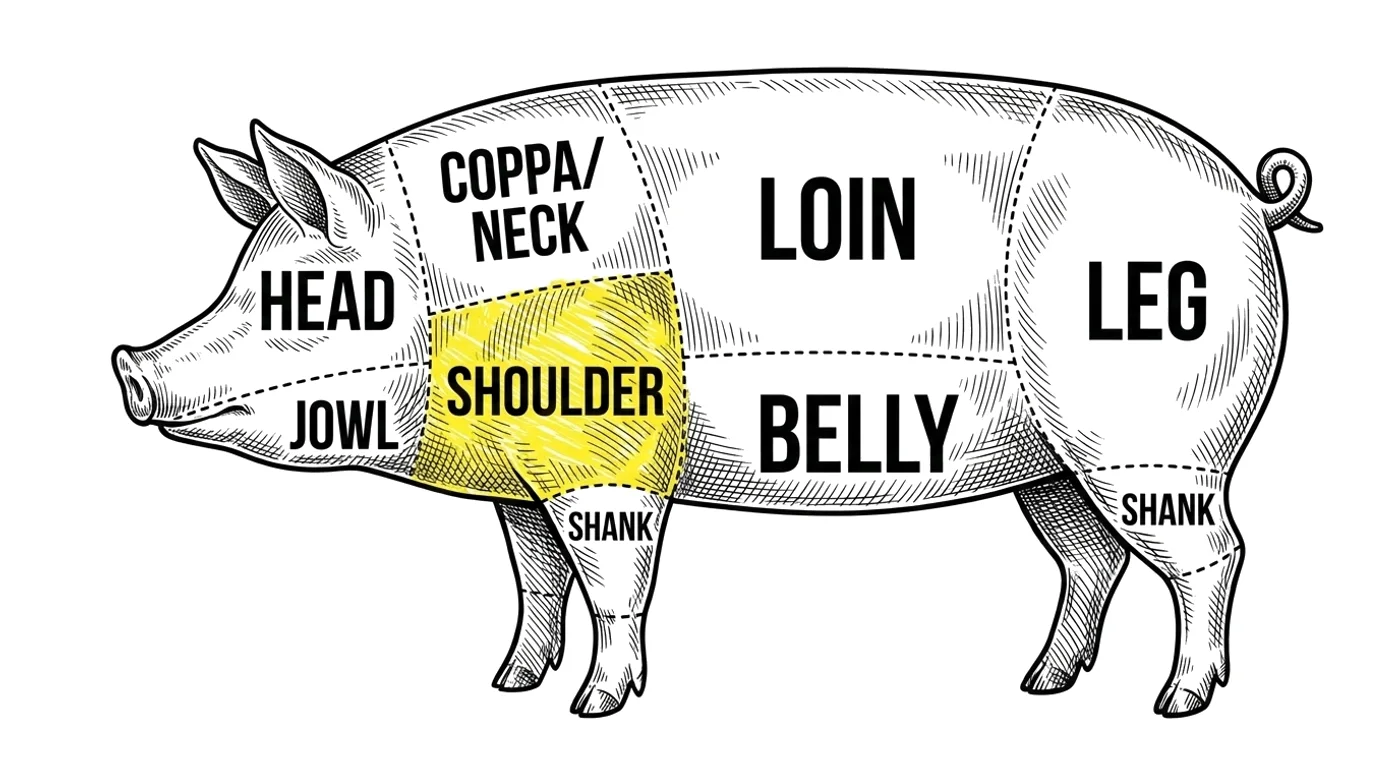
Identity and terminology
Wiankowa derives from wianek, a wreath or garland, and points first to form. That name is more specific than the English Ring Sausage, which can describe any looped product. Historical Polish technical records place Wiankowa among hot-smoked sausages of limited durability. It has no current EU protected designation and should not borrow the identity of modern regional sausages that happen to use the same casing shape.
Composition and characteristics
Four animal fractions perform separate jobs. Lean pork supplies the largest pieces, semi-fat pork gives the main body, lean beef adds darker meat particles and connective beef becomes the fine binding phase. The finished ring should show these classes clearly without crumbling. Garlic and marjoram mark the Polish profile; paprika warms the colour but does not turn the sausage into a chorizo-like product.
Production and process
Each meat class is cut or ground separately. The connective beef is fine-cut with ice, cure and seasoning, while pork and lean beef are mixed until tacky before the binder is added. The filling is packed into hog casing and tied into rings, then cured under refrigeration, surface-dried, smoked, cooked until the centre reaches 71°C and chilled. The home branch stops there rather than pursuing unvalidated semi-dry storage.
History and regional forms
Wiankowa belongs to the post-war Polish technical canon in which named sausages were defined by raw-material classes, particle size, process and expected keeping quality. Its wreath form also reflects practical hanging and retail display. Historical instructions extended life through further drying and smoking after cooking, but those methods predate modern household validation and cannot be translated into ambient-storage permission without water-activity evidence.
Use, storage and related products
Serve the ring cold in slices with rye bread, mustard, horseradish or pickles, or warm portions gently with cabbage or potatoes. Its mixed particle structure distinguishes it from smooth parówki, while its moderate calibre and ring form separate it from large Krakowska. Keep the finished sausage refrigerated. A dried casing and multiple smoke stages do not prove shelf stability.
Recipe and cure
This is not a finished recipe. It is a window into how this meat is traditionally cured. Before you follow any process, run it through one of our curing calculators so the salt, cure and timings are right and safe for your own batch.
Make this — the measured Curesmith version →“Make this” opens the same cure as a measured recipe, scaled to your batch.
- Meat
- Pork shoulder
- Cut
- Pork shoulder
- Salt (%)
- 2
- Curing salt
- Cure #1 as specified in the recipe
- Fermented
- No
- Starter or mould
- None; this product is not fermented
- Smoked
- Yes
- Maturation
- Refrigerate at 0–4°C; use within 4 days or freeze promptly
- Basis
- per 1,000 g pork shoulder
- Style
- Polish cured hot-smoked ring sausage
Ingredients
- Pork ham15% · 150 g
- Pork shoulder100% · 1000 g
- Beef15% · 150 g
- Beef shank with connective tissue35% · 350 g
- Crushed ice3% · 50 g
- Fine salt2% · 33.5 g
- Cure #1, 6.25% sodium nitrite0.24% · 4 g
- Ground black pepper0.2% · 3.5 g
- Sweet paprika0.05% · 0.8 g
- Dried marjoram0.05% · 0.8 g
- Fresh garlic, crushed0.15% · 2.5 g
Method
- Weigh and chill meat, fat, liquid and equipment to 0–2°C.
- Dice lean pork to 20 mm, grind semi-fat pork and lean beef through 10 mm, and grind connective beef through 3 mm.
- Fine-cut connective beef with ice, Cure #1 and spices; mix the other fractions with salt until tacky, then combine without smearing.
- Fill 32 mm hog casing formed into rings firmly, remove air and refrigerate 8–12 hours.
- Dry the casing under controlled airflow, then apply moderate hot smoke until evenly coloured.
- Poach, steam or finish in the smokehouse until the cold point reaches 71°C.
Safety. Distribute cure through the full animal block, keep the fine bind cold, verify the cook and reject ambient storage without water-activity validation.