
Kiełbasa Wiejska
Also known as Rural Sausage, Country Sausage, Polish Rural Sausage
Poland
Overview
Kiełbasa wiejska is a Polish country-style sausage family rather than one protected national formula. The developed branch has large pieces of lean pork held in a finer beef binder with visible pork fat, garlic and black pepper. It is cured, formed as a broad ring, hot-smoked and cooked. A good slice shows clear meat particles and white fat against a cohesive cured-pink background, with smoke and garlic supporting rather than masking the pork.
Where it's from
The cut
Identity and terminology
The adjective wiejska means rural or of the countryside. Polish usage attaches it to many foods and to numerous local sausage traditions, so the words do not by themselves prove a single place of origin or legal specification. Historical technical collections record a defined butcher's formula, while modern producers and households use the name more broadly. The Atlas therefore keeps Kiełbasa Wiejska as a family article and does not absorb separately registered village products into it.
Composition and characteristics
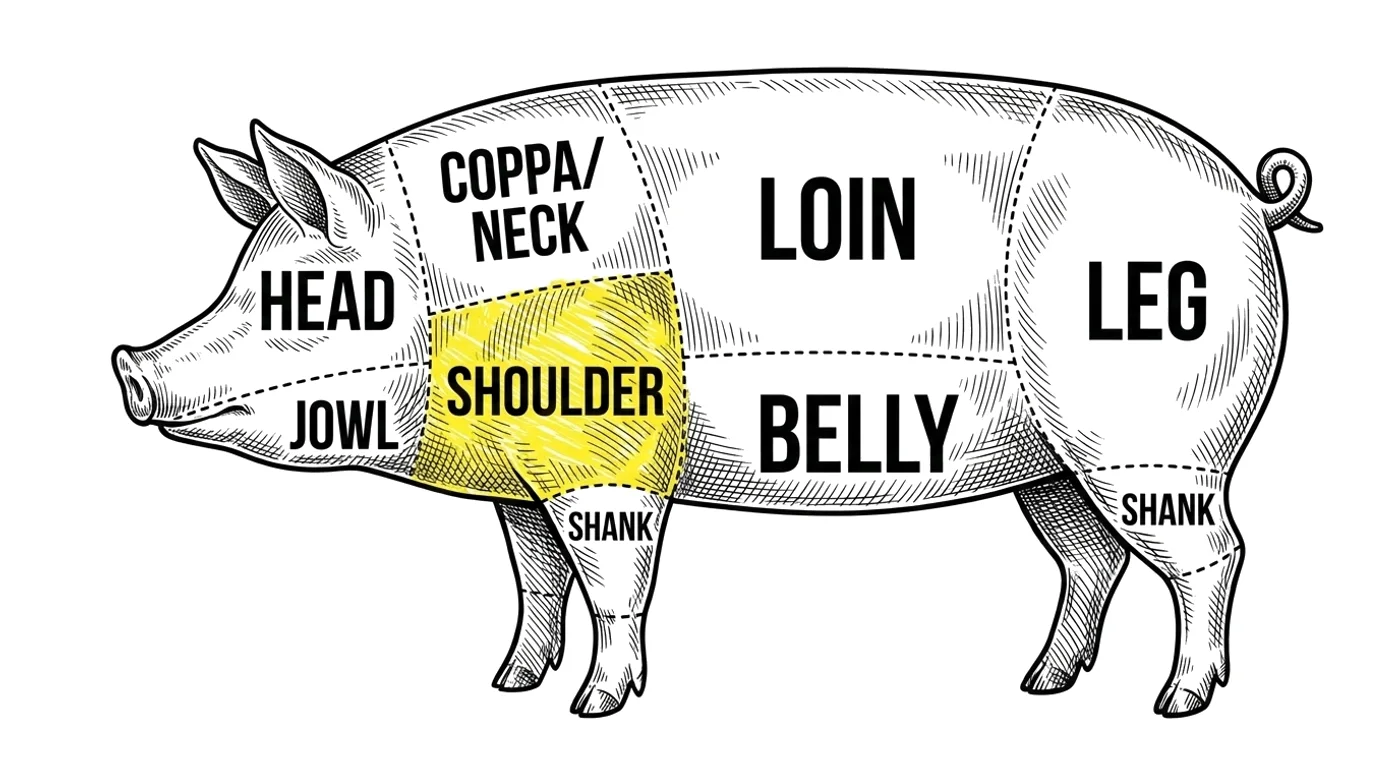
The source construction separates texture deliberately. Lean pork supplies the large show pieces, finely comminuted beef extracts protein for bind, and firmer pork fat gives discrete richness. Garlic and pepper form the direct seasoning profile. Some commercial and household versions use pork only, add marjoram, reduce the particle size or make shorter links. Those variations belong to the wider country-sausage idea but should not be silently substituted into this documented branch.
Production and process
Cold meat is cut and ground by fraction, then the fine beef portion is worked with ice, curing salt and seasoning until sticky. The coarse pork is mixed with salt before the beef binder and fat are folded through. The mixture is packed into a broad casing, cured under refrigeration, dried until the surface accepts smoke and cooked to a measured centre temperature. Rapid chilling follows because the finished ring remains a moist refrigerated food.
History and regional forms
Country sausages grew from household pig slaughter, preservation and the practical use of mixed cuts. Ring forms suited smokehouse hanging and later market display. Polish state technical systems documented repeatable compositions for public production, but they did not erase regional recipes or turn every rural name into a protected designation. Today's Traditional Products List contains many more specific local sausages, illustrating why the generic family and its named regional children need separate Atlas identities.
Use, storage and related products
Serve Kiełbasa Wiejska sliced cold with rye bread, mustard, horseradish or pickles, or warm it gently with cabbage, beans and potatoes. The coarse slice distinguishes it from an emulsified parówka, while its broad family title distinguishes it from a certified local speciality. Keep it refrigerated, protect the ready-to-eat cut surface and freeze for longer storage. Smoke colour and a firm casing do not make a home-produced ring shelf stable.
The recipe for this product is in preparation and will be published once it has been verified.
Safety. Calculate cure against the complete animal block, cure under refrigeration, verify the cold-point cook, chill rapidly and make no unsupported protected-name claim.