
Kiszka Podgardlana
Also known as Jowl Sausage, Polish liver-jowl sausage, Kiszka z podgardla
Poland
Overview
Kiszka podgardlana is a Polish cooked sausage centred on podgardle, the fatty jowl and throat area, combined with liver or other selected pork materials and a cereal binder. The filling is soft, moist and grey-brown rather than cured pink. The Curesmith branch uses jowl, shoulder and head meat, liver, skin and wheat semolina, producing a rich but sliceable sausage after poaching and chilling.
Where it's from
The cut
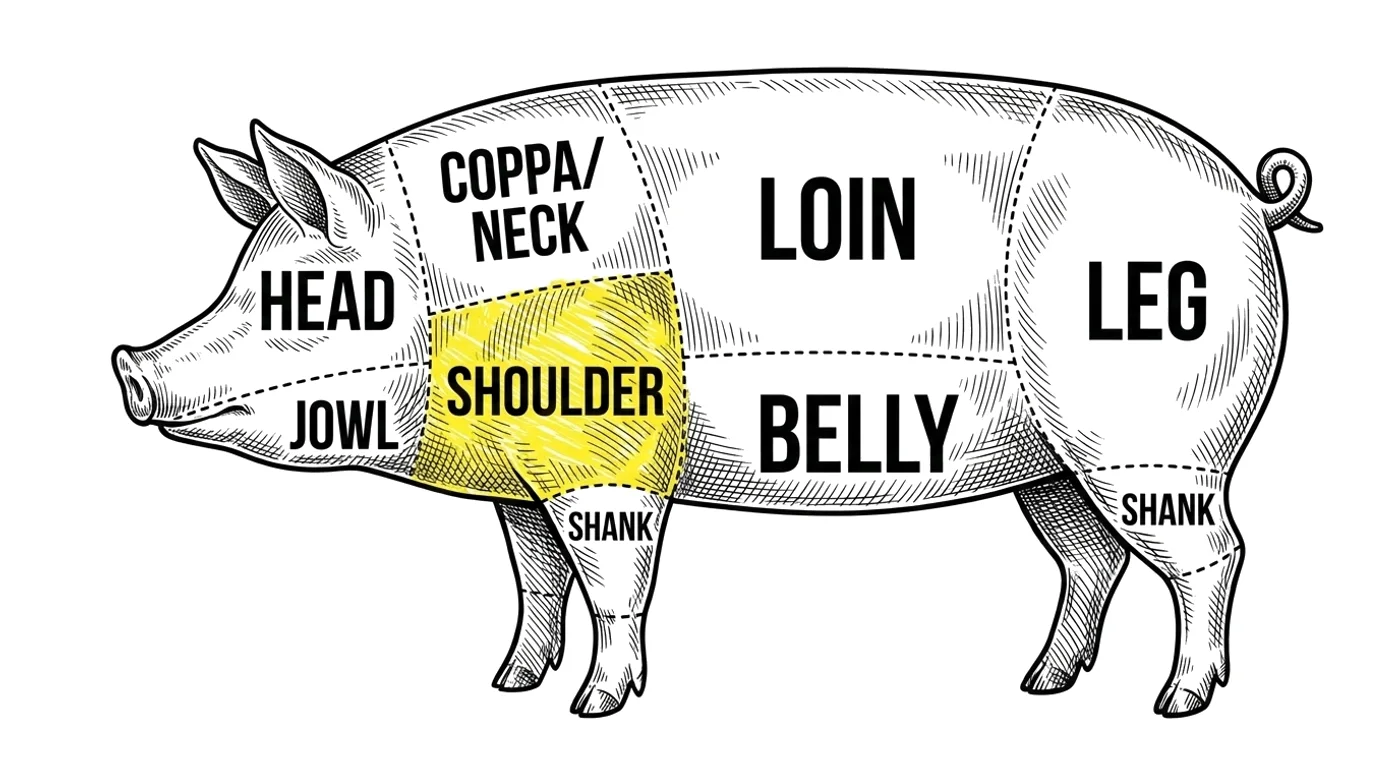
Identity and terminology
The English source title Jowl Sausage is too broad to carry the cultural identity on its own. Historic Polish technical standards record kiszka podgardlana as a named cooked-product style, while the word kiszka also covers a wider family of filled offal, blood and cereal preparations. This generic national style has no protected geographical designation in the evidence checked. It must not be confused automatically with kaszanka, in which blood is normally central.
Composition and characteristics
Pork jowl contributes soft fat and a strong pork flavour, while head and shoulder meat supply structure. Liver deepens the colour and savoury aroma; minced skin provides gelatin that firms as the sausage cools. Hydrated semolina remains a soft cereal phase rather than disappearing into an emulsion. Onion, marjoram, pepper and allspice complete a restrained Polish seasoning. The casing is filled loosely because the cooked cereal expands.
Production and process
The pork meats and skin are simmered separately from the liver, then chilled promptly with defatted stock. Semolina is hydrated in a measured amount of hot stock and likewise cooled. The cold components are ground, mixed with softened onion and spices, loosely stuffed and poached again to a 74°C cold point. Single-layer controlled chilling prevents the dense offal-and-cereal filling from cooling too slowly.
History and regional forms
Cooked offal sausages belong to the practical repertoire of Polish household slaughter and small-scale butchery, where jowl, skin, liver and stock could be converted quickly into a cohesive product. Formulae varied according to the available pig and local cereal. The historical standard supports the technical name, not a claim that one modern recipe reproduces every household version or that the product is tied to one town.
Use, storage and related products
Serve slices cold, warm them gently, or brown them in a pan so the exterior crisps while the centre stays soft. Refrigerate at 0–4°C and use promptly or freeze. Wheat semolina requires wheat and gluten declarations. The sausage is distinct from smooth liver pâté, blood-rich kaszanka and dry cured jowl products; its identity rests on cooked jowl, offal, cereal and a final poach.
Recipe and cure
This is not a finished recipe. It is a window into how this meat is traditionally cured. Before you follow any process, run it through one of our curing calculators so the salt, cure and timings are right and safe for your own batch.
Make this — the measured Curesmith version →“Make this” opens the same cure as a measured recipe, scaled to your batch.
- Meat
- Pork shoulder and deboned head meat
- Cut
- Pork shoulder and deboned head meat
- Salt (%)
- 2
- Curing salt
- None
- Fermented
- No
- Starter or mould
- None; this product is not fermented
- Smoked
- No
- Maturation
- Refrigerate at 0–4°C; use within 3 days or freeze promptly
- Basis
- per 1,000 g pork shoulder and deboned head meat
- Style
- uncured cooked Polish jowl, liver and cereal sausage
Ingredients
- Pork jowl90% · 900 g
- Pork shoulder and deboned head meat100% · 1000 g
- Pork liver40% · 400 g
- Cleaned pork skin25% · 250 g
- Wheat semolina19.6% · 500 g
- Defatted pork stock14.7% · 375 g
- Softened onion3.9% · 100 g
- Fine salt2% · 50 g
- Black pepper0.15% · 4 g
- Dried marjoram0.1% · 2.5 g
- Ground allspice0.05% · 1.5 g
Method
- Clean the pork, skin and liver. Simmer the jowl, shoulder, head meat and skin until tender; poach the liver separately.
- Chill the cooked pork and stock promptly. Hydrate the semolina with the measured hot stock, then cool it rapidly to 5°C or below.
- Grind the chilled cooked pork, skin and liver through their specified plates.
- Fold the meat mass with hydrated semolina, onion and spices until evenly dispersed but not emulsified.
- Fill the casing loosely, remove air and tie in manageable lengths.
- Poach at 78–82°C until the cold point reaches 74°C.
Safety. Use named inspected pork materials, cool cooked cereal and offal rapidly, reach 74°C after stuffing and declare wheat and gluten.