
Knack d’Alsace
Also known as Knack d'Alsace, Alsatian knack, Saucisse de Strasbourg
Alsace, France
Overview
Knack d’Alsace is a fine cured sausage of Alsace, especially associated with Strasbourg. Pork supplies the main body and fat, beef contributes colour and binding strength, and a taut natural sheep casing creates the characteristic snap. The links are hot-smoked over beech and cooked, producing a smooth pink interior, flexible curve and light brown or pink-orange exterior with a clean smoked aroma.
Where it's from
The cut
Identity and terminology
The name comes from the cracking sensation described in French as knackant. Its geographical meaning is cultural rather than currently protected under the European quality scheme. France applied to register Knack d’Alsace as a Protected Geographical Indication, and the specification was published in 2015. The authorities then withdrew the application before registration. Calling the sausage an EU PGI is therefore factually incorrect.
Composition and characteristics
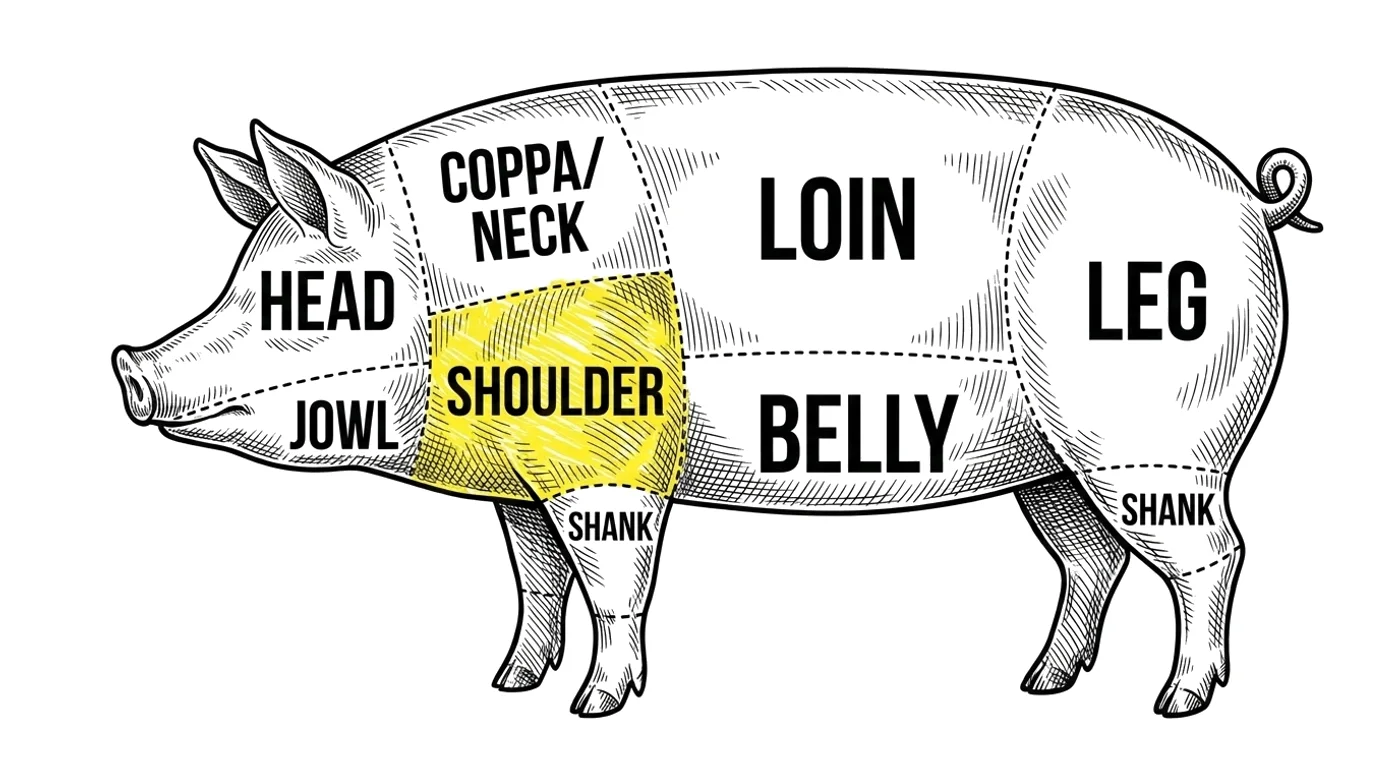
The withdrawn specification remains useful evidence of the proposed identity: a fine farce containing pork and beef, a minimum meat proportion, natural sheep intestine and beech smoke. The source recipe fits the broad pork-to-beef balance but does not define its pork cuts. A precise craft formula separates lean shoulder from skinless belly, uses a measured ice addition and seasons with white pepper, nutmeg, coriander, mild paprika and garlic.
Production and process
Cold meat is ground and fine-cut with salt, nitrite cure and ice until glossy and elastic. The farce is filled into narrow sheep casings under enough tension to create snap without tearing. After a refrigerated curing rest, the links are dried and exposed to clean hot beech smoke. Poaching follows until the cold point reaches 71°C, then rapid chilling prevents shrinkage and limits post-process growth.
History and regional forms
Alsatian charcuterie developed at the border of French and German sausage traditions. The published application linked the product’s reputation to regional butchery skills, village celebrations and documentary references reaching back to the eighteenth century. Knack remains closely associated with choucroute garnie and popular festive service. It is related to Frankfurt-style sausages but distinguished by its Alsatian name, sheep casing and documented beech-smoking tradition.
Use, storage and related products
Serve Knack d’Alsace warmed gently with bread and sweet mustard, in pairs at informal gatherings, or as part of choucroute. High heat can burst the slender casing and drive out moisture. The product must remain refrigerated and should never be treated as shelf stable merely because it is cured and smoked. Honest presentation may describe an Alsatian-style home adaptation but must not claim a PGI that does not exist.
Recipe and cure
This is not a finished recipe. It is a window into how this meat is traditionally cured. Before you follow any process, run it through one of our curing calculators so the salt, cure and timings are right and safe for your own batch.
Make this — the measured Curesmith version →“Make this” opens the same cure as a measured recipe, scaled to your batch.
- Meat
- Pork shoulder
- Cut
- Pork shoulder
- Salt (%)
- 1.8
- Curing salt
- Cure #1 as specified in the recipe
- Fermented
- No
- Starter or mould
- None; this product is not fermented
- Smoked
- Yes
- Maturation
- Refrigerate at 0–4°C; use within 4 days or freeze promptly
- Basis
- per 1,000 g pork shoulder
- Style
- fine cured hot-smoked Alsatian sausage in natural sheep casing
Ingredients
- Pork shoulder100% · 1000 g
- Pork belly50% · 500 g
- Beef chuck15% · 150 g
- Ice water8.1% · 133.5 g
- Fine salt1.8% · 30 g
- Cure #1, 6.25% sodium nitrite0.24% · 4 g
- White pepper0.2% · 3.5 g
- Ground nutmeg0.1% · 1.5 g
- Ground coriander0.1% · 1.5 g
- Sweet paprika0.1% · 1.5 g
- Fresh garlic0.35% · 6 g
Method
- Trim, weigh and chill pork, beef, water and equipment to 0–2°C.
- Grind all meat through 8 mm.
- Dissolve Cure #1 in part of the ice water; fine-cut meat with salt, cure, remaining water and seasonings until smooth and glossy.
- Fill natural sheep casing under enough tension to give a clean snap, form curved links and refrigerate for 8–12 hours.
- Dry the casing, then hot-smoke with clean beech smoke until evenly coloured and lightly aromatic.
- Poach at 78–80°C until the cold point reaches 71°C.
Safety. Maintain a cold fine-cut, use natural casing hygienically, calculate nitrite cure accurately, cook to 71°C and cool quickly.