
Knækpølse
Also known as Knockpolse, Knaekpoelse, Danish knack sausage
Denmark
Overview
Knækpølse is a Danish thick cooked sausage whose name refers to the casing’s snap. Modern Danish dictionary evidence describes it as a thick Bavarian-style sausage, while the historical dictionary records small cooked and smoked sausages divided by twisting the casing. The source title Knockpolse is an anglicised or corrupted spelling, so it is retained as an alias rather than used as the canonical name.
Where it's from
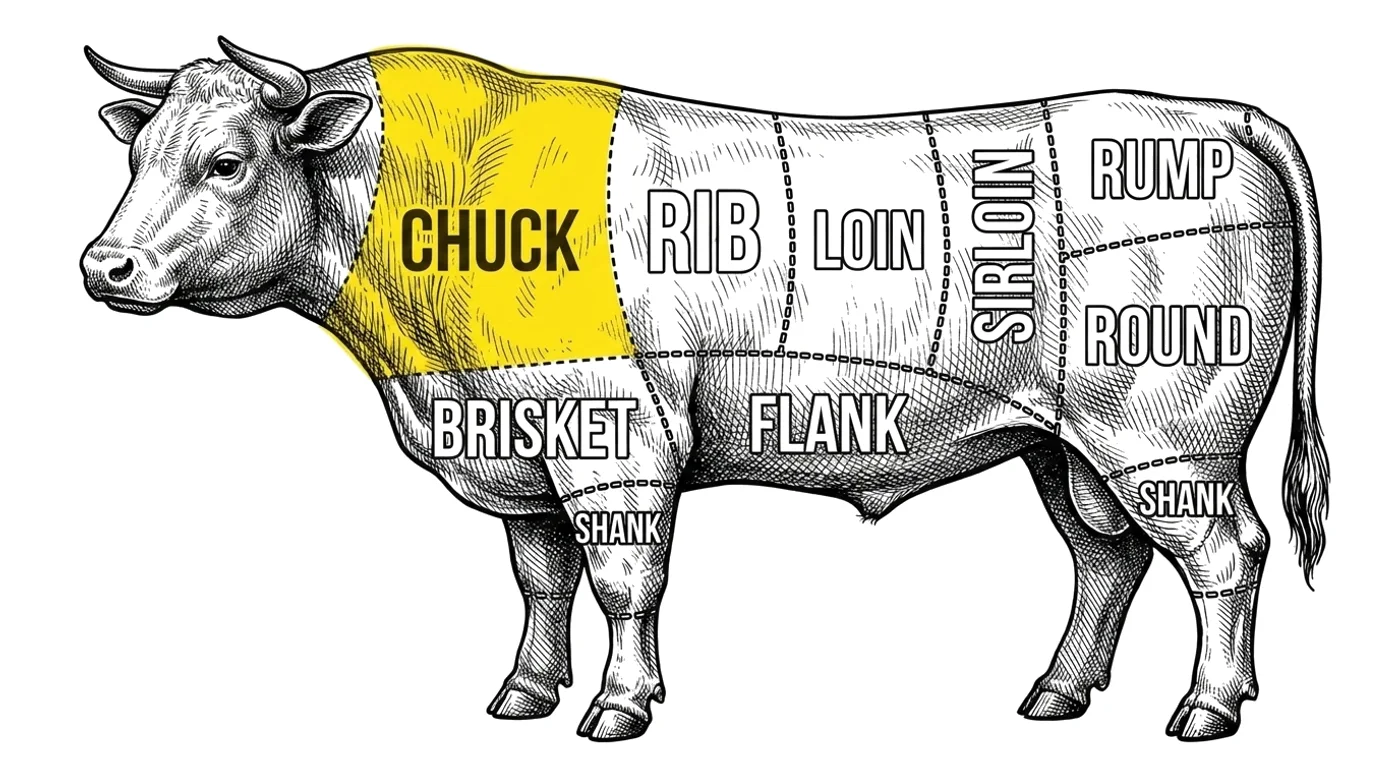
The cut
Identity and terminology
The word combines knæk, a crack or snap, with pølse, sausage. It describes texture and form rather than a protected recipe. Knækpølse should not be confused with the thin red-dyed Rød pølse sold at Danish hot-dog stands, nor with fresh coiled Medister. The source formula represents a substantial smoked link of beef, veal and pork, carrying a sweeter spice profile than most German Knacker recipes.
Composition and characteristics
Beef and veal are ground finely to form the binding matrix. Pork and back fat remain slightly coarser, giving the slice a modest grain and richer bite. White pepper, nutmeg and ginger provide familiar northern European warmth, while a trace of cinnamon gives this branch a distinctive sweet-spice note. Garlic keeps the flavour savoury. Nitrite cure creates the pink colour and supports the controlled smoked-cooked process.
Production and process
All animal fractions are kept close to freezing and ground according to their structural roles. Cure is dissolved in the measured water and mixed through the lean meats with salt until the mass becomes tacky. Coarser pork, fat and spices are folded in before stuffing into thick hog casings. A chilled curing hold replaces warm standing. The links are dried, smoked with beech or oak, poached until the cold point reaches 71°C and rapidly chilled.
History and regional forms
Danish sausage vocabulary absorbed and adapted central European forms through trade and industrial meat processing. The dictionary link to a Bavarian-style sausage records that relationship without making Knækpølse identical to Austrian Knackwurst or German Knacker. The Danish branch’s mixed beef, veal and pork formula, sweet spice and thick link justify a separate Atlas identity, while the source spelling is documented transparently.
Use, storage and related products
Serve Knækpølse heated gently, grilled briefly or sliced cold after cooking and chilling. Mustard, bread and pickles suit its smoke and sweet spice. The product remains refrigerated and is not a hard dry sausage despite the source’s description. Denmark applies specific controls to nitrite in meat products, but a home formula must follow the curing salt actually available in its jurisdiction and never substitute an assumed commercial dose.
Recipe and cure
This is not a finished recipe. It is a window into how this meat is traditionally cured. Before you follow any process, run it through one of our curing calculators so the salt, cure and timings are right and safe for your own batch.
Make this — the measured Curesmith version →“Make this” opens the same cure as a measured recipe, scaled to your batch.
- Meat
- Beef chuck
- Cut
- Beef chuck
- Salt (%)
- 1.8
- Curing salt
- Cure #1 as specified in the recipe
- Fermented
- No
- Starter or mould
- None; this product is not fermented
- Smoked
- Yes
- Maturation
- Refrigerate at 0–4°C; use within 4 days or freeze promptly
- Basis
- per 1,000 g beef chuck
- Style
- cured smoked and cooked Danish thick sausage
Ingredients
- Beef chuck100% · 1000 g
- Veal shoulder65% · 650 g
- Pork shoulder65% · 650 g
- Pork back fat25% · 250 g
- Ice water5.9% · 150 g
- Fine salt1.8% · 45 g
- Cure #1, 6.25% sodium nitrite0.25% · 6.5 g
- White pepper0.2% · 5 g
- Ground cinnamon0.07% · 1.5 g
- Ground nutmeg0.05% · 1.5 g
- Ground ginger0.05% · 1.5 g
- Fresh garlic0.35% · 9 g
Method
- Trim, weigh and chill the four animal fractions, water and equipment to 0–2°C.
- Grind pork and fat through 6 mm and beef and veal through 3 mm.
- Dissolve Cure #1 in water; mix beef, veal, pork, salt and cure until tacky.
- Add pepper, cinnamon, nutmeg, ginger, garlic and ground back fat; mix just until even.
- Fill hog casings, form thick links and refrigerate for 8–12 hours.
- Dry the casing, smoke with beech or oak at about 60°C, then poach at 78–80°C until the cold point reaches 71°C.
Safety. Use the correct local nitrite cure, maintain cold extraction, cook to 71°C, cool rapidly and keep the finished links refrigerated.