
Kochsalami
Also known as Koch Salami, Cooked salami, German style
Germany
Overview
Kochsalami is a German large-calibre sausage whose cured pork, beef and firm fat are ground fine, smoked and then cooked. Its name can mislead English readers: koch means cooked, so this product belongs with moist heat-treated sausages rather than fermented dry salami. A correct slice is compact and pink-red, dotted with pale fat and cracked pepper, and remains refrigerated.
Where it's from
The cut
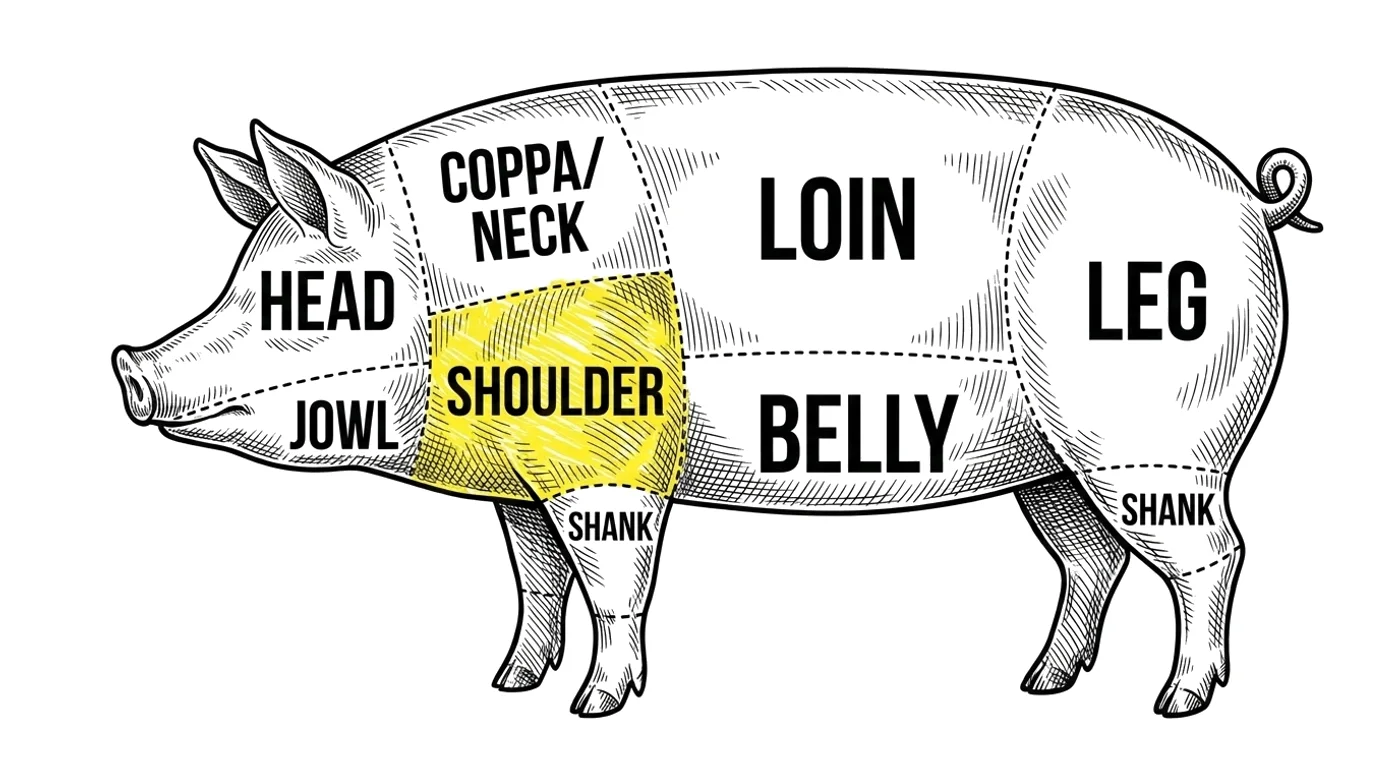
Identity and terminology
The compound name states the critical process distinction. German sausage terminology uses salami imagery for the shape and cut face, while Kochsalami is stabilised by heat rather than by a measured acidification and long moisture loss. Salami cotto is the closest Italian-American descriptive parallel, but it has its own seasoning and commercial history. Neither term authorises a dry-sausage shelf-life claim.
Composition and characteristics
Lean pork and beef provide the protein matrix, while hard back fat gives clean white points instead of an emulsified smear. Ground and whole pepper produce two levels of pungency; coriander, paprika and garlic keep the profile recognisably central European. The broad smoke-permeable casing creates a luncheon-meat chub intended for slicing, not a narrow snack stick.
Production and process
Cold meat is ground finely and mixed with salt, nitrite cure and ice water until adhesive. Partly frozen fat is incorporated last so the cut face stays distinct. After tight stuffing and a refrigerated cure, the chub is surface-dried, smoked, poached until the centre reaches 71°C, then chilled rapidly. Its diameter makes both centre probing and cooling control more important than a fixed time instruction.
History and regional forms
Cooked salami-style sausages arose within the German Brühwurst and cooked-meat trade as a way to offer salami appearance and spice without a raw fermentation cycle. The form suits commercial slicing and predictable heat treatment. The available evidence supports a process identity rather than one protected town of origin, and the Atlas does not invent a geographical designation.
Use, storage and related products
Serve Kochsalami cold in slices on bread, in composed cold plates or briefly warmed. It differs from true raw salami in acidity, water activity, texture and keeping quality. Once cut, the moist chub is vulnerable to surface contamination and drying, so it should be wrapped, held at refrigeration temperature and consumed within the validated chilled period.
Recipe and cure
This is not a finished recipe. It is a window into how this meat is traditionally cured. Before you follow any process, run it through one of our curing calculators so the salt, cure and timings are right and safe for your own batch.
Make this — the measured Curesmith version →“Make this” opens the same cure as a measured recipe, scaled to your batch.
- Meat
- Pork shoulder
- Cut
- Pork shoulder
- Salt (%)
- 1.8
- Curing salt
- Cure #1 as specified in the recipe
- Fermented
- No
- Starter or mould
- None; this product is not fermented
- Smoked
- Yes
- Maturation
- Refrigerate at 0–4°C; use within 4 days or freeze promptly
- Basis
- per 1,000 g pork shoulder
- Style
- cured smoked and cooked German large-calibre sausage
Ingredients
- Pork shoulder100% · 1000 g
- Beef chuck85% · 850 g
- Pork back fat70% · 700 g
- Ice water11.1% · 283 g
- Fine salt1.8% · 46.5 g
- Cure #1, 6.25% sodium nitrite0.24% · 6 g
- Ground black pepper0.2% · 5 g
- Coarsely cracked black pepper0.1% · 2.5 g
- Ground coriander0.1% · 2.5 g
- Sweet paprika0.1% · 2.5 g
- Fresh garlic0.15% · 4 g
Method
- Trim and chill meat, fat, water and equipment to 0–2°C.
- Grind beef and pork separately through 3 mm; grind partly frozen back fat last.
- Dissolve Cure #1 in part of the ice water and mix beef, pork, salt and cure until tacky.
- Fold in fat, remaining water, both peppers, coriander, paprika and garlic.
- Fill the broad fibrous casing tightly, remove air and refrigerate 8–12 hours.
- Dry the casing, smoke at about 60°C, then poach at 78–80°C until the cold point reaches 71°C.
Safety. Calculate cure on the animal block, cook the centre to 71°C, chill the broad casing rapidly and never release it as fermented or shelf stable.