
Krainer Sausage
Also known as Krainer, Schweinskrainer
Central Europe, Austria
Overview
Krainer is a cured, smoked and cooked central European link made in Austrian and German practice from pork, beef, fat, garlic and pepper. The form is usually short, paired and medium-grained. Its name is historically connected with Krain, the German name for Carniola, but generic Krainer sold under Austrian or German guidelines must not be confused automatically with Slovenia's protected Kranjska klobasa.
Where it's from
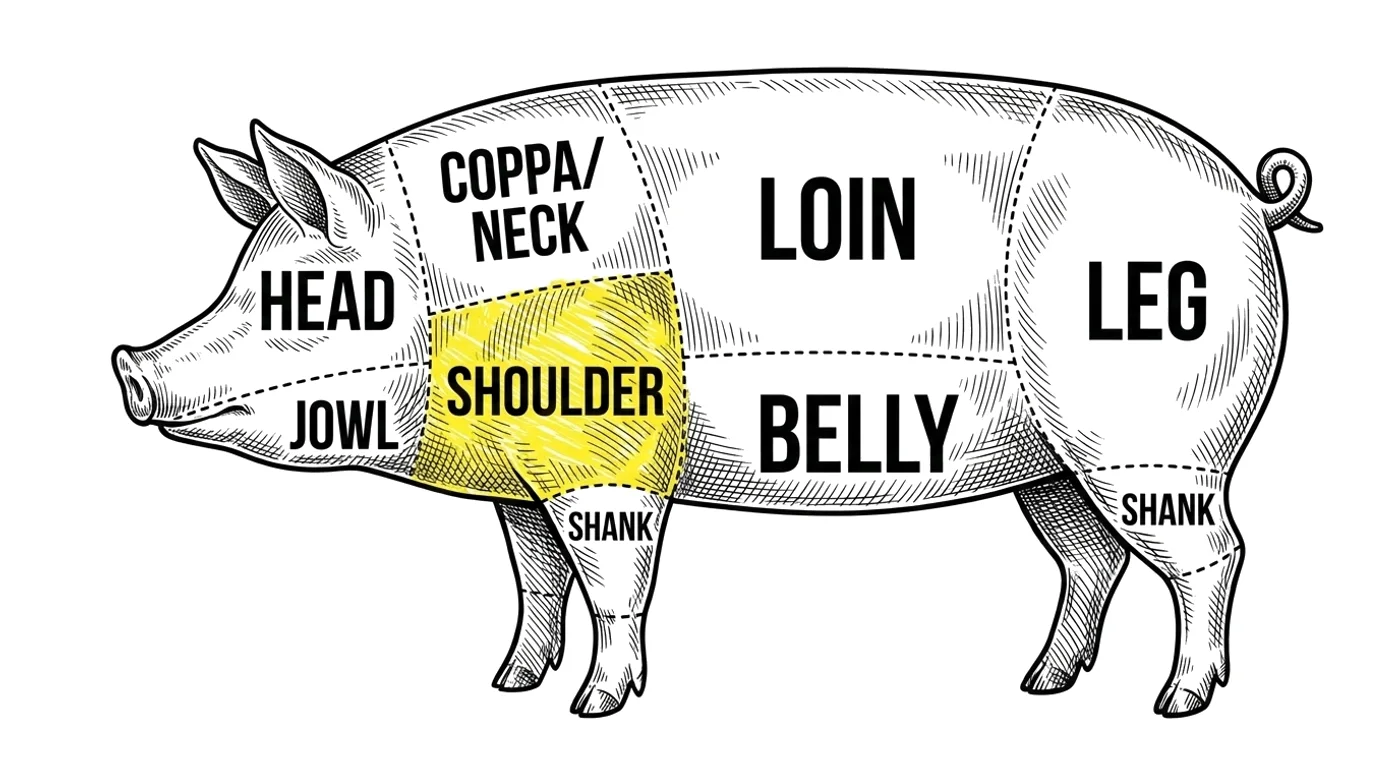
The cut
Identity and terminology
Austrian Codex tables place Krainer among Fleischwürste, while German meat guidelines group the name with coarse scalded sausages such as Debreziner and Bauernwürstchen. Kranjska klobasa, by contrast, is a Slovenian PGI with a defined composition, linked-pair form, wooden skewer, production area and labelling rules. Related language and history do not make the legal names interchangeable.
Composition and characteristics
The source branch contains predominantly lean pork, a smaller beef fraction and firm pork fat. A five-millimetre grind gives visible grain without the large show-meat cubes of Krakauer. Garlic and black pepper are deliberately simple so smoke and cured meat remain dominant. Short hog-casing links should be plump and resilient with an even reddish-brown exterior.
Production and process
Pork and beef are ground cold, mixed with salt, accurately weighed cure and ice water until tacky, then combined with separately ground fat. The links cure under refrigeration before drying, smoking and gentle poaching. A probe verifies the centre rather than relying on a short water-cook. Rapid chilling prevents the moist link from remaining for long in the growth range.
History and regional forms
The wider Krainer family reflects the historical movement of names and meat-working techniques across Carniola, Austria and German-speaking markets. Slovenia's successful registration protects Kranjska klobasa as a geographical product, while national food codes continue to recognise related generic sausage names within their own legal settings. The history is layered and does not collapse into a single origin.
Use, storage and related products
Krainer may be warmed in water, grilled briefly or served with bread, mustard and horseradish. It is distinct from cheese-filled Käsekrainer, from the paprika-rich Debreziner and from the exact PGI product. A generic home recipe should be labelled Krainer-style or Krainer according to local law and must never display the protected logo or imply certification it does not hold.
Recipe and cure
This is not a finished recipe. It is a window into how this meat is traditionally cured. Before you follow any process, run it through one of our curing calculators so the salt, cure and timings are right and safe for your own batch.
Make this — the measured Curesmith version →“Make this” opens the same cure as a measured recipe, scaled to your batch.
- Meat
- Pork shoulder
- Cut
- Pork shoulder
- Salt (%)
- 1.6
- Curing salt
- Cure #1 as specified in the recipe
- Fermented
- No
- Starter or mould
- None; this product is not fermented
- Smoked
- Yes
- Maturation
- Refrigerate at 0–4°C; use within 4 days or freeze promptly
- Basis
- per 1,000 g pork shoulder
- Style
- cured smoked and cooked generic Krainer sausage
Ingredients
- Pork shoulder100% · 1000 g
- Pork back fat20% · 200 g
- Beef chuck20% · 200 g
- Ice water9.2% · 128.5 g
- Fine salt1.6% · 23 g
- Cure #1, 6.25% sodium nitrite0.25% · 3.5 g
- Black pepper0.21% · 3 g
- Fresh garlic0.31% · 4.5 g
Method
- Trim, weigh and chill pork, beef, fat, water and equipment to 0–2°C.
- Grind pork and beef through 5 mm, then grind the partly frozen back fat separately.
- Dissolve cure in ice water and mix pork and beef with salt until tacky.
- Fold in fat, pepper and garlic without losing the medium grain.
- Fill hog casing, form short pairs and refrigerate 8–12 hours.
- Dry the casing and apply clean smoke at about 60°C.
Safety. Use the generic identity honestly, weigh cure on the complete animal block, cook to 71°C and keep refrigerated.