
Krakauer, German Cooked Style
Also known as Gebrühte Krakauer, Kawassy, German Krakauer sausage
Germany
Overview
German cooked Krakauer is a broad, cured scalded sausage with a fine binding matrix and visible coarse meat pieces. The source calls its version Kawassy and combines beef, semi-fat pork and lean pork show meat. Smoke, garlic, white pepper and nutmeg give the sausage a stronger profile than fine Lyoner, while the large casing makes the mosaic cut an important part of identification.
Where it's from
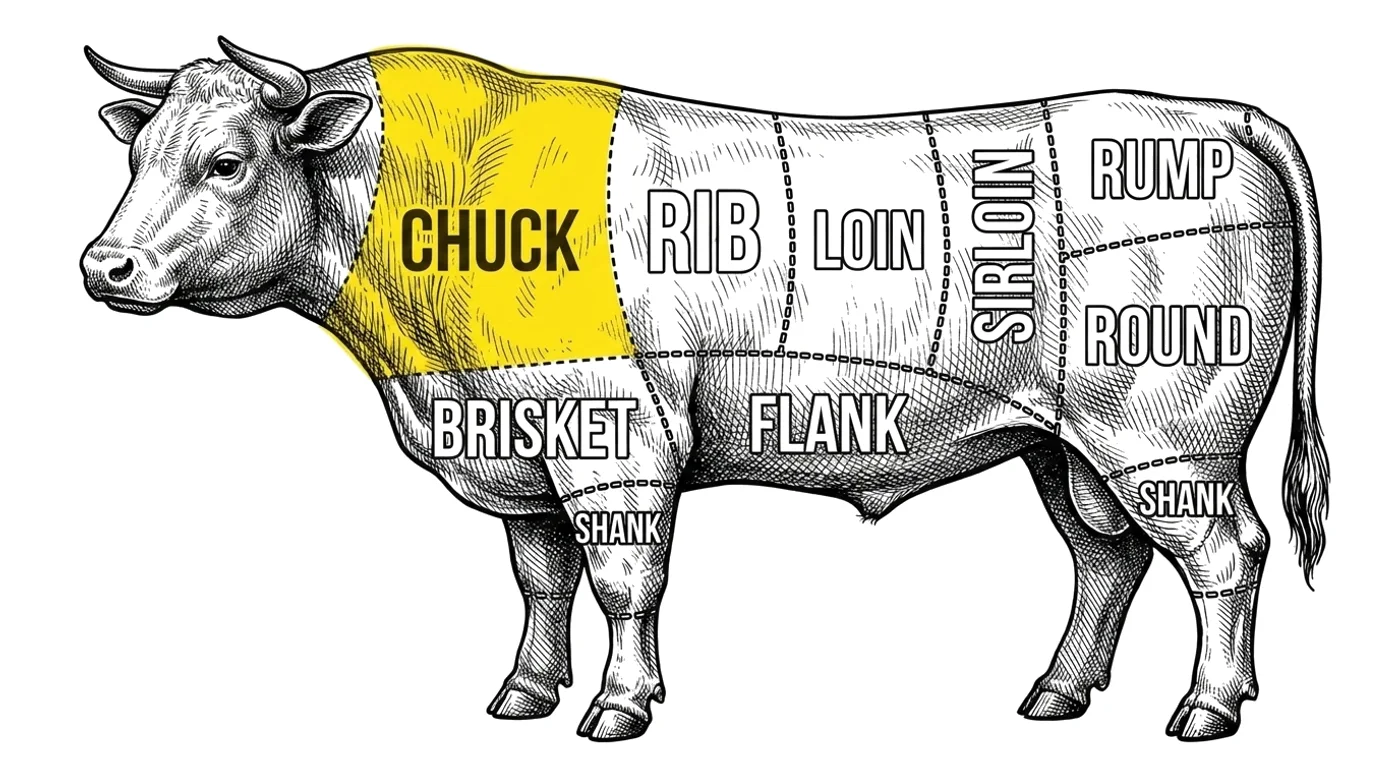
The cut
Identity and terminology
Current German meat guidelines list gebrühte Krakauer as a coarse scalded sausage. Kawassy functions as a trade or source alias rather than a separately protected identity. The German cooked form must be kept apart from Poland's Kiełbasa krakowska sucha staropolska, which is registered as a Traditional Speciality Guaranteed and is deliberately dried. Shared reference to Kraków does not make their legal names, moisture levels or methods interchangeable.
Composition and characteristics
The source branch uses beef for the binding mass, semi-fat pork for coarse texture and intact lean pork cubes as show meat. Nitrite cure creates a stable pink-red slice; garlic, white pepper and nutmeg add aroma without the strong caraway profile of some neighbouring sausage families. A broad beef middle or fibrous casing supports slicing. The defining texture is neither a smooth frankfurter emulsion nor a dry salami matrix.
Production and process
The three meat fractions are cured separately under refrigeration so salt and nitrite reach each one accurately. Beef is ground finely and worked with measured ice water to create bind. Semi-fat pork remains coarse and cured lean pork stays in visible pieces. After stuffing, the chub is dried, smoked and poached until the cold point reaches 71°C, then cooled rapidly. Smoke supplies flavour and colour but does not replace cooking.
History and regional forms
The German style developed within a Central European exchange of sausage names and techniques centred on Kraków's reputation. That history produced related but divergent products in Germany, Austria and Poland. A German cooked Krakauer may be sold moist and ready to slice, whereas the protected Polish dry sausage has its own traditional composition, smoking and drying requirements. Treating Kawassy as an independent national product would obscure that relationship.
Use, storage and related products
Serve German cooked Krakauer cold in thick slices, warm it gently, or brown slices shortly before eating. It remains refrigerated and should not be confused with a shelf-stable dry sausage. A recognisable piece shows a cured red matrix, lighter fat and distinct lean pork inlay. Labels using the Polish protected name require compliance with that specification; this home recipe makes no such claim.
Recipe and cure
This is not a finished recipe. It is a window into how this meat is traditionally cured. Before you follow any process, run it through one of our curing calculators so the salt, cure and timings are right and safe for your own batch.
Make this — the measured Curesmith version →“Make this” opens the same cure as a measured recipe, scaled to your batch.
- Meat
- Beef chuck
- Cut
- Beef chuck
- Salt (%)
- 1.8
- Curing salt
- Cure #1 as specified in the recipe
- Fermented
- No
- Starter or mould
- None; this product is not fermented
- Smoked
- Yes
- Maturation
- Refrigerate at 0–4°C; use within 4 days or freeze promptly
- Basis
- per 1,000 g beef chuck
- Style
- cured smoked and cooked German coarse Krakauer with visible pork inlay
Ingredients
- Beef chuck100% · 1000 g
- Semi-fat pork shoulder and belly80% · 800 g
- Pork ham, 15–20 mm20% · 200 g
- Ice water7% · 140 g
- Fine salt1.8% · 36 g
- Cure #1, 6.25% sodium nitrite0.25% · 5 g
- White pepper0.2% · 4 g
- Ground nutmeg0.05% · 1 g
- Fresh garlic0.35% · 7 g
Method
- Divide salt and Cure #1 accurately across the cubed beef, semi-fat pork and lean show meat; cover and refrigerate for 24–48 hours.
- Grind beef through 3 mm and semi-fat pork through 8 mm; retain cured lean pork as show pieces.
- Fine-cut the beef with measured ice water, then mix in pepper, nutmeg, garlic, coarse pork and show meat.
- Fill the broad casing firmly, remove air and refrigerate while the surface dries.
- Apply clean warm smoke at 50–60°C until the surface is evenly coloured.
- Poach at 78–80°C until the cold point reaches 71°C.
Safety. Cure every meat fraction accurately, keep the batter cold, cook the centre to 71°C and cool the large chub rapidly.