
Overview
Krakowska is a large-calibre Polish sausage recognised by prominent coarse lean pork pieces and a cured smoked flavour. It is commonly sold as a cooked and smoked slicing sausage, but the family also includes the reserved dry product Kiełbasa krakowska sucha staropolska TSG.
Where it's from
The cut
Identity and terminology
The TSG specification explicitly confirms that kiełbasa krakowska is a generic term. The reserved child adds sucha staropolska, meaning dry and old-Polish style. Krakauer and foreign Krakowska-style sausages may be related but should not be assumed to match either the ordinary Polish family or the TSG composition and process.
Composition and characteristics
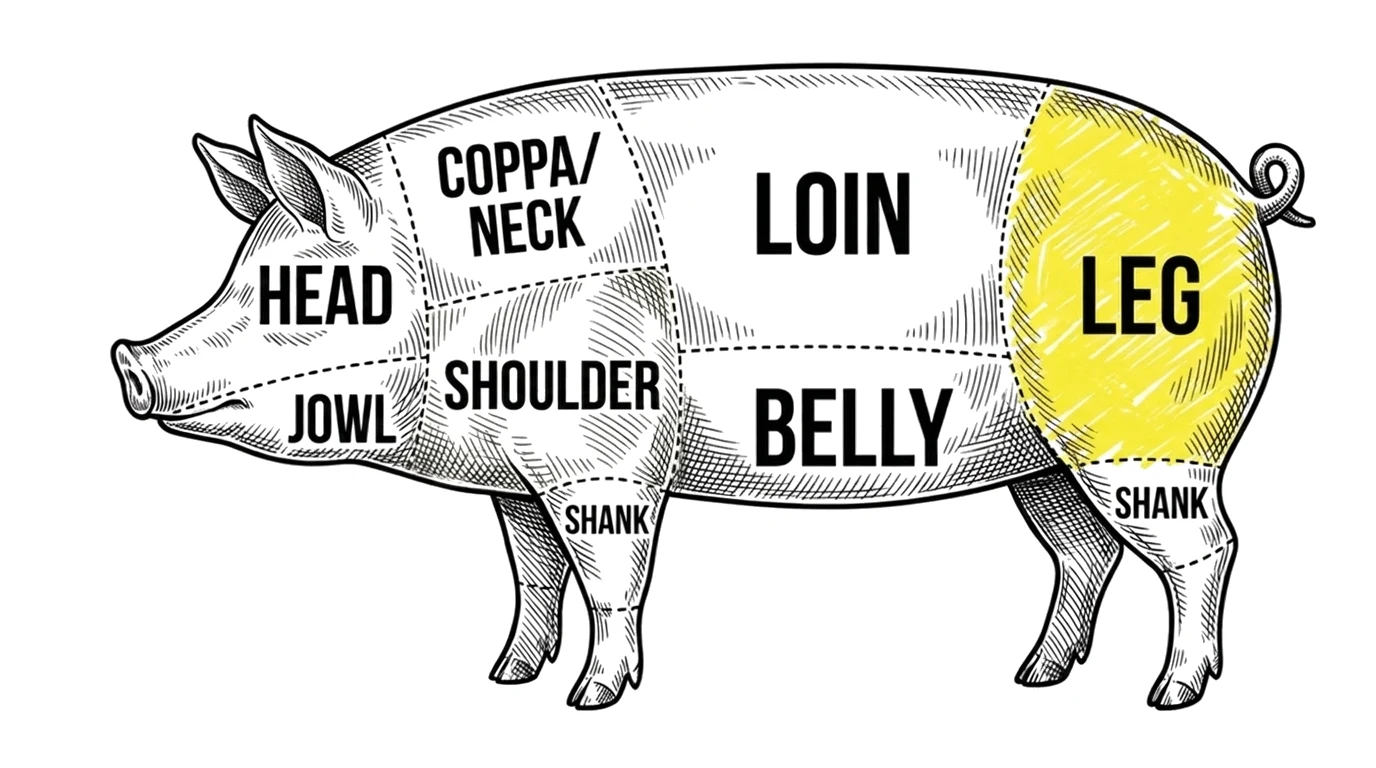
Krakowska typically uses high-quality pork, including large cubes or chunks of lean meat held in a finer binding matrix. The protected dry child places strong emphasis on Class I pork and a distinctly coarse cut. The slice should be meaty and clearly structured, not a uniform emulsion.
The coarse lean pieces are central to the identity and should remain clearly visible after slicing. Weak protein binding creates gaps around the inclusions, while excessive fine batter can make the product resemble ordinary cooked sausage rather than recognisable Krakowska.
Production and process
Generic Krakowska commonly follows curing, coarse cutting, stuffing, smoking and cooking, followed by cooling. The TSG child uses lengthy resting, characteristic smoking and drying to create a durable product. These branches must not share one generic safety statement: cooked product relies on lethality and refrigeration, while the dry child also requires controlled moisture reduction and specification compliance.
History and regional forms
The name connects the sausage with Kraków and the wider Polish tradition of high-quality coarse sausages. Industrial and regional producers developed cooked, smoked and dried versions. The TSG registration protects the staropolska dry method while leaving the generic family name available.
Use, storage and related products
Krakowska is sliced thin or thick for bread, sandwiches and cold platters. Cooked forms normally remain refrigerated; dry forms follow their verified water activity and packaging classification. Related entries include Krakauer and Kiełbasa krakowska sucha staropolska, which are distinct products rather than alternative names.
Recipe and cure
This is not a finished recipe. It is a window into how this meat is traditionally cured. Before you follow any process, run it through one of our curing calculators so the salt, cure and timings are right and safe for your own batch.
Make this — the measured Curesmith version →“Make this” opens the same cure as a measured recipe, scaled to your batch.
- Meat
- Lean pork ham, diced 10–12 mm
- Cut
- Lean pork ham, diced 10–12 mm
- Salt (%)
- 1.8
- Curing salt
- Cure #1/#2 as specified
- Fermented
- No
- Smoked
- Yes
- Basis
- per 1,000 g lean pork ham, diced 10–12 mm
- Style
- Generic coarse hot-smoked and cooked Krakowska branch; not Kiełbasa krakowska sucha staropolska TSG.
Ingredients
- Lean pork ham, diced 10–12 mm100% · 1000 g
- Pork shoulder30% · 300 g
- Pork back fat15% · 150 g
- Fine salt1.8% · 25.5 g
- Cure #1 containing 6.25% sodium nitrite0.25% · 3.5 g
- Black pepper0.25% · 3.5 g
- Garlic0.25% · 3.5 g
- Ground coriander0.1% · 1.5 g
- Ground nutmeg0.05% · 0.7 g
- Ice-cold water5.9% · 85.5 g
Safety. The generic and TSG branches use different process architectures. A cooked Krakowska requires validated lethality and cooling; a dry branch requires validated fermentation or acidification, drying and release controls. The complete reserved name may not be used unless the TSG specification is met.