
Kranjska Klobasa
Also known as Carniolan sausage, Krainer sausage PGI
Carniola, Slovenia
Overview
Kranjska klobasa is Slovenia's protected Carniolan sausage: a coarsely minced pork-and-back-fat link, cured with nitrite salt, seasoned chiefly with garlic and pepper, smoked and pasteurised. Its most recognisable physical sign is a pair of short sausages joined at the ends and closed with a wooden skewer. It is sold cooked but is commonly warmed before eating.
Where it's from
The cut
Identity and terminology
Kranjska is the Slovene adjective for Kranjska, the historical region known in German as Krain and in English as Carniola; klobasa means sausage. Related names travelled into Austria, Germany and neighbouring countries as Krainer. EU protection applies to the exact name Kranjska klobasa and its specification, while generic national usages of related words have separate legal histories.
Composition and characteristics
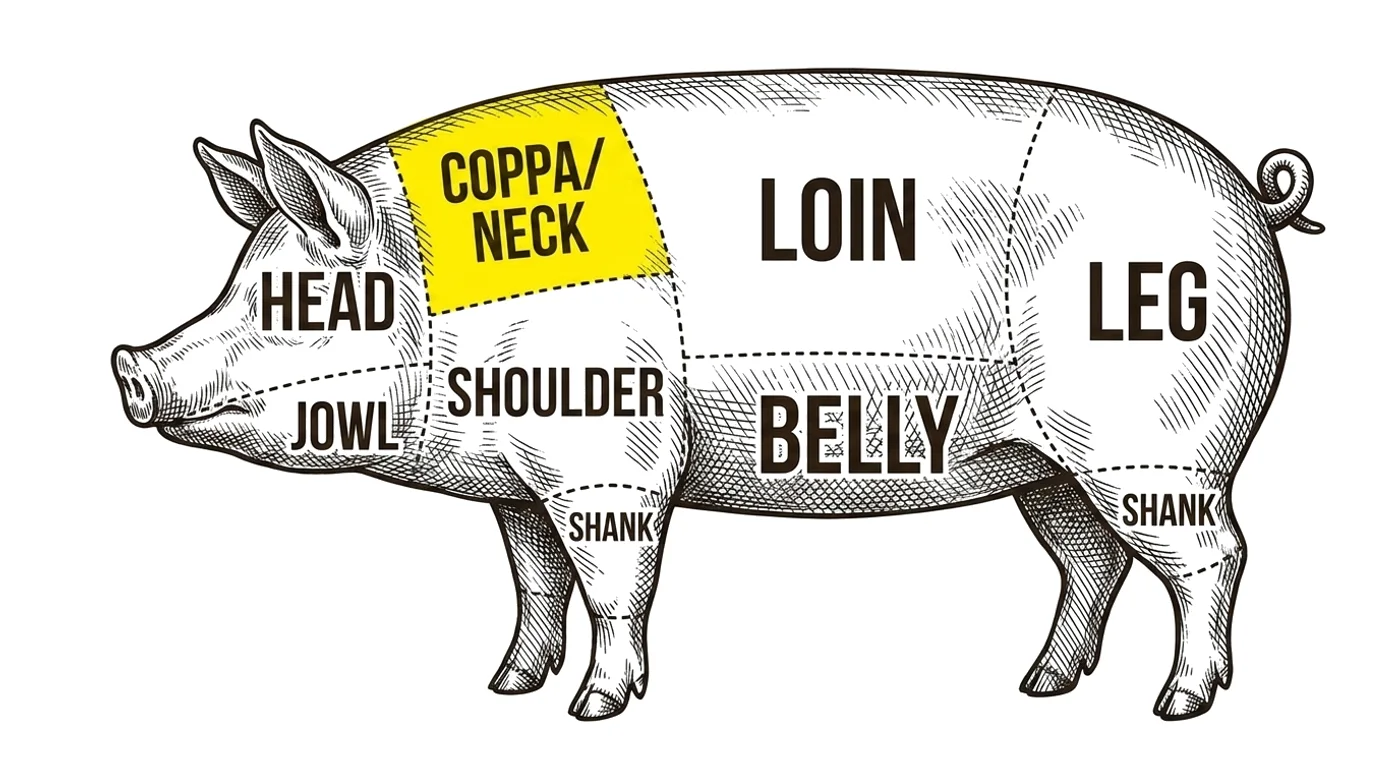
The protected product uses pork leg, shoulder and neck together with firm back fat. The lean meat is coarsely minced and the fat remains clearly visible. Garlic and black pepper define the aroma without paprika or cheese. The casing is pig small intestine, and the paired, skewered form is not decorative alone: it is part of the product description.
Production and process
After mixing to a cohesive bind, the filling is stuffed, linked in pairs and secured with a wooden dowel. The surface is dried, traditionally smoked with beech and pasteurised so the centre reaches the specified heat treatment. Cooling fixes the texture and protects the cooked product. A home safety overlay uses a measured cold-point endpoint and rapid chilling.
History and regional forms
Written references to Carniolan sausage reach back into the nineteenth century, and the product became an emblem of Slovenian food identity during the following century. The PGI specification ties present-day quality to that reputation and to production knowledge in Slovenia. The protected form is therefore more than any garlic pork link sold under a translated name.
Use, storage and related products
Warm gently in hot water and serve with mustard, horseradish, bread or fermented cabbage. Boiling hard can split the casing and leach flavour. Kranjska klobasa is related to generic Krainer and Käsekrainer but is not interchangeable with them: cheese-filled forms, fine emulsions, different species or unskewered presentation leave the protected identity.
Recipe and cure
This is not a finished recipe. It is a window into how this meat is traditionally cured. Before you follow any process, run it through one of our curing calculators so the salt, cure and timings are right and safe for your own batch.
Make this — the measured Curesmith version →“Make this” opens the same cure as a measured recipe, scaled to your batch.
- Meat
- Pork leg, shoulder and neck
- Cut
- Pork leg, shoulder and neck
- Salt (%)
- 1.8
- Curing salt
- Cure #1 as specified in the recipe
- Fermented
- No
- Starter or mould
- None; this product is not fermented
- Smoked
- Yes
- Maturation
- Refrigerate at 0–4°C; use within 4 days or freeze promptly
- Basis
- per 1,000 g pork leg, shoulder and neck
- Style
- Slovenian PGI-style cured smoked and pasteurised pork pair
Ingredients
- Pork leg, shoulder and neck100% · 1000 g
- Pork back fat35% · 350 g
- Ice water5.9% · 80 g
- Fine salt1.8% · 24 g
- Cure #1, 6.25% sodium nitrite0.24% · 3.5 g
- Coarsely ground black pepper0.3% · 4 g
- Fresh garlic0.69% · 9.5 g
Method
- Use pork leg, shoulder and neck with firm back fat; chill all materials to 0–2°C.
- Grind the lean pork through 12 mm and cut or grind the back fat to 8–10 mm.
- Dissolve Cure #1 in ice water and mix pork with salt, cure, pepper and garlic until tacky; fold in fat last.
- Fill pig small intestine, form equal short links, join them in pairs and secure the joined ends with a wooden skewer.
- Refrigerate 8–12 hours, dry the casing, then apply beech smoke around 55°C until reddish brown.
- Raise the chamber or poach gently until the cold point reaches 71°C.
Safety. Follow the official composition and form, pasteurise to a measured endpoint, chill rapidly, and reserve the PGI claim for authorised certified production.