
Landjäger
-, Southern Germany/Alpine, Germany
A flat, pressed, smoked semi-dry snack sausage of the Alpine countries.
Overview
Landjäger is a flat, pressed, smoked semi-dry snack sausage of the alpine countries. Short paired links with flattened sides, a dark red dense interior and cumin, pepper and light smoke. The sausage should bend only slightly and should not contain a wet central seam. The Codex treats it as a complete production system, not merely a familiar name. Raw material, cut or particle size, casing, smoke, fermentation, cooking and maturation all contribute to the identity. The current status is Generic Central European traditional sausage : no generic EU GI. The protected or traditional reference and the Curesmith home method remain separate.
Where it's from
Climate. Southern Germany, Switzerland, Austria and Alsace.
Altitude. Alpine and upland
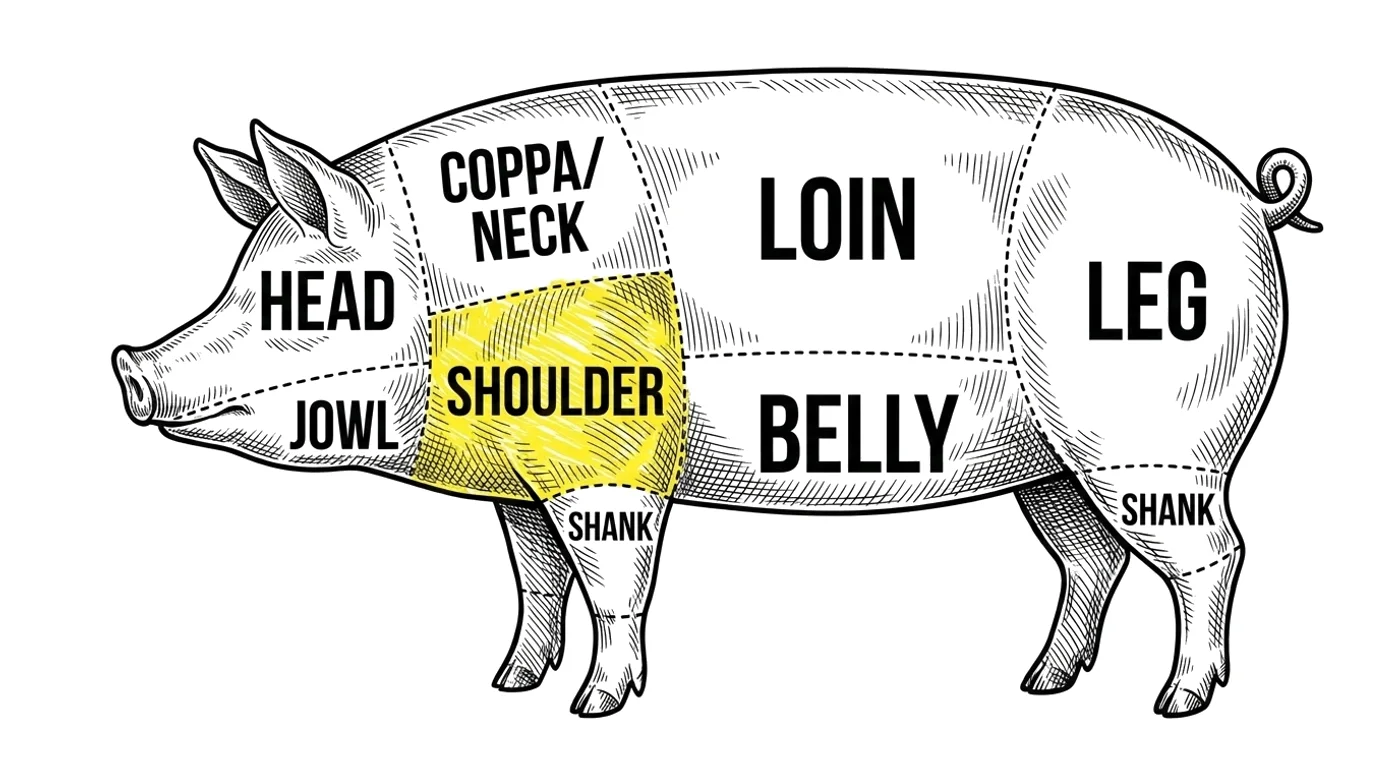
The cut
How to recognise it
Short paired links with flattened sides, a dark red dense interior and cumin, pepper and light smoke. The sausage should bend only slightly and should not contain a wet central seam. Grease smear, hollow pockets, case hardening, a wet centre, rancidity or uncontrolled dark mould is a production fault.
- Shape and size
- Flat rectangular pairs
- Lean colour
- Dark red
- Fat and marbling
- Flecked
- Casing
- Narrow natural casing, pressed
- Surface bloom
- Light
Origins and history
Landjäger belongs to the Alemannic borderlands of Switzerland, southern Germany, Alsace and Austria. Its name evokes country police or mounted officials, although the exact naming story is less secure than the sausage's practical purpose. Butchers pressed links in pairs into a flat rectangular form that dried evenly, packed neatly and survived travel in a pocket or saddlebag. The Swiss National Museum places the modern form in the nineteenth-century industrialisation of the meat trade, when recipes became more standardised even though earlier versions used whatever meats were available. It remains a generic regional family rather than a single protected product.
Name. Landjager, a rural gendarme; the sausage was their portable ration.
- Production today
- Made across the Alpine countries.
- Protection
- Not EU-protected as a general name.
- Tradition vs modern
- Pressed, smoked, semi-dried; eaten without cooking.
- Seasonality
- Year-round.
Compare with. Chistorra
Serving and cultural significance
Eat it as a travel snack with bread, cheese, mustard or pickles, or warm it gently with potatoes and lentils. A validated dry Landjäger may be shelf stable, but a soft home batch should remain refrigerated.
Recipe and cure
This is not a finished recipe. It is a window into how this meat is traditionally cured. Before you follow any process, please run it through one of our curing calculators, so the salt, cure and timings are right and safe for your own batch.
Make this — the measured Curesmith version →The cure below is the traditional reference. “Make this” opens the measured Curesmith home recipe, scaled to your batch.
Traditional or protected production
Generic Landjäger has no single protected specification. A lean pork-and-beef mixture with firm fat is seasoned, cured, fermented, stuffed into narrow casing and pressed in pairs into a flat rectangular shape. The sausages are then lightly smoked and dried until firm. Commercial and regional versions differ in moisture, smoke and shelf stability, so the name alone does not establish a safe storage classification.
- Meat
- pork and beef
- Salt (%)
- 2.5
- Curing salt
- Not included in the base recipe below
- Fermented
- Yes
- Target pH
- 4.9
- Starter or mould
- Natural surface mould
- Smoked
- Yes
- Target aW or weight loss
- ~20% weight loss (semi-dry)
- Temperature (°C)
- ferment 22 to 24, then dry 13 to 15
- Humidity (%)
- ferment ~90, then 75 to 80
- Maturation
- pressed, smoked, dried ~2 to 3 weeks
- Basis
- per 1000 g green meat
- Style
- Traditional pressed, fermented, smoked and semi-dried sausage
Ingredients
- beef and pork (base)100% · 1000 g/kg
- sea salt2.5% · 25 g/kg
- black pepper0.4% · 4 g/kg
- garlic0.3% · 3 g/kg
- caraway or coriander0.2% · 2 g/kg
- sugar0.3% · 3 g/kg
Method
- Mince meat and fat and mix with all ingredients to green meat weight.
- Stuff into casing and press into pairs.
- Ferment to the target pH, with smoke where traditional.
- Dry to the target weight loss.
Notes
- This traditional recipe uses no nitrite. For safety we recommend adding Cure #2: in a low-oxygen, slow-dried product nitrite is the specific guard against Clostridium botulinum, while salt, acidity and drying control Salmonella, E. coli, Listeria and Staphylococcus.
In the Codex
What this product teaches, and where to read more.
Temple. Roof, Water Activity