
Lap Cheong
Also known as Chinese sausage, Lap Chong, preserved Chinese sausage
Southern China and Hong Kong, China
Where it's from
The cut
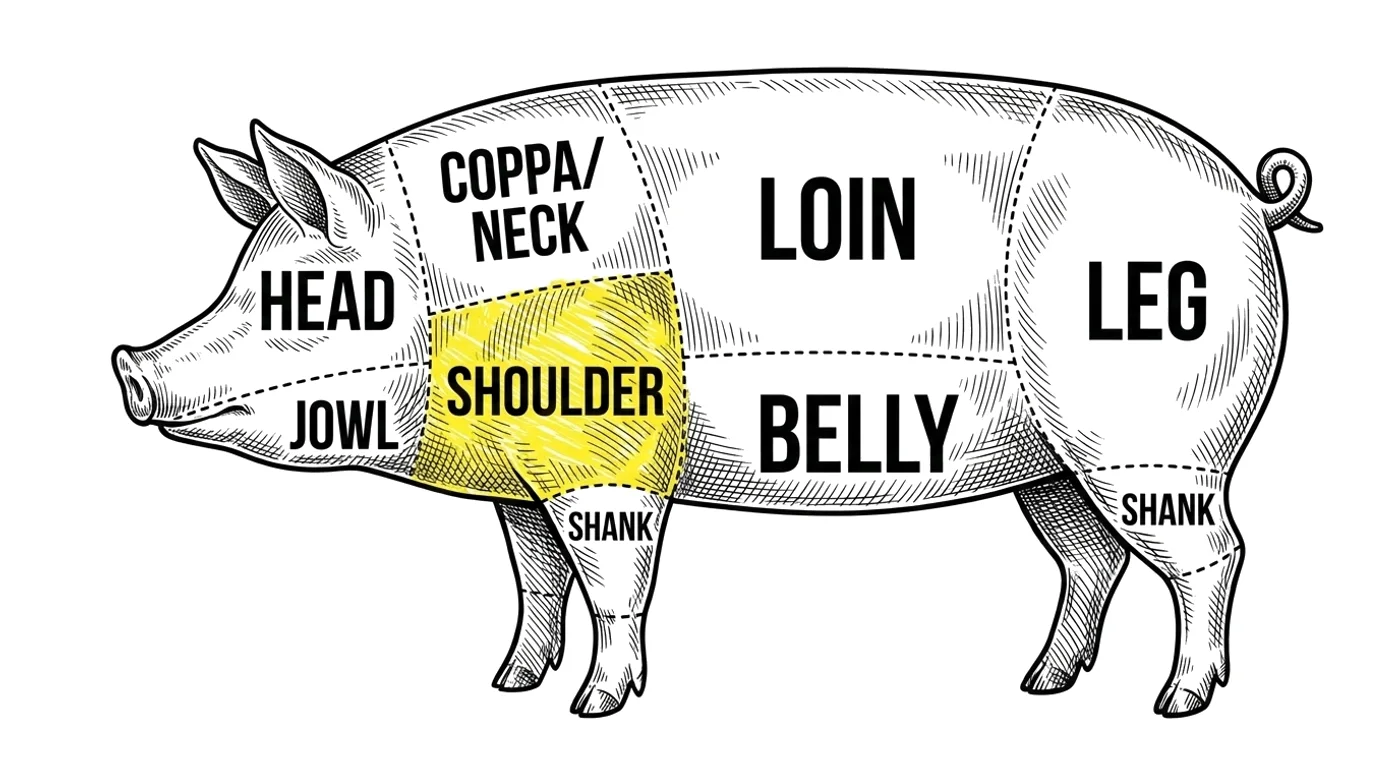
Identity within lap-mei
Lap cheong is the best-known Chinese preserved sausage and belongs to the wider lap-mei family of cured meats. Hong Kong's Centre for Food Safety distinguishes preserved Chinese sausages, preserved pork and preserved duck as the three principal market forms. The sausage is characteristically sweet, salty, wine-scented and firm.
Name, season and history
Official Hong Kong risk material explains lap through an older ritual association and through Lap-Yue, the twelfth lunar month when surplus meat was cured for the festival season. Winter production suited drying and linked preserved meats to household preparation for the Lunar New Year. English spellings vary because Chinese names are transliterated through different systems and dialects.
Traditional composition
Pork and firm fat are cut or coarsely minced, then seasoned with salt, substantial sugar, rice wine and controlled nitrate or nitrite. Soy sauce and other flavourings appear in some formulas. The resulting links are reddish brown, visibly fatty and sweeter than most European dry sausages.
Drying and commercial production
The traditional process cures the filling, stuffs narrow casings and removes enough moisture to create the firm preserved texture. Hong Kong's technical account reports finished moisture around 25% or lower and notes that modern factories often use controlled drying instead of weather-dependent air exposure. That is materially different from simply smoking and cooking a fresh link.
Cooking and culinary use
Lap cheong is normally cooked before eating, often steamed with rice so its fat and sweet wine aroma season the grain. It is also sliced into fried rice, clay-pot rice, turnip cake and vegetable dishes. Thin diagonal pieces expose the translucent fat and distribute its concentrated sweetness.
Home-production boundary
The Centre for Food Safety warns that improperly made home lap-mei can support Clostridium botulinum without obvious spoilage. For that reason this intake does not turn the source's short smoked-cooked formula into a traditional shelf-stable claim. The executable branch is a refrigerated adaptation; authentic dried production requires a validated commercial process and legal additive control.
Variations
Named formulas within this product rather than separate ones. Quantities are per 1000 g of the meat block.
Lap Cheong - Star-Anise Cooked Refrigerated Branch
- Lean pork shoulder700 g
- Firm pork back fat300 g
- Fine salt18 g
- Cure #1, 6.25% sodium nitrite2.5 g
- White sugar60 g
- Standard soy sauce30 g
- Chinese rice wine15 g
- Ground cinnamon2 g
- Powdered star anise0.5 g
- Ground ginger0.5 g
- Monosodium glutamate2 g
Recipe and cure
This is not a finished recipe. It is a window into how this meat is traditionally cured. Before you follow any process, run it through one of our curing calculators so the salt, cure and timings are right and safe for your own batch.
Make this — the measured Curesmith version →“Make this” opens the same cure as a measured recipe, scaled to your batch.
- Meat
- Pork shoulder
- Cut
- Pork shoulder
- Salt (%)
- 1.2
- Curing salt
- Cure #1 as specified in the recipe
- Fermented
- No
- Starter or mould
- None; this controlled cooked source branch is not fermented
- Smoked
- Yes
- Maturation
- Refrigerate at 0–4°C; use within 4 days or freeze
- Basis
- per 1,000 g pork shoulder
- Style
- sweet soy-and-rice-wine pork sausage, cured, smoked, cooked and refrigerated
Ingredients
- Pork shoulder100% · 1000 g
- Skinless pork belly45% · 450 g
- Standard soy sauce4.3% · 43 g
- Fine salt1.1% · 17 g
- Cure #1, 6.25% sodium nitrite0.24% · 3.5 g
- White sugar4.8% · 71.5 g
- Monosodium glutamate0.4% · 4.5 g
- Ground cinnamon0.09% · 1.5 g
- Chinese rice wine2.9% · 43 g
- White pepper0.19% · 3 g
- Fresh garlic0.33% · 5 g
- Ice water7.6% · 114.5 g
Method
- Trim, dice and chill all meat and fat to 0–2°C; chill grinder parts.
- Grind chilled pork shoulder and belly separately through 10 mm.
- Mix pork with soy sauce, salt, Cure #1, sugar, MSG, cinnamon, rice wine, pepper, garlic and ice water.
- Stuff into sheep or small hog casing, 22–26 mm; remove air pockets and form the specified links.
- Rest the tied links for 8–12 hours.
- Dry the surface, then hot-smoke at 55–60°C until dark reddish brown.
Safety. Do not improvise home drying. Use controlled nitrite, validated moisture reduction and commercial controls, or make the clearly cooked refrigerated adaptation supplied here.