
Lietuviška Cooked Sausage
Also known as Lietuviska, Lietuviška dešra, cooked style
Lithuania
Overview
Lietuviška Cooked Sausage is the controlling name for a source-specific Lithuanian-style chub made from beef, lean pork and a much larger fatty-pork fraction. All meats are finely ground and mixed with water into a cohesive paste before cooking and post-smoking. The result is rich, smooth and sliceable rather than a coarse country link or a fermented dry sausage.
Where it's from
The cut
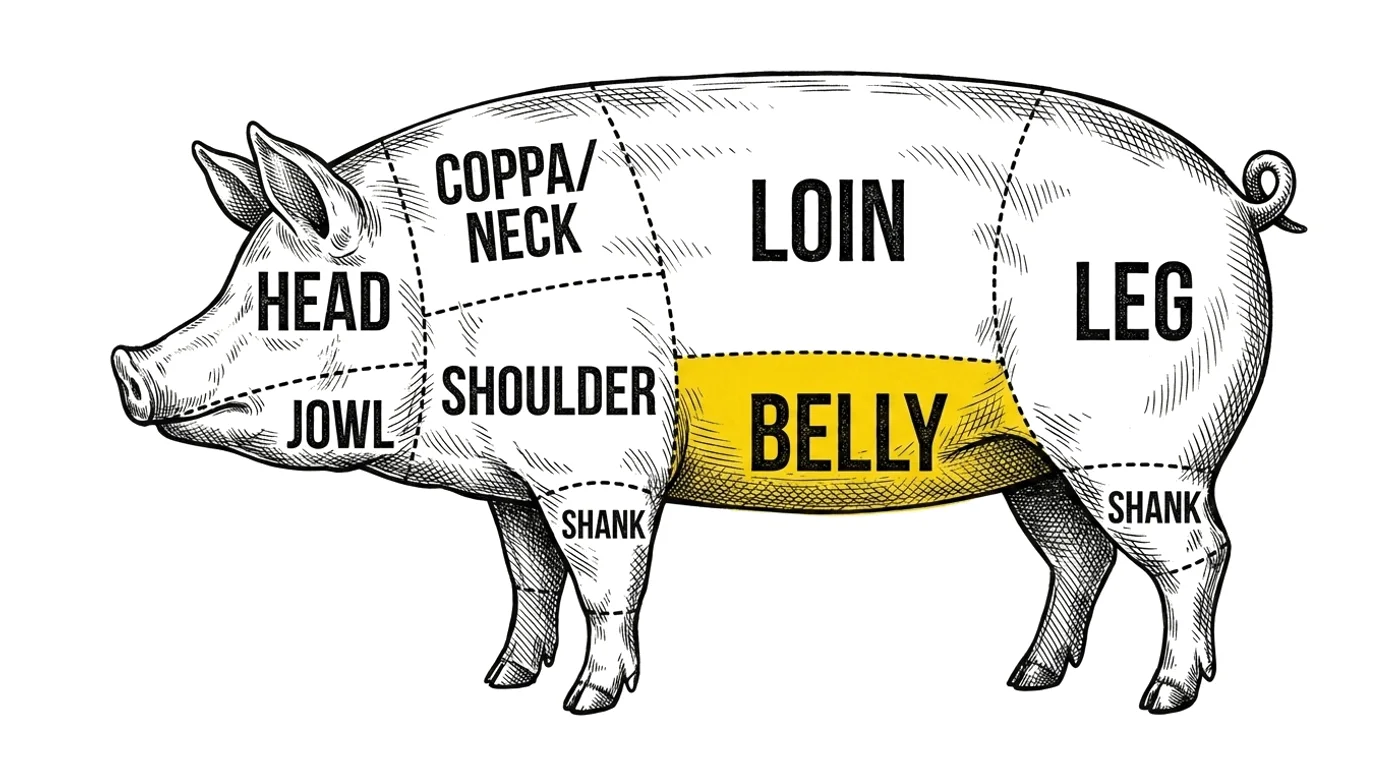
Identity and terminology
Lietuviška is the feminine form of the Lithuanian adjective meaning Lithuanian and naturally modifies the feminine noun dešra, sausage. Used alone, it is descriptive rather than a uniquely protected product name. This is one formula, and it does not define every Lithuanian sausage. It is expressly separated from Lietuviškas skilandis, the registered TSG with a different casing, maturation and dry-cured identity.
Composition and characteristics
Fine beef supplies strong protein extraction, lean pork rounds the flavour, and fatty pork creates the pale, rich body. Coriander, black pepper and nutmeg give a northern European spice profile, while a small amount of sugar softens cure and smoke. The interior should be even and cohesive, without the large lean cubes of Polish cut-meat sausages or the open grain of dried skilandis.
Production and process
The historical process bakes the surface, poaches the chub and then smokes it for an extended period. In the controlled branch, cooking is verified first, chilling interrupts bacterial growth, and post-smoking is divided into manageable sessions with refrigeration. That order preserves the unusual smoke-after-cook character without treating prolonged warm holding as an acceptable domestic storage method.
History and regional forms
Lithuanian food culture contains many distinct sausages and stuffed products, including fresh, smoked, cooked and matured forms. A generic national adjective cannot carry their full history. This article is deliberately narrow: it preserves one documented fine pork-and-beef technique while acknowledging that the best-known protected Lithuanian meat speciality, skilandis, follows another architecture entirely.
Use, storage and related products
Slice cold for bread, mustard, pickles or a mixed meat plate, or warm gently without boiling. The high fat content calls for clean slicing at refrigerator temperature. Store chilled or frozen; smoke does not make the moist chub shelf stable. Do not market the archive-derived formula as Lietuviškas skilandis or imply TSG certification.
Recipe and cure
This is not a finished recipe. It is a window into how this meat is traditionally cured. Before you follow any process, run it through one of our curing calculators so the salt, cure and timings are right and safe for your own batch.
Make this — the measured Curesmith version →“Make this” opens the same cure as a measured recipe, scaled to your batch.
- Meat
- Pork shoulder and belly, about 50% fat
- Cut
- Pork shoulder and belly, about 50% fat
- Salt (%)
- 2.5
- Curing salt
- Cure #1 as specified in the recipe
- Fermented
- No
- Starter or mould
- None; this product is not fermented
- Smoked
- Yes
- Maturation
- Refrigerate at 0–4°C; use within 4 days or freeze promptly
- Basis
- per 1,000 g pork shoulder and belly, about 50% fat
- Style
- fine cured cooked and post-smoked Lithuanian-style sausage
Ingredients
- Beef chuck35% · 350 g
- Pork shoulder35% · 350 g
- Pork shoulder and belly, about 50% fat100% · 1000 g
- Ice water14.7% · 250 g
- Fine salt2.5% · 41.5 g
- Cure #1, 6.25% sodium nitrite0.25% · 4 g
- Ground black pepper0.19% · 3.5 g
- Ground coriander0.1% · 1.5 g
- White sugar0.19% · 3.5 g
- Ground nutmeg0.03% · 0.5 g
Method
- Chill the meats and equipment to 0–2°C, then grind each fraction through 3 mm.
- Dissolve Cure #1 in the ice water and fine-mix beef with salt, cure and seasonings until adhesive.
- Add lean pork, then fold in fatty pork while maintaining a cold cohesive paste.
- Fill the casing firmly, remove air and refrigerate 8–12 hours.
- Poach at 78–80°C until the cold point reaches 71°C.
- Shower briefly and complete controlled chilling before smoking.
Safety. Keep the emulsion cold, cook to a verified endpoint, chill before post-smoking, refrigerate, and maintain the boundary from skilandis TSG.