
Overview
Liverwurst is a family of cooked sausages made with liver, meat, fat and seasonings. It may be fine and spreadable, coarse and rustic, firm enough to slice, lightly smoked or unsmoked. The common feature is a meaningful liver component within a cooked sausage matrix; the name does not describe one universal meat block or texture.
Where it's from
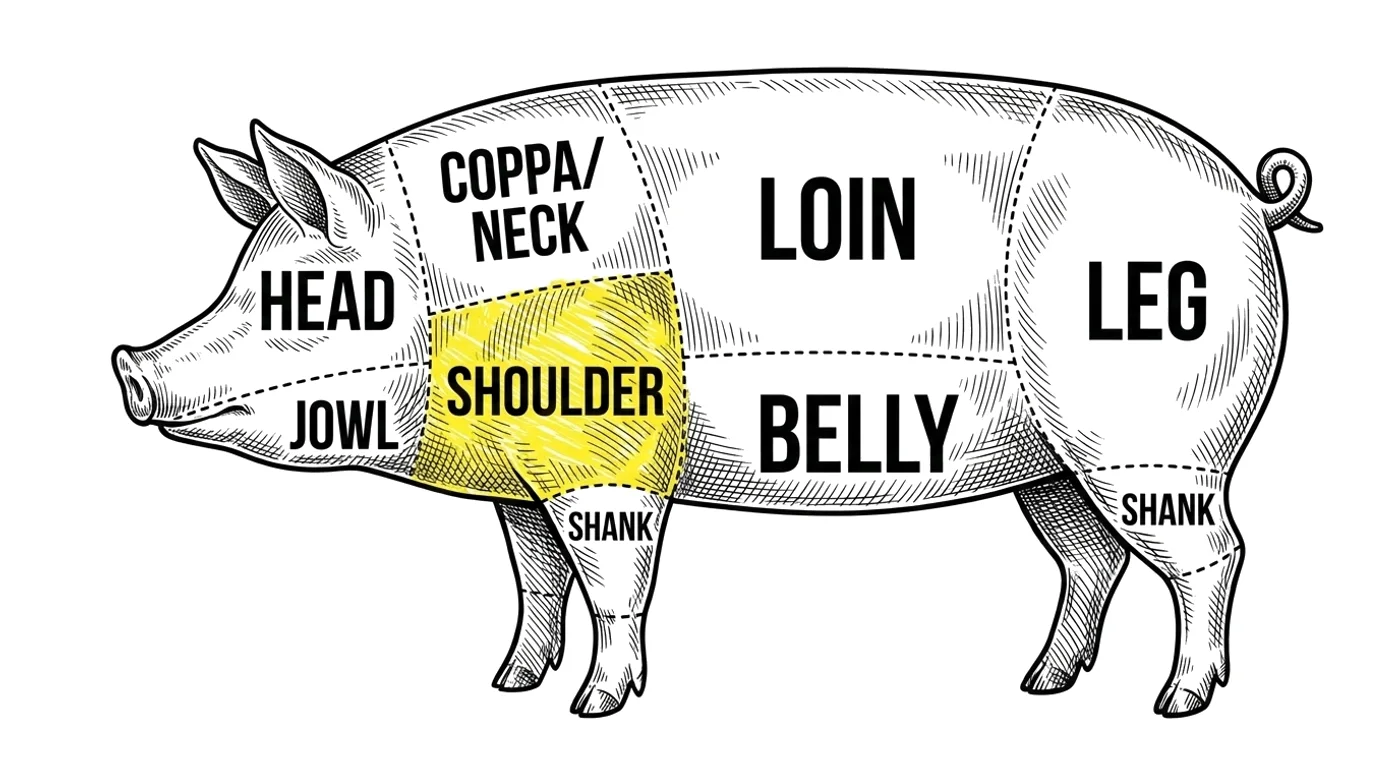
The cut
Identity and terminology
German food guidance treats Leberwurst as a broad cooked-sausage group with quality grades and regional branches. In the United States, Liver Sausage or Liverwurst has a regulated minimum liver content based on fresh-liver weight. Braunschweiger may overlap with liverwurst in some jurisdictions but can denote a specific smoked or liver-sausage branch. Liver pâté and liver terrine are adjacent products, not automatic synonyms, because their structure, packing and culinary identity differ.
Composition and characteristics
Typical ingredients include pork liver, cooked pork or veal, pork fat, onions and spices such as pepper, marjoram, allspice or nutmeg. Fine products are emulsified or very finely comminuted; coarse products retain visible particles. Spreadability depends on fat content, particle size and final cooling. Colour ranges from beige and grey-brown to cured pink. Poultry and other species branches must be named accurately.
Production and process
Meat, fat and some offal are precooked as required. Liver is trimmed and incorporated at a controlled stage to protect flavour and emulsion quality. The mixture is seasoned, comminuted to the required texture, filled and cooked until the centre reaches 74°C. The product is cooled rapidly and kept refrigerated. Smoking, when used, is a flavour and identity step rather than proof of preservation.
History and regional forms
Liver sausages emerged within Central European slaughter-day practice, where cooked meat, fat and organs were converted into perishable sausages for early consumption. Regional forms differ in liver percentage, grind, smoke, casing and seasoning. German classifications include fine, coarse, delicacy, poultry and named regional branches; North American products developed their own standards and commercial forms.
Use, storage and related products
Spreadable liverwurst is served on rye bread, rolls or crackers, often with mustard, pickles or onion. Firmer branches are sliced. Refrigeration is normally required before and after opening. Related entries include Braunschweiger, Liver Pâté, Liver Terrine and regional Leberwurst children, each with its own composition and process.
Recipe and cure
This is not a finished recipe. It is a window into how this meat is traditionally cured. Before you follow any process, run it through one of our curing calculators so the salt, cure and timings are right and safe for your own batch.
Make this — the measured Curesmith version →“Make this” opens the same cure as a measured recipe, scaled to your batch.
- Meat
- Pork liver
- Cut
- Pork liver
- Salt (%)
- 1.75
- Curing salt
- Cure #1/#2 as specified
- Fermented
- No
- Smoked
- Yes
- Basis
- per 1,000 g pork liver
- Style
- Representative coarse cooked Liverwurst branch.
Ingredients
- Pork liver100% · 1000 g
- Skinless pork belly or fatback100% · 1000 g
- Fine salt1.7% · 35 g
- Cure #1 containing 6.25% sodium nitrite0.25% · 5 g
- White pepper0.15% · 3 g
- Nutmeg0.05% · 1 g
- Marjoram0.15% · 3 g
- Ground ginger0.05% · 1 g
- Ground cardamom0.1% · 0.5 g
- Onion powder0.15% · 3 g
- Crushed ice or chilled stock8% · 160 g
Safety. Liverwurst is a cooked, perishable product. Raw liver and meat require hygienic handling; the complete batch requires a validated thermal process, rapid cooling and refrigerated storage. Smoked flavour does not create shelf stability. Liver proportion and species must comply with the applicable national identity and labelling rules.