
Overview
Longeole is a large, coarse Geneva pork sausage distinguished by raw pork rind and whole fennel seed. It is sold raw, cooked slowly before service and assessed as a finished product after cooking. The texture is rich and gelatinous because of the rind.
Where it's from
The cut
Identity and terminology
Longeole is registered as a Swiss IGP. Production is tied to the Geneva area and uses Swiss pigs. The current specification, including the 2024 amendment, controls the eligible raw materials, proportions, nitrite-salt range, seasoning, casings and processing conditions. Only compliant product may use the protected name.
Composition and characteristics
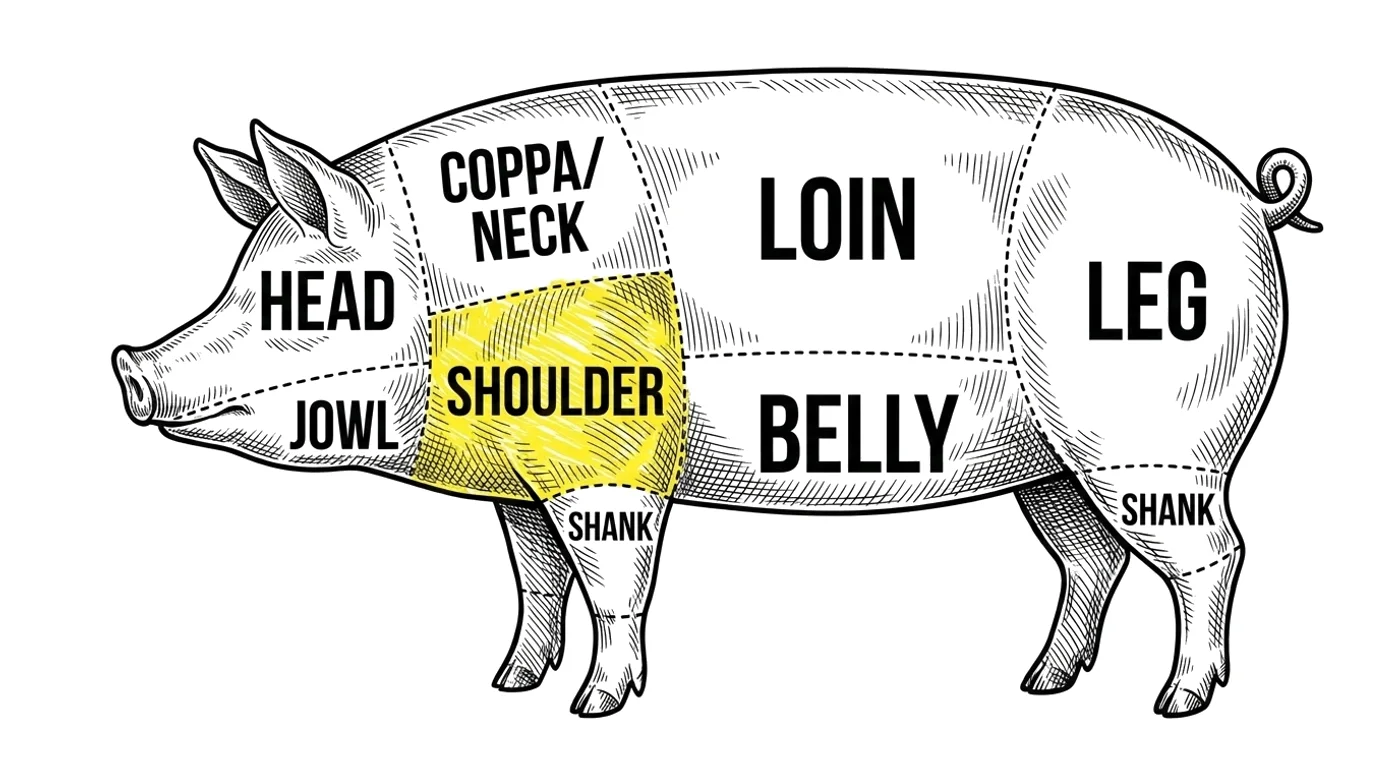
The protected meat block is built around approximately equal thirds of lean pork, jowl or neck fat and raw rind. Whole fennel seed is the signature seasoning. The sausage is large, coarse and dense, with a clear pork-and-fennel aroma and a soft gelatinous structure after long cooking. The whole fennel seeds remain visible and release aroma during cooking. The large calibre and rind content mean the product heats slowly, so cooking guidance must be based on the coldest point rather than time alone.
Production and process
Raw materials are prepared and comminuted to the required grain, mixed with the specified curing salt and seasonings and stuffed into authorised casings. The sausage undergoes the specified resting or colour-development stages before sale. It remains raw and requires slow cooking until the cold point reaches 71°C before consumption.
History and regional forms
Longeole belongs to the food culture of Geneva and is associated with local pork butchery and winter dishes. The IGP protects the regional connection and prevents the name from becoming a generic label for any fennel sausage. The protected specification turns a local sausage into a controlled regional identity. It preserves the link between Geneva, Swiss raw material and the characteristic equal-part composition while allowing production to remain commercially viable.
Use, storage and related products
Longeole is cooked gently, often for an extended period, and served in thick slices with potatoes, lentils, cardoons or other regional accompaniments. Raw product remains refrigerated and must be handled as uncooked meat. Cotechino is a useful international analogue because both use rind and require cooking, but the identities and specifications differ.
Recipe and cure
This is not a finished recipe. It is a window into how this meat is traditionally cured. Before you follow any process, run it through one of our curing calculators so the salt, cure and timings are right and safe for your own batch.
Make this — the measured Curesmith version →“Make this” opens the same cure as a measured recipe, scaled to your batch.
- Meat
- Pork shoulder
- Cut
- Pork shoulder
- Salt (%)
- 1.75
- Curing salt
- Cure #1/#2 as specified
- Fermented
- No
- Smoked
- No
- Basis
- per 1,000 g pork shoulder
- Style
- Home adaptation inspired by the Longeole IGP composition; not designation-compliant.
Ingredients
- Pork shoulder100% · 1000 g
- Pork jowl or neck fat95% · 950 g
- Pork rind95% · 950 g
- Fine salt1.8% · 51.5 g
- Cure #1 containing 6.25% sodium nitrite0.24% · 7 g
- Whole fennel seed0.81% · 23.5 g
- Black pepper0.2% · 6 g
- Garlic0.15% · 4.5 g
- Chilled water4.1% · 117.5 g
Safety. Longeole is sold raw and must be cooked before eating. The protected specification controls raw materials, composition, nitrite salt, casing and production area. A Curesmith home adaptation must be labelled separately and requires a validated cold-point cooking endpoint, cooling and storage instructions.