
Overview
Lucanica is an ancient sausage name associated with Lucania in southern Italy and transmitted through Roman literature into many European languages. The Curesmith recipe is a fresh pork-and-rind variation, not the protected Lucanica di Picerno.
Where it's from
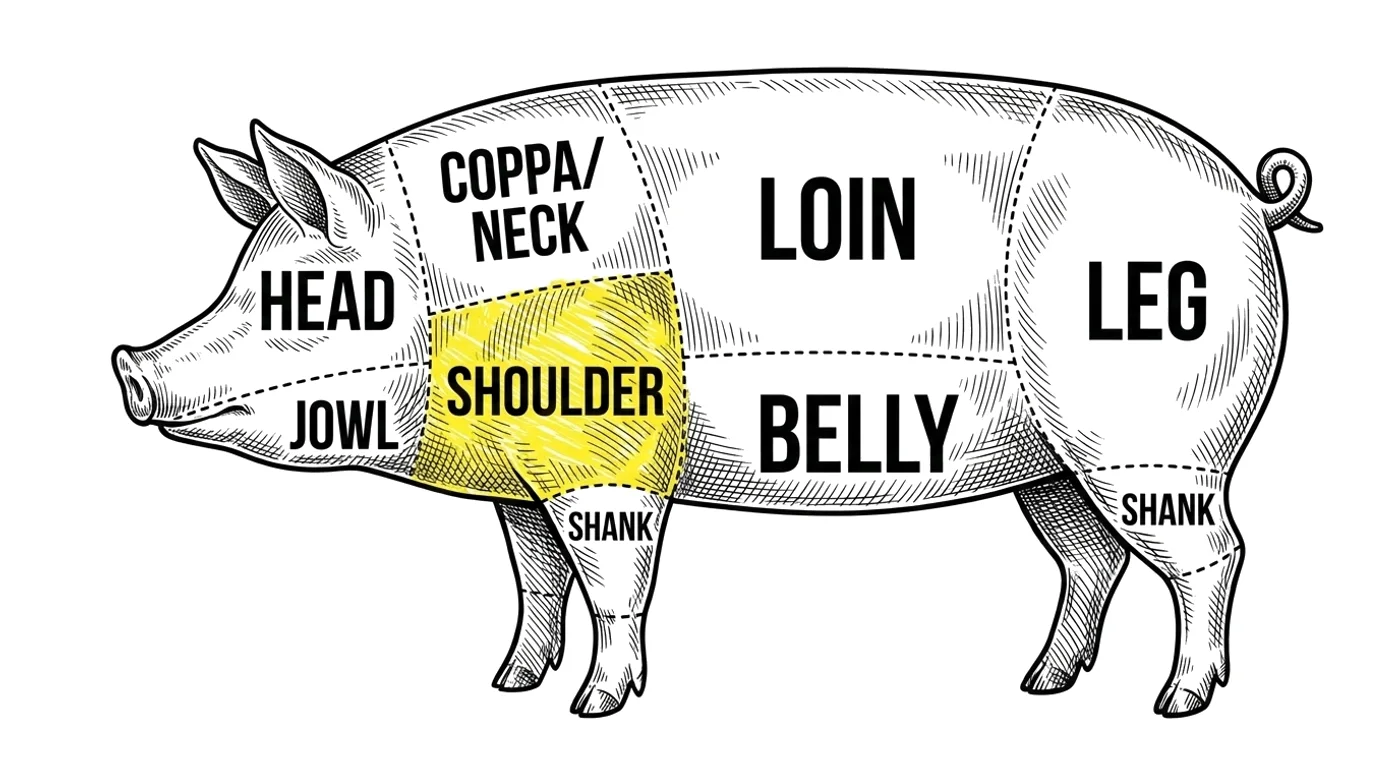
The cut
Identity and terminology
The distinction from Lucanica di Picerno PGI is mandatory. That protected sausage has a registered production area and specification. A generic fresh lucanica or home adaptation cannot use the protected name commercially.
Composition and characteristics
The developed branch uses pork shoulder, back fat and cooked rind with sage, anise and pepper. Its coarse texture and rind distinguish it from the fermented and matured PGI product.
Production and process
The rind is cooked and finely minced, then combined with coarsely minced pork and fat and stuffed into casing. This branch is refrigerated and cooked before eating.
History and regional forms
Roman authors referred to lucanica as a sausage from Lucania, and the name spread into Italian luganega, Portuguese linguiça, Spanish longaniza and related terms. Modern southern Italian sausages preserve the linguistic legacy in diverse forms.
Use, storage and related products
It is grilled or fried and served with bread, vegetables or pulses. It is not Lucanica di Picerno PGI, and not Lombard luganega.
Recipe and cure
This is not a finished recipe. It is a window into how this meat is traditionally cured. Before you follow any process, run it through one of our curing calculators so the salt, cure and timings are right and safe for your own batch.
Make this — the measured Curesmith version →“Make this” opens the same cure as a measured recipe, scaled to your batch.
- Meat
- Pork shoulder
- Cut
- Pork shoulder
- Salt (%)
- 1.8
- Curing salt
- None
- Fermented
- No
- Smoked
- No
- Maturation
- Raw sausage ≤4°C for up to 2 days; freeze for longer storage
- Basis
- per 1,000 g pork shoulder
- Style
- Fresh Italian pork-and-rind sausage; cook before eating
Ingredients
- Pork shoulder100% · 1000 g
- Pork back fat40% · 400 g
- Pork rind15% · 150 g
- Fine salt1.8% · 27.5 g
- Ground black pepper0.2% · 3 g
- Dried sage0.1% · 1 g
- Whole aniseed0.05% · 0.8 g
- Cayenne0.05% · 0.8 g
- Fresh garlic, crushed0.35% · 5.5 g
Method
- Remove bristles and excess inner fat. Simmer rind at 80–90°C until tender, then chill rapidly.
- Chill pork, fat, rind and equipment to 0–4°C.
- Grind tender rind through 3 mm; grind shoulder and back fat through 10 mm.
- Mix shoulder with salt, pepper, sage, aniseed, cayenne and garlic.
- Fold in back fat and ground rind until evenly distributed.
- Stuff into 36 mm hog casings and form 10 cm links.
Safety. Cooked rind does not make the mixed raw sausage ready to eat. Refrigerate and cook fully.