
Lucanica
-, Basilicata, Italy
Coarse, fennel-and-chilli scented, an ancient sausage in a living tradition.
Overview
Lucanica is coarse, fennel-and-chilli scented, an ancient sausage in a living tradition. The dry Curesmith version is a coarse red sausage with white fat, chilli warmth and a strong wild-fennel aroma. Fresh Lucanica is a separate uncured cooking style.
Where it's from
Climate. Basilicata (ancient Lucania) and the south.
Altitude. Southern hills
The cut
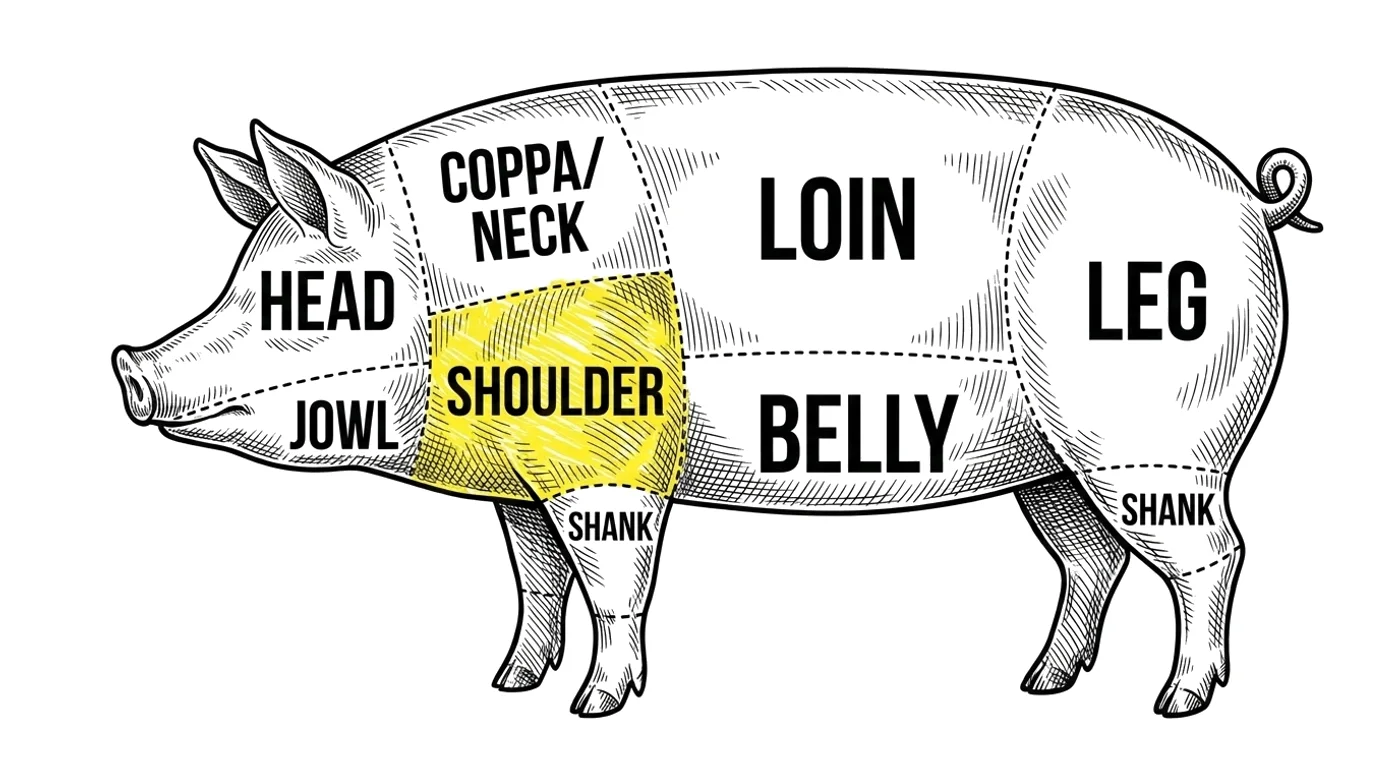
How to recognise it
The dry Curesmith version is a coarse red sausage with white fat, chilli warmth and a strong wild-fennel aroma. Fresh Lucanica is a separate uncured cooking style. The chosen form must be clear; a product that is half fresh and half dried without validated controls is unsafe and poorly defined.
- Shape and size
- Thin coiled links
- Lean colour
- Red
- Fat and marbling
- Flecked
- Casing
- Natural casing, 40 to 44 mm
- Surface bloom
- Possible if dried
Origins and history
Lucanica carries the name of Lucania, the old name for the country that is now mostly Basilicata in the south of Italy, and Roman writers were already describing a spiced sausage from there two thousand years ago. Soldiers and traders carried the idea widely, which is why sausages with closely related names still turn up across Italy and around the Mediterranean. In the southern homeland the character settled into a coarse grind warmed with chilli and scented with wild fennel. It has never become a museum piece, and is still made in small workshops and eaten as ordinary, well loved food.
Roman writers used a name derived from Lucania for a seasoned sausage, and related names travelled widely through Italy and the Mediterranean. Modern southern versions often feature chilli and wild fennel. The verified production area is Basilicata and wider southern Italy. Stories and etymologies are retained when they help explain the tradition, but legends are not used as evidence for the modern specification.
Name. Lucanica, from Lucania, the ancient region; Roman writers already used the word.
- Production today
- Made across the south and beyond.
- Protection
- Not EU-protected as a general name.
- Tradition vs modern
- Both fresh and cured versions exist.
- Seasonality
- Traditionally the winter slaughter.
Compare with. Salsiccia di Calabria
Serving and cultural significance
Lucanica may be grilled fresh, dried for slicing or cooked into sauces according to the regional form. The Atlas version is a dry fermented sausage, served with bread, caciocavallo, peppers and Aglianico. It must not be presented as Lucanica di Picerno PGI unless that specification is followed.
Recipe and cure
This is not a finished recipe. It is a window into how this meat is traditionally cured. Before you follow any process, please run it through one of our curing calculators, so the salt, cure and timings are right and safe for your own batch.
Curesmith home adaptation — not designation-compliant
Make this — the measured Curesmith version →The cure below is the traditional reference. “Make this” opens the measured Curesmith home recipe, scaled to your batch.
Traditional or protected production
Lucanica is an ancient generic sausage name linked to Lucania. It covers fresh and dried regional forms. Lucanica di Picerno is a separate protected PGI with its own production area and specification and should not be treated as equivalent to every sausage called Lucanica.
- Meat
- pork
- Salt (%)
- 2.5
- Curing salt
- Not included in the base recipe below
- Fermented
- Yes
- Target pH
- 4.9
- Starter or mould
- Natural surface mould
- Smoked
- No
- Target aW or weight loss
- ~30% weight loss
- Temperature (°C)
- ferment 22 to 24, then dry 13 to 15
- Humidity (%)
- ferment ~90, then 75 to 80
- Maturation
- fresh, or dried a couple of weeks
- Basis
- per 1000 g green meat
- Style
- Traditional fermented and dried salame
Ingredients
- Pork shoulder, lean cuts (base)100% · 1000 g/kg
- Lean pork from leg or loin75% · 750 g/kg
- Pork belly, jowl and back fat75% · 750 g/kg
- Sugar0.3% · 3 g/kg
- Black pepper0.1% · 1 g/kg
- Hot chilli pepper0.1% · 1 g/kg
- Fennel seeds0.15% · 2 g/kg
Method
- Mince pork and fat and mix with all ingredients to green meat weight.
- Stuff into casing.
- Ferment to the target pH.
- Dry to the target weight loss.
Notes
- The official protected specification controls the named product. Any Curesmith EQ, starter-culture, curing-salt or home-scale adaptation is a separate method and must not be presented as designation-compliant.
- This traditional recipe uses no nitrite. For safety we recommend adding Cure #2: in a low-oxygen, slow-dried product nitrite is the specific guard against Clostridium botulinum, while salt, acidity and drying control Salmonella, E. coli, Listeria and Staphylococcus.
In the Codex
What this product teaches, and where to read more.
Temple. Roof, Water Activity