
Overview
Mettenden are German raw sausages traditionally formed in short rings or end casings. The German Food Book lists Mettwurst in Enden among medium- to fine-grained raw sausages and recognises a separate Mettenden einfach category. The name therefore conveys more than a convenient casing shape.
Where it's from
The cut
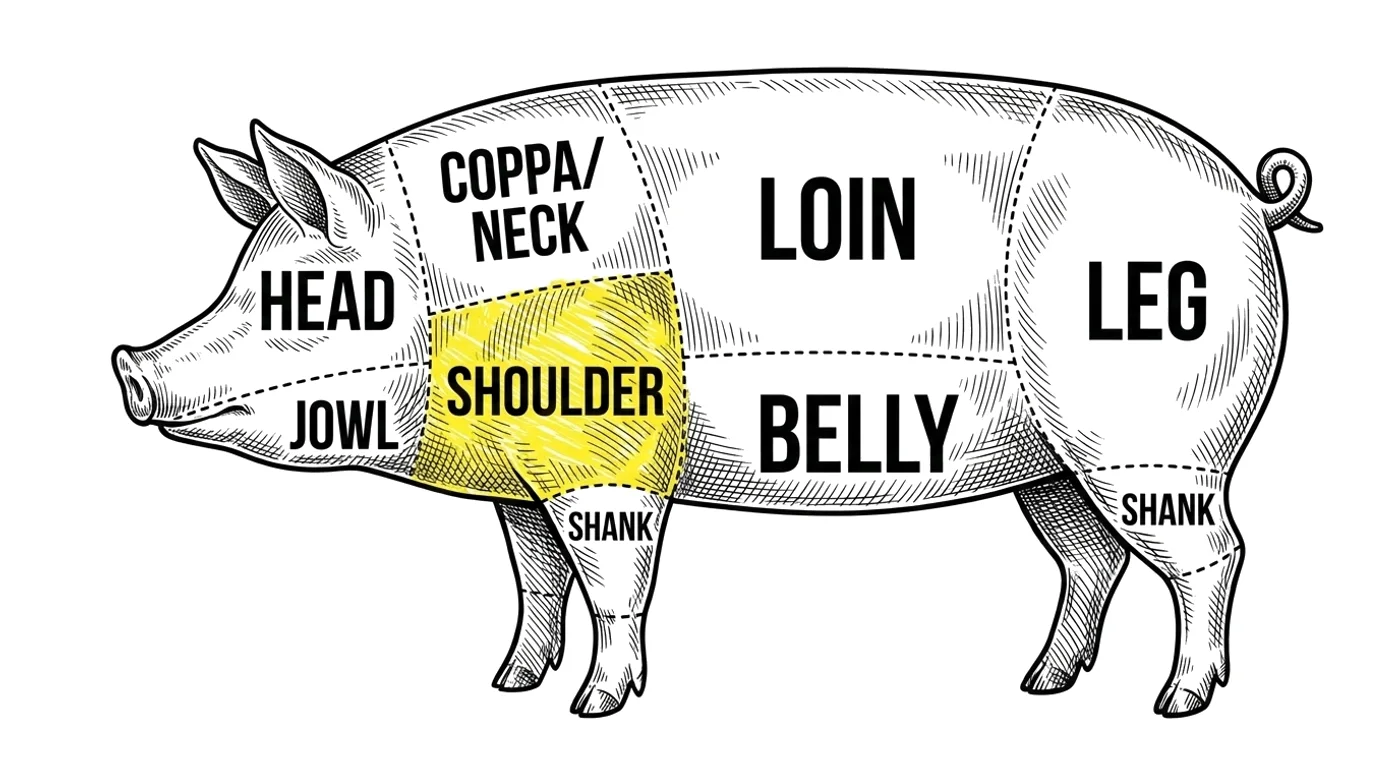
Identity and boundaries
Mettenden belongs within the Mettwurst family but is not the same as every Mettwurst, smoked soup sausage or cooked ring. The standard and einfach quality tiers have different analytical expectations. Product labels also matter because some regional Mettenden are sold for cooking rather than direct eating. The casing presentation is characteristic, but the identity also depends on the raw-sausage meat block, quality tier and intended state at sale.
Composition and characteristics
The standard German class uses beef, fatty pork and fat, with a cohesive medium-to-fine grain and common ring casing. Smoke is frequent but not universal. A good product has clean cured colour, even particle distribution, a resilient bite and no greasy pockets or under-dried centre.
Production and maturation
Chilled meat and fat are ground, cured, seasoned and mixed before stuffing into rings or short lengths. The selected route may include culture-led fermentation, smoking and drying. Small calibre can accelerate moisture loss, so humidity and airflow must prevent case hardening while the centre reaches its validated endpoint. Products sold for cooking must carry preparation instructions and cannot be assumed equivalent to matured ready-to-eat Mettenden merely because the name and shape match.
History and context
The word Enden refers to sausage ends or particular casing formats, and Mettenden became a practical portable form of Mettwurst. Over time, regional cooking traditions also adopted smoked rings for soups and stews, which explains why service state cannot be inferred from appearance alone.
Culinary use and relationships
Ready-to-eat Mettenden are sliced or eaten with bread and mustard. Cooking varieties flavour kale, beans, lentils and potato dishes. The entry links to Mettwurst, Rohe Touristenwurst and raw Knoblauchwurst while keeping cooked soup sausage and the einfach tier clearly identified. Both culinary uses are current, and the release state, quality class and regional name vary with them.
Recipe and cure
This is not a finished recipe. It is a window into how this meat is traditionally cured. Before you follow any process, run it through one of our curing calculators so the salt, cure and timings are right and safe for your own batch.
Make this — the measured Curesmith version →“Make this” opens the same cure as a measured recipe, scaled to your batch.
- Meat
- Pork shoulder
- Cut
- Pork shoulder
- Salt (%)
- 2.2
- Curing salt
- Cure #1/#2 as specified
- Fermented
- Yes
- Target pH
- 5.3 or lower
- Smoked
- Yes
- Basis
- per 1,000 g pork shoulder
- Style
- Ring-shaped fermented, smoked and cooked Mettwurst branch.
Ingredients
- Pork shoulder100% · 1000 g
- Lean beef25% · 250 g
- Pork back fat30% · 300 g
- Fine salt2.2% · 34 g
- Cure #1 containing 6.25% sodium nitrite0.25% · 4 g
- Dextrose0.5% · 7.5 g
- Black pepper0.3% · 4.5 g
- Garlic0.3% · 4.5 g
- Marjoram0.1% · 1.5 g
- Flora Italia LC or equivalent starter culture0.03% · 0.4 g
Safety. Mettenden are raw cured sausages. Products intended for direct eating require validated fermentation or maturation, drying and release endpoints. Some market versions are cooked before service, so labels and producer instructions must be followed rather than assuming every ring is shelf-stable.