
Mettwurst
Also known as Streichmettwurst
Northern Germany, Germany
Overview
Mettwurst is a soft, spreadable reddish sausage with pepper, allspice and smoke. it should remain smooth and cohesive, never sour, separated or stored warm. A soft, spreadable reddish sausage with pepper, allspice and smoke. It should remain smooth and cohesive, never sour, separated or stored warm. Raw material, cut or particle size, casing, smoke, fermentation, cooking and maturation all contribute to the identity. The current status is Generic German sausage family : no generic EU GI. The protected or traditional reference and the Curesmith home method remain separate.
Where it's from
The cut
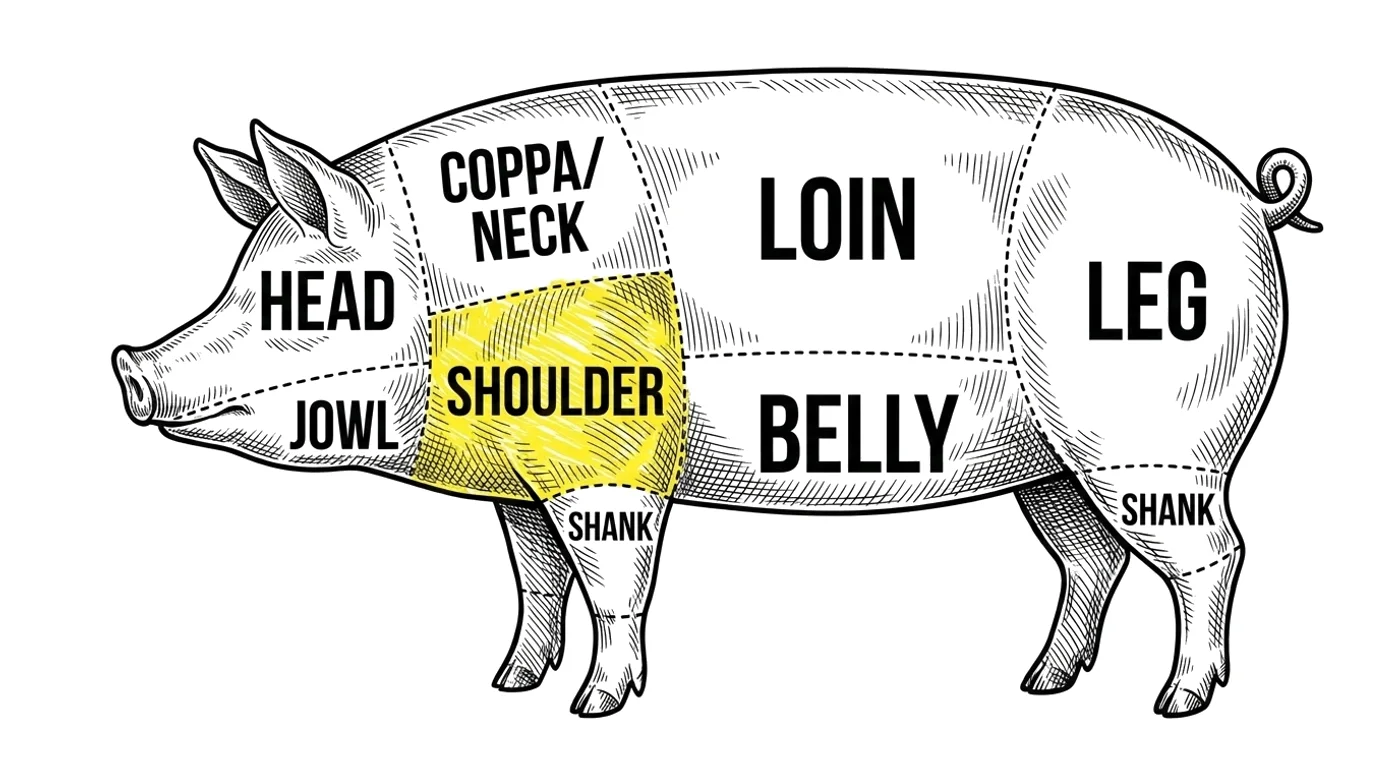
Traditional or protected production
Mettwurst is a broad German raw-sausage family rather than one protected formula. The soft version represented here uses pork and fatty pork, curing salt, seasoning and fermentation followed by restrained cold smoke and only limited drying. The paste remains spreadable and is stored refrigerated. Firmer regional Mettwürste that undergo longer drying should be treated as separate styles with their own release criteria.
How to recognise it
A soft, spreadable reddish sausage with pepper, allspice and smoke. It should remain smooth and cohesive, never sour, separated or stored warm. Grease smear, hollow pockets, case hardening, a wet centre, rancidity or uncontrolled dark mould is a production fault.
Origins and history
Mettwurst takes its name from minced or chopped meat and has never described only one recipe. German regions developed soft spreadable Mettwurst, firmer smoked links and long-dried slicing sausages according to casing size, fat content and local climate. In northern towns and farming districts, short fermentation and smoke produced a rich bread spread that could be made soon after slaughter. Elsewhere, similar mixtures were dried much further. Industrial meat processing standardised particle size and curing salts but did not eliminate the family structure. Mettwurst is a broad German category. This entry is the soft, smoked and refrigerated form of it.
Serving and cultural significance
Spread it on dark bread with onion, pickles or mustard and keep it cold during service. Because this entry is a soft raw fermented sausage, return it to refrigeration promptly and use clean utensils. In northern German households it is also served at breakfast and supper as part of a simple bread meal, where onion and acidity balance the high fat content.
Recipe and cure
This is not a finished recipe. It is a window into how this meat is traditionally cured. Before you follow any process, run it through one of our curing calculators so the salt, cure and timings are right and safe for your own batch.
Make this — the measured Curesmith version →The cure below is the traditional reference. “Make this” opens the measured Curesmith home recipe, scaled to your batch.
- Meat
- Pork and beef
- Cut
- Minced
- Salt (%)
- 2.2 to 2.5%
- Curing salt
- Cure #1
- Other agents
- dextrose; white pepper, allspice, sometimes garlic
- Fermented
- Yes
- Target pH
- ~4.9
- Starter or mould
- lactic acid bacteria starter
- Smoked
- often cold-smoked
- Target aW or weight loss
- modest, or ~30% for the sliceable form
- Temperature (°C)
- ferment then dry 12 to 14
- Humidity (%)
- 72 to 75
- Maturation
- weeks
- Basis
- per 1,000 g pork shoulder
- Style
- minced, cured, fermented and dried
Traditional formulation
As the protected or traditional product is made. The Curesmith home version, worked to house salt and nitrite standards, is on the measured recipe page.
- Minced100% · 1000 g
- Pork shoulder100% · 1000 g
- Pork belly45% · 450 g
- Salt2.5% · 35.5 g
- Cure #10.25% · 3.5 g
- Starter culture0.02% · 0.4 g
- Dextrose0.3% · 4.5 g
- Black pepper0.2% · 3 g
- Allspice0.05% · 0.7 g
- Garlic0.1% · 1.5 g
Notes
- Nitrite at 156 ppm ingoing.
- Target roughly pH 4.9 through a prompt, clean ferment.
- Convert any volume spice measures to weight as a percentage of the meat.
- Runs from a soft spreadable paste (Streichmettwurst) to a firm sliceable sausage depending on region and drying.
Safety. A fermented sausage: the acid drop and drying carry the safety. Ferment promptly to close the early Staphylococcus aureus window.
In the Codex
What this product teaches, and where to read more.
Temple. Roof, pH