
Mojama
Also known as Jamon del mar, Ham of the sea
Barbate (Cadiz), Andalusia, Spain
Salt-cured, wind-dried tuna loin, the ham of the sea.
Overview
Mojama is a firm dark reddish-brown tuna loin with a close grain, clean sea aroma and concentrated savoury flavour. the slice should not be rancid, sour or soft and wet at the centre.
Where it's from
Climate. The wind-dried coast of the Gulf of Cadiz, in the path of the almadraba tuna.
Altitude. Sea level
The cut
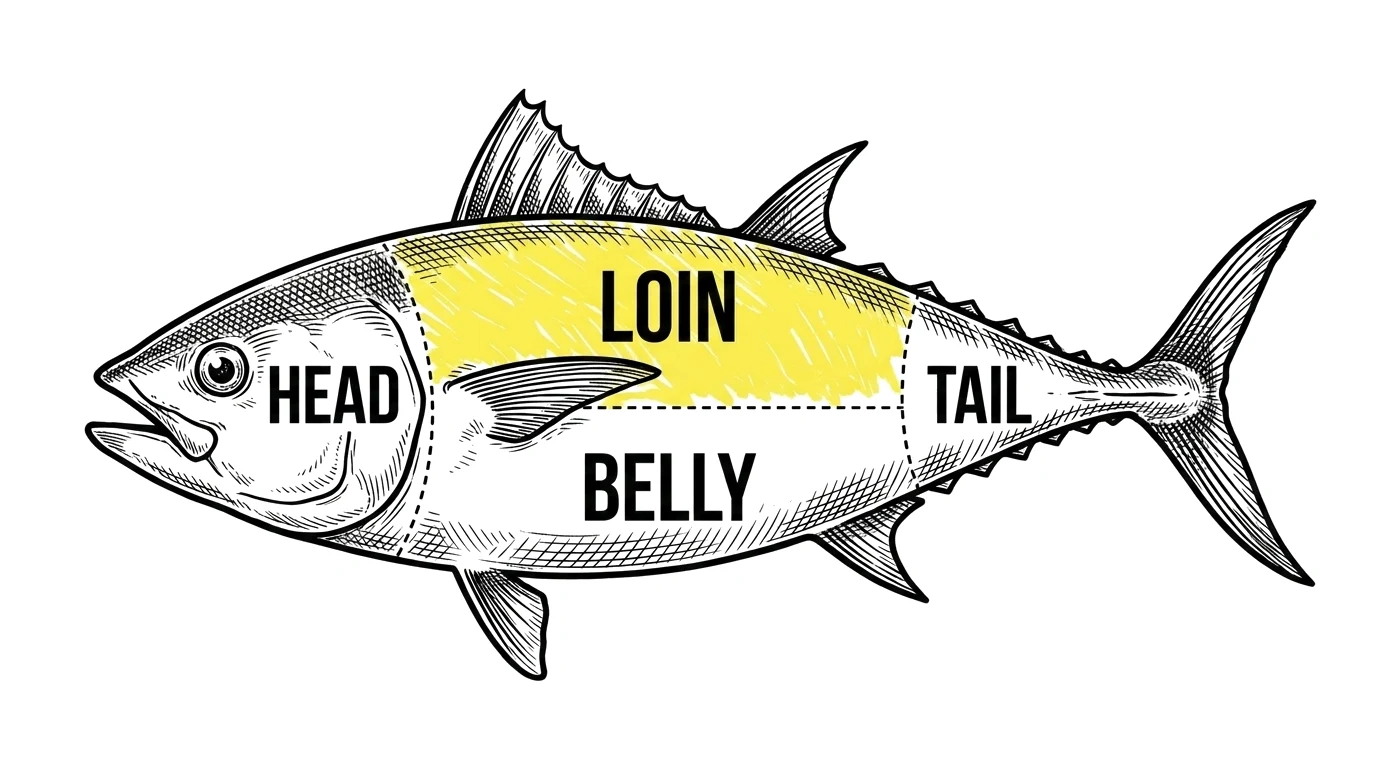
How to recognise it
A firm dark reddish-brown tuna loin with a close grain, clean sea aroma and concentrated savoury flavour. The slice should not be rancid, sour or soft and wet at the centre. A hard dry rim, wet or grey centre, rancid fat, sourness, insect damage or uncontrolled mould indicates an unsafe or uneven cure.
- Shape and size
- Dark, compact strips or blocks
- Lean colour
- Deep garnet-red, darker at the edges
- Fat and marbling
- Lean, with fine tuna streaks
- Casing
- None
- Surface bloom
- Dark brown surface
Origins and history
Mojama is among the oldest cured foods still made in Spain, with roots in the Phoenician trading post of Gadir, now Cadiz, where tuna was packed in sea salt so it could keep and travel. Its name comes from Arabic words meaning dry or waxed, a trace of the long Moorish presence along this coast. The craft is strongest today in Barbate in Cadiz and in Isla Cristina in Huelva, both of which hold protected geographical status. Tuna for the best grades is still taken by traditional net fishing and only the loins are used. Tuna preservation on the Andalusian Atlantic coast grew around the almadraba fisheries and older Mediterranean salting traditions. Removing the loin, salting and drying it created a dense food that could travel far beyond the fishing season. Today the names Mojama de Barbate and Mojama de Isla Cristina are separately protected, while generic mojama continues to describe salt-cured tuna loin made elsewhere.
Name. From the Arabic musama, meaning dry or cured.
- Production today
- Made in Cadiz (Barbate, Conil), Huelva (Isla Cristina) and Murcia.
- Protection
- PGI for Mojama de Barbate (2015) and Mojama de Isla Cristina (2016).
- Tradition vs modern
- Traditional almadraba tuna and wind-drying; industrial versions dry faster and taste of it.
- Seasonality
- Tied to the spring almadraba migration.
Compare with. Bresaola della Valtellina
Serving and cultural significance
Slice the tuna paper-thin and dress it with olive oil, toasted almonds and tomato, or serve it with oranges and bread. The cured loin is intensely savoury, so small portions are enough. Refrigerate the cut piece and protect it from drying.
Recipe and cure
This is not a finished recipe. It is a window into how this meat is traditionally cured. Before you follow any process, please run it through one of our curing calculators, so the salt, cure and timings are right and safe for your own batch.
Curesmith home adaptation — not designation-compliant
Make this — the measured Curesmith version →The cure below is the traditional reference. “Make this” opens the measured Curesmith home recipe, scaled to your batch.
Traditional or protected production
The protected Mojama products are made from cleaned loin of yellowfin or bluefin tuna, using sea salt and drying without additives. Mojama de Barbate has Extra and Primera categories. Its specification sets finished salt at 3–9% and moisture at 35–45%.
- Meat
- fish (tuna)
- Cut
- loin, bloodline removed
- Salt (%)
- traditional salt-box; PGI final salt 3 to 9%
- Fermented
- No
- Smoked
- No
- Target aW or weight loss
- 35 to 45% weight loss; PGI moisture 40 to 50%
- Temperature (°C)
- cool wind-drying
- Maturation
- salt for days, then air-dry 2 to 3 weeks and rest
- Basis
- per 1000 g tuna loin
- Style
- Salt-box (salazon), wind-dried
Ingredients
- coarse sea salt37.5% · 375 g/kg
- sugar12.5% · 125 g/kg
Method
- Trim the loin and remove the bloodline.
- Pack in salt for a few days.
- Rinse and rack for a couple of days to redistribute.
- Hang and wind-dry for two to three weeks.
- Rest to stabilise before slicing.
Notes
- The official protected specification controls the named product. Any Curesmith EQ, starter-culture, curing-salt or home-scale adaptation is a separate method and must not be presented as designation-compliant.
- A more efficient way of curing this product is using the EQ Method. No more than 2.5% salt to meat weight is required. To follow the EQ method, please use our whole-muscle EQ curing calculator to work out proper ratios and curing times.
- The salt-box figures here are packing amounts, not uptake; the PGI product finishes at 3 to 9% salt and 40 to 50% moisture after 35 to 45% weight loss.
- Fish safety differs from meat; follow the FDA Fish and Fishery Products guidance for histamine and Listeria control.
Safety. A cured fish, not a meat; manage histamine by using very fresh, well-chilled tuna and follow fish-specific guidance.
In the Codex
What this product teaches, and where to read more.
Temple. Roof, Water Activity