
Overview
Morrpølse, also written morr, mør or mårpølse in regional usage, is a foundational Norwegian cured-sausage family. It combines chopped meat, fat, salt and spices and is sold in coils, rings, sticks or slices. Sheep and game are common, but the family is not limited to one species.
Where it's from
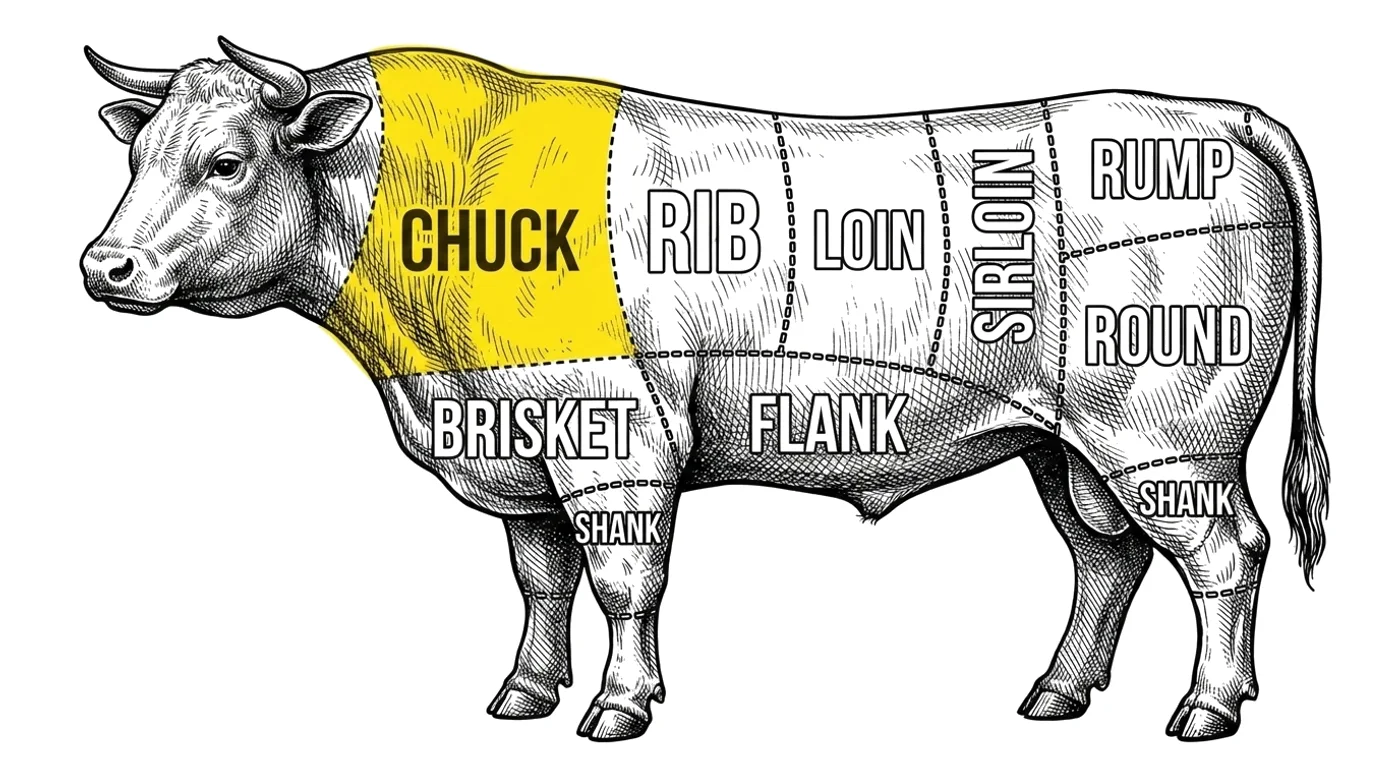
The cut
Identity and boundaries
Norwegian educational sources describe morr as a broad traditional family that may use sheep, game, pork, beef and, historically, offal or blood. Those branches must be labelled rather than collapsed into one formula. Fårepølse is a sheep-led child, not a synonym for all morr. No single meat species, casing shape or spice mixture defines the entire family, which is why named regional and species branches require their own descriptions.
Composition and characteristics
Morr is generally coarsely chopped, visibly fatty and deeply cured, with smoke used in some regions. Species affects colour and flavour: sheep produces a distinct savoury character, game a darker lean profile, and pork a softer fat balance. Coil form is common but not mandatory.
Production and maturation
A modern controlled route uses chilled declared meats, complete-batch cure, starter culture, stuffing, measured fermentation, optional smoke and gradual drying. Historic practice relied on climate and experience, but commercial release requires validated pathogen reduction and water-activity control. Blood or offal versions require separate process documentation. Modern production must translate seasonal farm practice into measured fermentation and drying controls rather than using calendar time alone as proof of stability.
History and context
Morr grew from Norwegian farm preservation, when autumn slaughter meat was salted, sometimes smoked and hung to dry through winter. The broad family reflects local animal availability and household economy. Contemporary artisanal producers continue coiled forms while using modern hygiene and validation systems.
Culinary use and relationships
Morrpølse is sliced for open sandwiches, cold tables and packed meals. It pairs with flatbread, sour cream, cheese and pickled foods. The entry links to Fårepølse, game sausage and Scandinavian spekepølse, while blood-rich svartpølse and imported salami styles remain separate. Orthographic variants should remain searchable, but they should resolve to one Norwegian family hub unless evidence supports a genuinely separate product.
Recipe and cure
This is not a finished recipe. It is a window into how this meat is traditionally cured. Before you follow any process, run it through one of our curing calculators so the salt, cure and timings are right and safe for your own batch.
Make this — the measured Curesmith version →“Make this” opens the same cure as a measured recipe, scaled to your batch.
- Meat
- Lean beef
- Cut
- Lean beef
- Salt (%)
- 2.5
- Curing salt
- Cure #1/#2 as specified
- Fermented
- Yes
- Target pH
- 5.3 or lower
- Smoked
- Yes
- Basis
- per 1,000 g lean beef
- Style
- Modern mixed-beef-and-lamb Norwegian-style fermented sausage.
Ingredients
- Lean beef100% · 1000 g
- Lean lamb60% · 600 g
- Pork back fat40% · 400 g
- Fine salt2.5% · 50 g
- Cure #2 containing 6.25% sodium nitrite0.25% · 5 g
- Dextrose0.4% · 8 g
- Black pepper0.3% · 6 g
- Garlic0.2% · 4 g
- Crushed juniper berries0.1% · 2 g
- Flora Italia LC or equivalent starter culture0.03% · 0.5 g
Safety. Morrpølse includes species and historical ingredient branches with different hazards. Modern ready-to-eat production requires complete species declaration, validated curing and fermentation, controlled drying and verified release endpoints. Offal or blood variants need explicit raw-material and process controls.