
Mortadella Bologna
Bologna, Emilia-Romagna, Italy
Silky, delicate and gently spiced, dotted with sweet fat and often pistachio, best sliced thin in a rosette.
Overview
Mortadella Bologna is a finely emulsified cooked pork sausage studded with clean cubes of jowl fat. Its pale pink slice, delicate spice and silky texture made it the emblematic salume of Bologna and the ancestor of many inferior products that borrowed its name.
Where it's from
Climate. Bologna and Emilia.
Altitude. Po plain
The cut
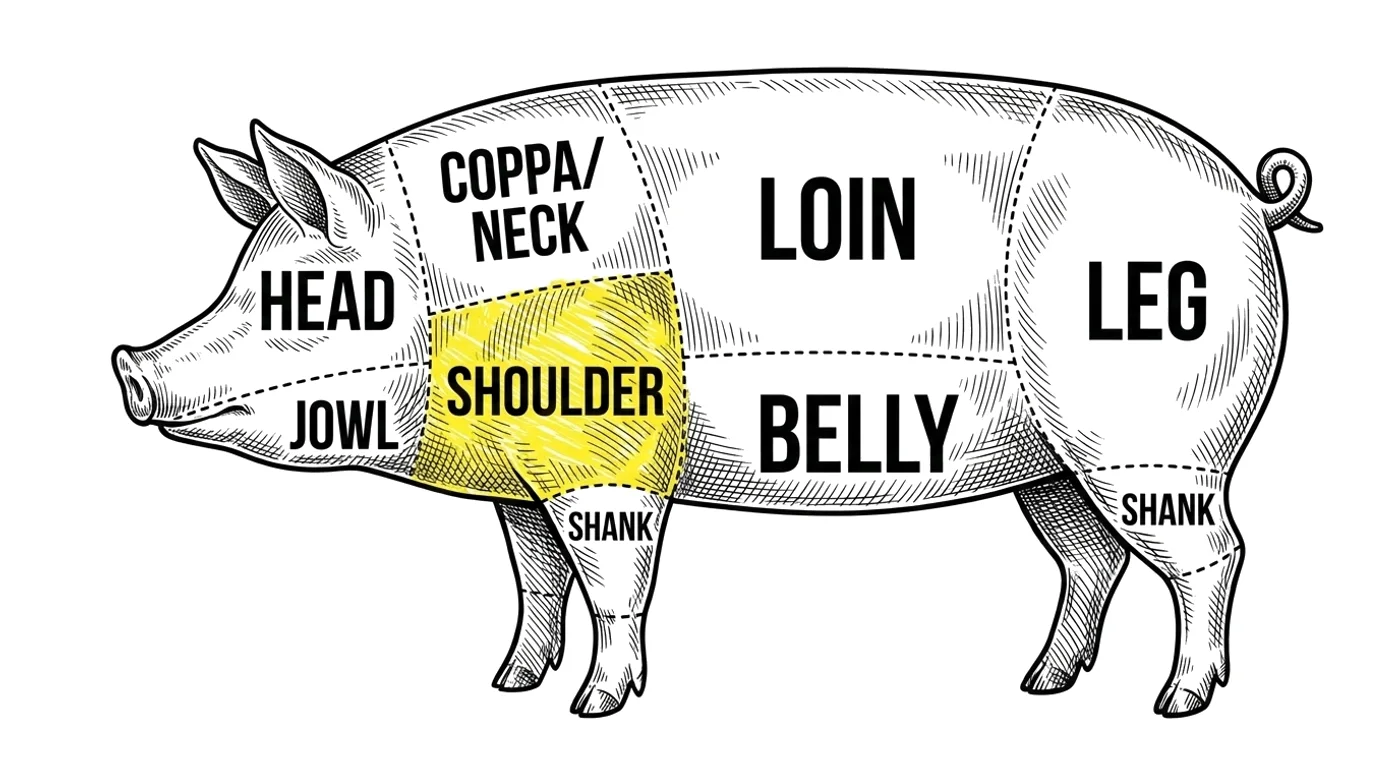
How to recognise it
A true Mortadella Bologna slice is evenly pale pink, glossy and silky, with sharply defined white jowl-fat cubes. Whole peppercorns or pistachios may appear in permitted presentations, but smoke is absent. The emulsion should be elastic and moist without rubberiness. Fat separation, grey raw pockets, air holes, sourness or a greasy broken texture are faults.
- Shape and size
- Very large cylinder, pink with white fat cubes
- Lean colour
- Smooth pink
- Fat and marbling
- White lardon cubes
- Casing
- Large casing
- Surface bloom
- None
Origins and history
Bologna's relationship with mortadella reaches into the city's Roman and medieval food culture. A Roman-era stone in the archaeological museum shows piglets on one side and a mortar on the other, supporting one explanation of the name from mortarium, the tool used to pound meat and spice. Another theory connects it with myrtle-seasoned farcimen myrtatum. The recipe was described in the early seventeenth century by Vincenzo Tanara. On 24 October 1661 Cardinal Farnese issued rules controlling production, an early example of food-name protection. Mortadella was once expensive and reserved for wealthy tables because fine chopping and long cooking demanded skill. Industrial technology later made it popular food, and PGI recognition in 1998 protected the authentic Italian product.
Name. Debated: possibly from the Latin mortarium, the mortar used to pound the meat, or from mirtatum, 'seasoned with myrtle'.
- Production today
- Producers across the Bologna zone.
- Protection
- IGP.
- Tradition vs modern
- Traditional slow cooking, now industrial and artisan.
- Seasonality
- Year-round.
Compare with. Mortadella di Prato
Serving and cultural significance
Slice it paper-thin and fold it into soft rosettes, or cut it into cubes for an aperitivo. Bologna also serves it in bread and uses it in fillings, mousses and pasta. Warming should be gentle; high heat destroys the silky emulsion and renders out the visible fat.
Recipe and cure
This is not a finished recipe. It is a window into how this meat is traditionally cured. Before you follow any process, please run it through one of our curing calculators, so the salt, cure and timings are right and safe for your own batch.
Curesmith home adaptation — not designation-compliant
Make this — the measured Curesmith version →The cure below is the traditional reference. “Make this” opens the measured Curesmith home recipe, scaled to your batch.
Traditional or protected production
Mortadella Bologna is made from finely comminuted pork muscle with visible cubes of pork jowl fat, salt and pepper, packed in vapour-permeable casing and cooked in dry-air ovens. The product is not smoked. Pistachio is optional rather than universal.
- Meat
- pork
- Salt (%)
- 2
- Curing salt
- Cure #1 at 2.5 g/kg (0.25%)
- Fermented
- No
- Smoked
- No
- Target aW or weight loss
- cooked, not dried
- Temperature (°C)
- cooked through to a safe core temperature
- Humidity (%)
- n/a
- Maturation
- cooked; eaten fresh or briefly kept
- Basis
- per 1000 g green meat
- Style
- Traditional, cooked
Ingredients
- lean pork (base)100% · 1000 g/kg
- back fat lardons15% · 150 g/kg
- sea salt2% · 20 g/kg
- Cure #10.25% · 2.5 g/kg
- white pepper0.3% · 3 g/kg
- myrtle berries0.1% · 1 g/kg
- pistachio (optional)2% · 20 g/kg
Method
- Emulsify the lean pork finely and fold in the fat lardons and seasoning.
- Stuff into a large casing.
- Cook slowly in a warm oven or bath until the core is safely done.
- Cool and store cold.
Notes
- The official protected specification controls the named product. Any Curesmith EQ, starter-culture, curing-salt or home-scale adaptation is a separate method and must not be presented as designation-compliant.
- This is a cooked product. It must be cooked through before eating. Where a cure is used it is Cure #1 (nitrite), suited to the shorter, cooked process rather than long drying.
In the Codex
What this product teaches, and where to read more.
Temple. Pillar, Meat Quality