
Overview
Moskovskaya Sausage is a Russian standards family rather than one universal sausage. Active GOST standards use the name for raw-smoked dry sausage, a semi-dry version and a separate cooked-smoked Category A product.
Where it's from
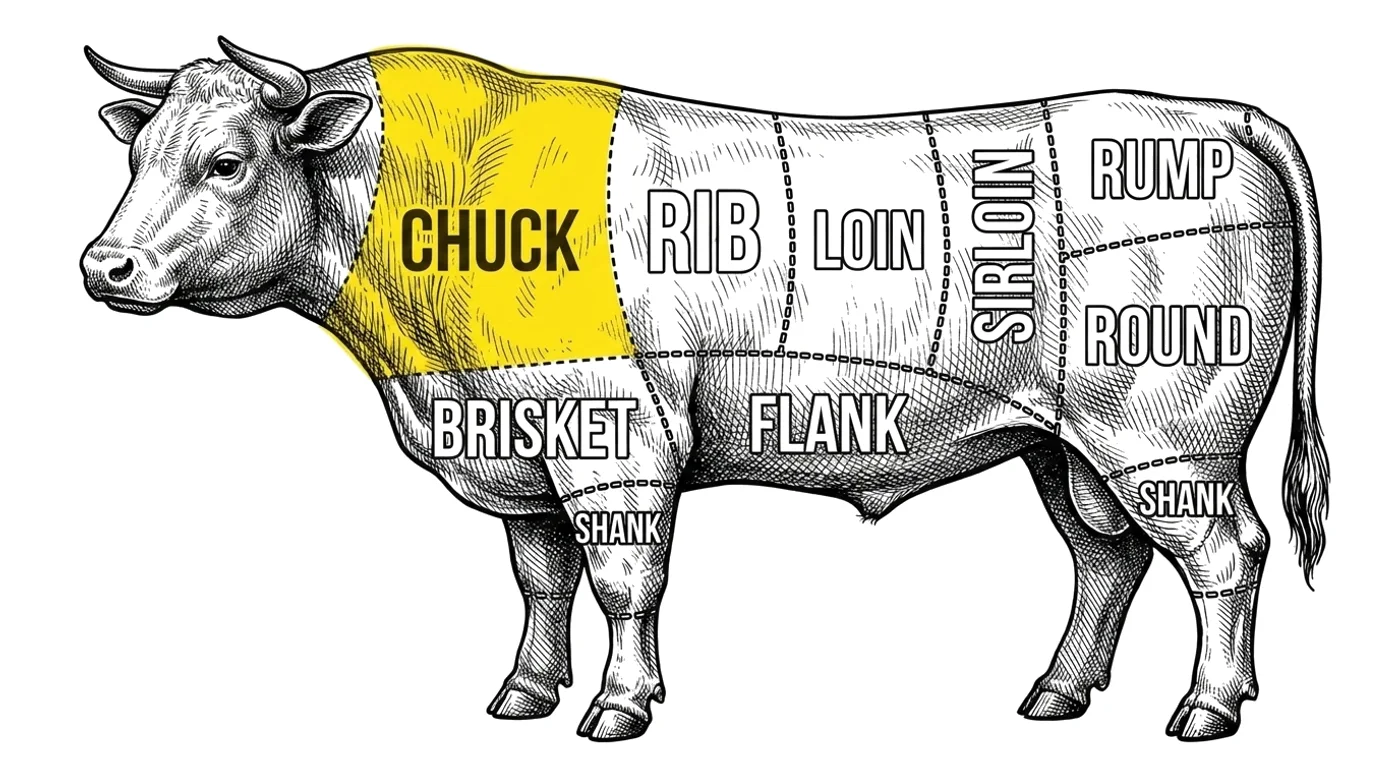
The cut
Identity and terminology
The Cyrillic name Московская should be transliterated and linked to the applicable standard. GOST R 55456-2013 covers raw-smoked and semi-dry branches, while GOST R 55455-2013 covers cooked-smoked sausage. A recipe or article that omits the branch risks combining incompatible compositions and safety controls.
Composition and characteristics
Raw-smoked Moskovskaya is a firm cured slicing sausage with visible fat and prolonged maturation. The semi-dry branch uses starter cultures and follows a faster controlled acidification route. Cooked-smoked Moskovskaya has a softer cooked texture and a different moisture and storage profile.
The branch distinction is visible in texture as well as process. Dry forms are firmer and more concentrated, while cooked-smoked forms retain more moisture and a softer bite. Semi-dry starter-culture products sit between these endpoints and should not be described as either fully dry or simply cooked.
Production and process
The raw-smoked branch is cured, comminuted, smoked and dried to a validated endpoint. The semi-dry branch adds controlled starter-culture fermentation. The cooked-smoked branch receives a thermal lethality step, smoking and rapid cooling. Each route requires its own pH, aw, temperature and storage criteria.
History and regional forms
The product name became established in Soviet meat standards and continued in modern Russian GOST systems. Changes in technology introduced starter-culture and cooked-smoked branches without eliminating the older raw-smoked identity.
Standards history explains why conflicting recipes circulate under one familiar name. Older technical books, Soviet formulations and current GOST texts may all describe legitimate but different branches, so the governing document and date should be stated.
Use, storage and related products
Moskovskaya is served sliced with bread, cheese, pickles and cold appetisers. Storage must follow the specific branch and package. Related entries include Soviet Sausage and other Russian dry or cooked-smoked standards, each tied to its own GOST standard.
Recipe and cure
This is not a finished recipe. It is a window into how this meat is traditionally cured. Before you follow any process, run it through one of our curing calculators so the salt, cure and timings are right and safe for your own batch.
Make this — the measured Curesmith version →“Make this” opens the same cure as a measured recipe, scaled to your batch.
- Meat
- Lean beef
- Cut
- Lean beef
- Salt (%)
- 2.5
- Curing salt
- Cure #1/#2 as specified
- Fermented
- Yes
- Target pH
- 5.3 or lower
- Smoked
- Yes
- Basis
- per 1,000 g lean beef
- Style
- Fermented and dried Moscow-style sausage; no exact GOST compliance claim.
Ingredients
- Lean beef100% · 1000 g
- Pork shoulder35% · 350 g
- Pork back fat35% · 350 g
- Fine salt2.5% · 41.5 g
- Cure #2 containing 6.25% sodium nitrite0.25% · 4 g
- Dextrose0.39% · 6.5 g
- Black pepper0.29% · 5 g
- Ground cardamom0.1% · 1.5 g
- Garlic0.15% · 2.5 g
- Flora Italia LC or equivalent starter culture0.02% · 0.4 g
Safety. The branch and governing standard must be identified before any process is described. Dry and semi-dry forms require controlled fermentation or acidification and drying; cooked-smoked product requires validated lethality and cooling. The shared name does not make the processes interchangeable.