
Münchner Weißwurst
Also known as Münchener Weisswurst, Munich white sausage
Bavaria, Germany
Overview
Münchner Weißwurst is Munich's pale, finely comminuted scalded sausage, made from veal or young beef with fatty pork, bacon and a small permitted connective-tissue fraction. Parsley shows as green flecks in the ivory cut face; lemon peel and mild warm spices give a fresh aroma. It is neither smoked nor nitrite-cured, so the colour stays cream-grey rather than cured pink.
Where it's from
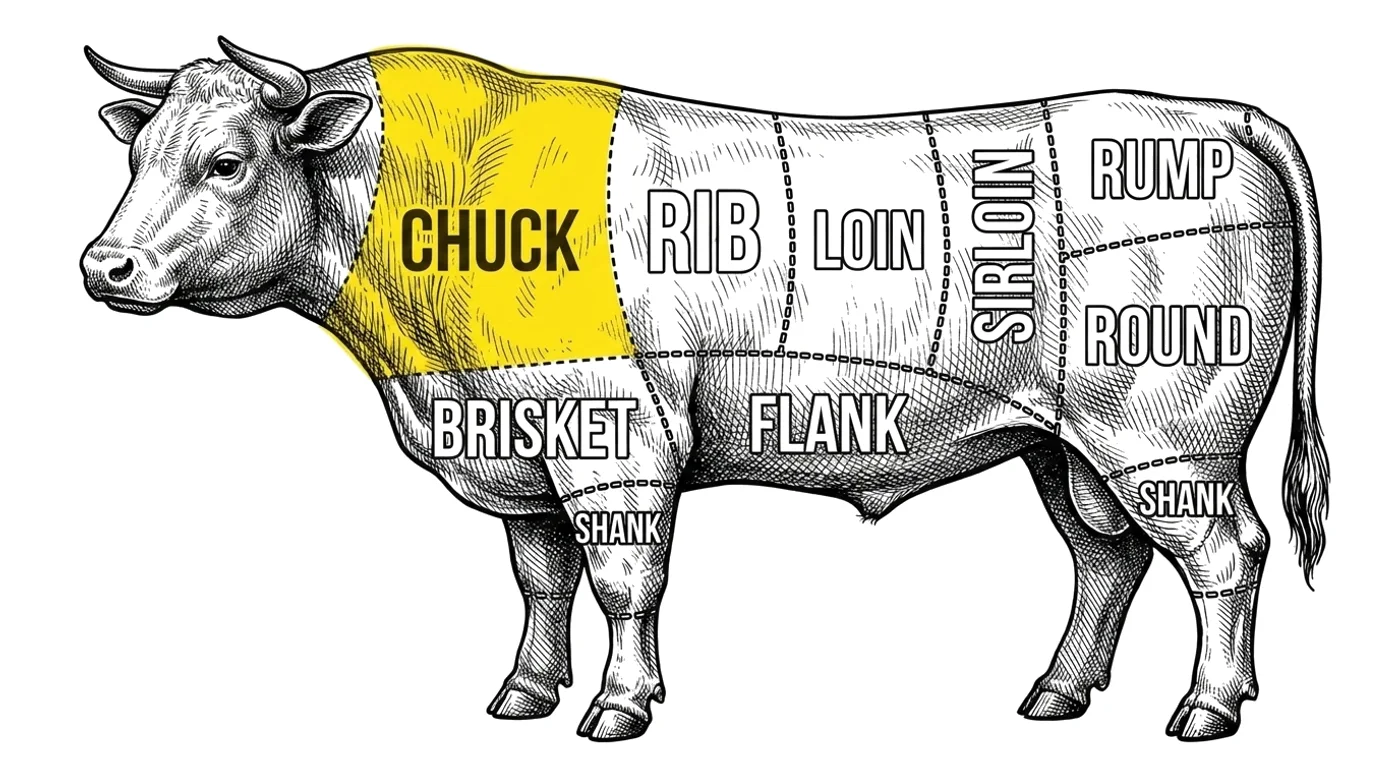
The cut
Identity and terminology
The name means Munich white sausage. Weißwurst is a descriptive German compound of white and sausage, while Münchner identifies the city association. Germany's current meat guidelines give Münchner Weißwurst its own entry rather than treating the name as a casual synonym for every pale veal sausage. It remains distinct from Kalbsbratwurst, Wollwurst and the many regional white bratwursts.
Composition and characteristics
Its defining structure is a smooth batter with a clear veal or young-beef emphasis, supported by fatty pork and back fat. Cooked rind or calf-head skin may provide additional binding collagen. Fresh parsley and lemon are central sensory markers; pepper, mace, coriander and ginger stay restrained. The plump hog casing and tender, almost mousse-like bite contrast with coarser grilled bratwurst.
Production and process
Cold meat and fat are minced and fine-cut with ice until the salt-soluble proteins hold water and fat in a stable emulsion. Parsley and lemon enter late so the herbs remain visible and aromatic. The links are gently scalded, rapidly chilled and later warmed without boiling. Traditional service often removes or avoids eating the relatively resilient casing rather than browning it over a grill.
History and regional forms
Munich's official chronology records the familiar story that the sausage was supposedly created on 22 February 1857, but it also cautions that the product was a variation of an older Munich sausage speciality. The Marienplatz account locates the legend at the inn Zum Ewigen Licht. This distinction matters: the date belongs to civic food folklore, whereas the broader white-sausage technique predates the anecdote.
Use, storage and related products
White sausage is associated with a morning or late-morning meal, sweet Bavarian mustard, pretzel and wheat beer. It is served hot from water rather than fried crisp. Because it is moist, uncured and ready to eat, a home batch remains refrigerated and is handled carefully after cooking. The name has a recognised German compositional identity but is not presented here as an EU geographical indication.
Recipe and cure
This is not a finished recipe. It is a window into how this meat is traditionally cured. Before you follow any process, run it through one of our curing calculators so the salt, cure and timings are right and safe for your own batch.
Make this — the measured Curesmith version →“Make this” opens the same cure as a measured recipe, scaled to your batch.
- Meat
- Veal shoulder or young beef, sinew removed
- Cut
- Veal shoulder or young beef, sinew removed
- Salt (%)
- 2
- Curing salt
- None
- Fermented
- No
- Starter or mould
- None; this product is not fermented
- Smoked
- No
- Maturation
- Refrigerate at 0–4°C; use within 4 days or freeze promptly
- Basis
- per 1,000 g veal shoulder or young beef, sinew removed
- Style
- fine pale Bavarian scalded sausage with parsley and lemon
Ingredients
- Veal shoulder or young beef, sinew removed100% · 1000 g
- Skinless pork jowl50% · 500 g
- Pork back fat20% · 200 g
- Cooked pork rind, fully chilled10% · 100 g
- Crushed ice10.9% · 196 g
- Fine salt2% · 35.5 g
- Ground white pepper0.22% · 4 g
- Ground mace0.11% · 2 g
- Ground coriander0.06% · 1 g
- Ground ginger0.03% · 0.6 g
- Flat-leaf parsley, finely chopped1.1% · 19.5 g
- Fresh lemon zest0.54% · 10 g
Method
- Cook the rind until tender, chill it fully, then chill all remaining animal materials and equipment to 0–2°C.
- Grind veal or young beef, jowl, fat and cooked rind separately through 3 mm.
- Fine-cut the lean meat with salt, spices and crushed ice; add jowl, fat and rind gradually until glossy and cohesive.
- Fold in parsley and lemon zest evenly without bruising the parsley into a green paste.
- Fill hog casings and form short plump links.
- Poach at 75–78°C until the cold point reaches 71°C.
Safety. Keep the fine batter cold, avoid emulsion breakage, verify the gentle cook, chill rapidly and protect the ready-to-eat links from post-cook contamination.