
Palangos Sausage
Also known as Palangos, Palanga sausage
Klaipėda County, Lithuania
Overview
Palangos Sausage is an archive-derived Lithuanian cooked-smoked chub made from beef, lean pork, fattier pork and diced belly. The slice is denser and more visibly mottled than Nevėžis Sausage, with lean fine particles around distinct small belly cubes. Pepper and nutmeg provide a restrained aroma beneath a light, sustained smoke character.
Where it's from
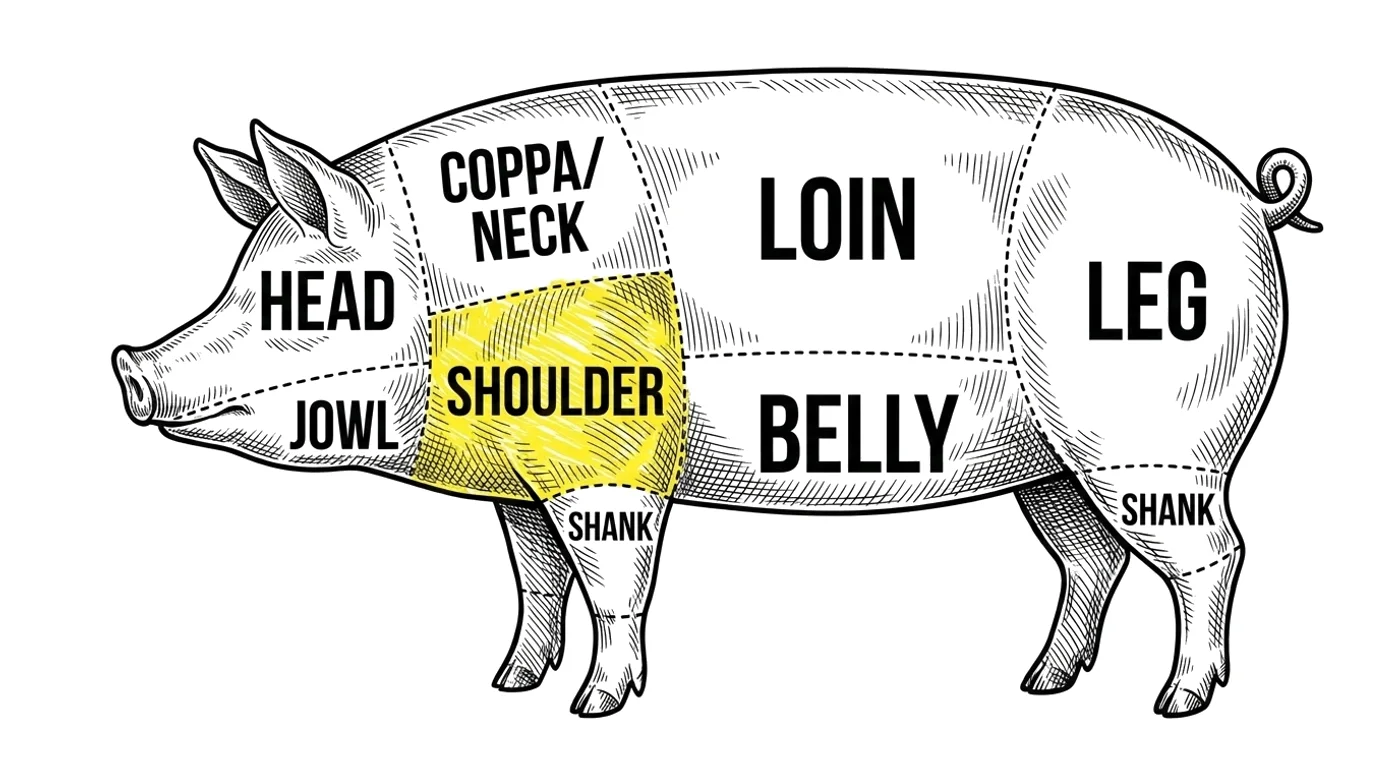
The cut
Identity and terminology
Palangos is the Lithuanian genitive form of Palanga and means of Palanga. The canonical title preserves that grammatical form because it is the name carried by the source, while Palanga sausage remains an explanatory alias. The record does not establish a current municipal specification, certification body or EU protection, so the place-name is not used as proof of protected production.
Composition and characteristics
Beef and lean pork form the fine dark binding fraction, medium-fat pork provides the middle grain and belly supplies small pale cubes. No added water is necessary. The source's high salt and sugar reflect a preservation-oriented process, but a modern cooked refrigerated branch can use a more moderate balance while retaining cure, pepper and nutmeg. Three transverse ties are a useful visual marker of the broad chub.
Production and process
Animal materials are cured under refrigeration, then ground by class and mixed without smearing the belly cubes. The sausage is stuffed into a broad casing, tied, surface-dried and lightly smoked before its final cook. That order replaces the archive instruction to expose an already cooked sausage to warm smoke for a day or longer. Rapid chilling follows the verified heat treatment.
History and regional forms
Palanga's municipal chronology records a Baltic trading settlement by the early medieval period and later development as a resort town. Those facts establish the cultural and geographic meaning of the sausage name, but not the age of the recipe. The source itself describes its long process as original Russian instructions, pointing to a Soviet technical transmission that should not be rewritten as an undocumented ancient Palanga household tradition.
Use, storage and related products
Slice the fully chilled chub for rye bread, cheese, pickles or a cold buffet, or warm it gently. Beef and nutmeg give it a different profile from garlic-led Polish kielbasa. Lithuanian food authorities classify cooked-smoked sausages as heat-treated meat products and stress controlled shelf-life setting. A home Palangos therefore stays refrigerated; long smoke, tying and reduced moisture do not justify ambient storage.
Recipe and cure
This is not a finished recipe. It is a window into how this meat is traditionally cured. Before you follow any process, run it through one of our curing calculators so the salt, cure and timings are right and safe for your own batch.
Make this — the measured Curesmith version →“Make this” opens the same cure as a measured recipe, scaled to your batch.
- Meat
- Medium-fat pork shoulder
- Cut
- Medium-fat pork shoulder
- Salt (%)
- 2.2
- Curing salt
- Cure #1 as specified in the recipe
- Fermented
- No
- Starter or mould
- None; this product is not fermented
- Smoked
- Yes
- Maturation
- Refrigerate at 0–4°C; use within 4 days or freeze promptly
- Basis
- per 1,000 g medium-fat pork shoulder
- Style
- archive-derived Lithuanian beef-and-pork cooked-smoked sausage
Ingredients
- Beef chuck65% · 650 g
- Lean pork shoulder25% · 250 g
- Medium-fat pork shoulder100% · 1000 g
- Pork belly65% · 650 g
- Fine salt2.2% · 55 g
- Cure #1, 6.25% sodium nitrite0.25% · 6.5 g
- Dextrose0.78% · 20 g
- Ground black pepper0.2% · 5 g
- Ground nutmeg0.1% · 2.5 g
Method
- Cut meats, mix all animal material with salt, Cure #1 and dextrose, cover and refrigerate 24–48 hours.
- Grind the lean and medium-fat fractions to their stated sizes and dice belly to 5 mm.
- Mix ground meats with pepper and nutmeg until cohesive, then fold in belly cubes.
- Fill the casing firmly, close securely and apply three evenly spaced transverse ties.
- Dry the surface and apply light warm smoke for two to three hours.
- Poach at 75–78°C until the cold point reaches 71°C.
Safety. Cure only under refrigeration, shorten and move smoke before the final cook, measure the centre temperature, chill promptly and reject ambient storage for the home branch.