
Overview
Palcówka is a coarse Polish sausage traditionally filled by hand and matured until firm. The visible pieces of meat and fat, irregular wrinkled casing and assertive garlic-and-pepper flavour distinguish it from finely minced kielbasa. Many regional forms are dried and unsmoked, although some are cold-smoked after maturation. The defining craft idea is direct: chopped meat is pushed into the casing with the fingers or through a simple wide horn, preserving a rustic cut face and avoiding the fine texture of machine-minced sausage.
Where it's from
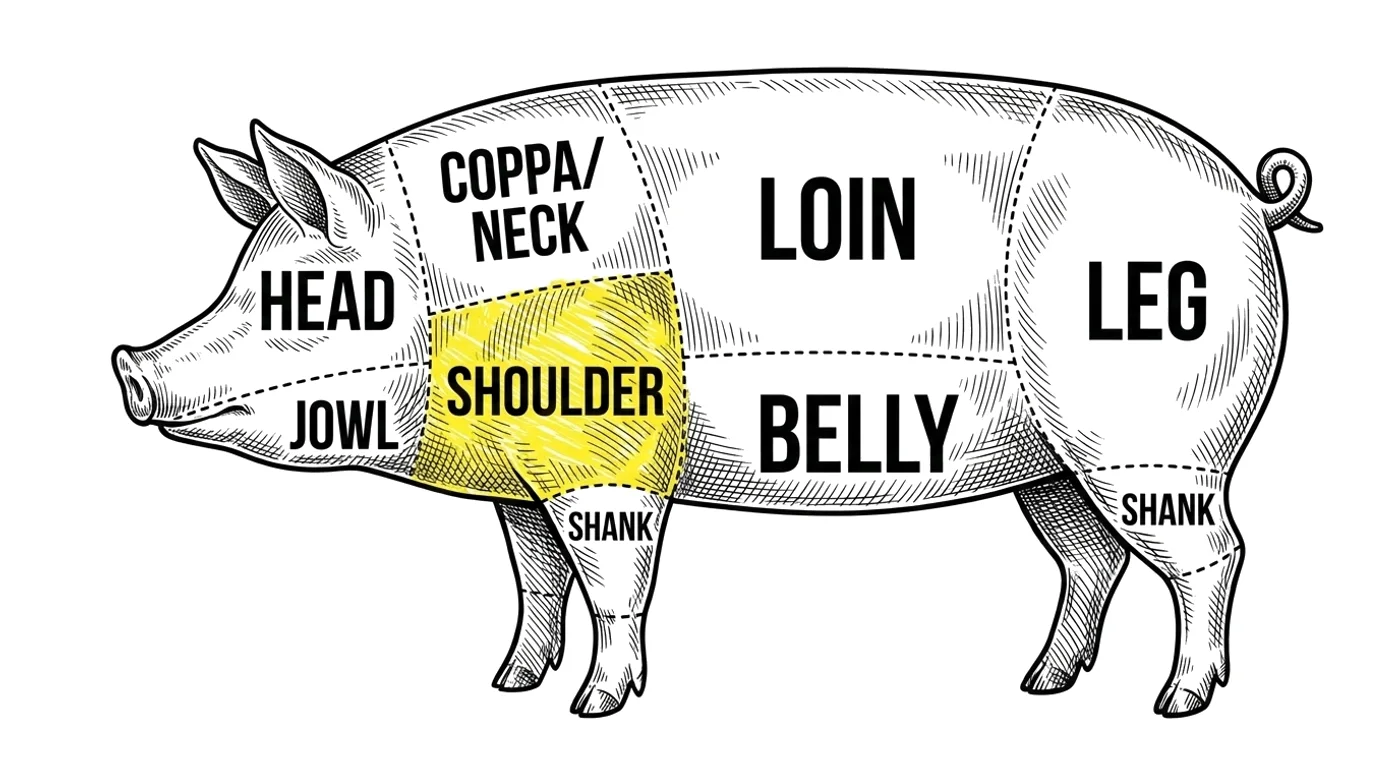
The cut
Identity and terminology
The name derives from palec, finger. Kiełbasa palcówka therefore means finger-stuffed sausage. Polish ministry records document more than one regional product under the name, including a Mazovian thin, dried, unsmoked sausage and a Lubuskie wild-boar form associated with migrants from the former eastern borderlands. These records show a family of related regional practices rather than one protected national formula. Finger Sausage is a useful English alias, though Palcówka is the canonical name.
Composition and characteristics
Pork ham, loin or shoulder is cut by hand into visible pieces and balanced with firm back fat. Garlic and coarse black pepper are central; marjoram, allspice, coriander or a little sugar vary by household and region. The natural casing is unevenly filled and tied into pairs or U-shaped loops. As moisture leaves, the surface wrinkles and the sausage becomes firm and brittle. A clean white ripening mould may occur on long-matured versions, but uncontrolled mould colour or odour cannot be treated as automatically beneficial.
Production and process
Finger stuffing must be treated as an identity and texture feature, not a safety control. A controlled Curesmith branch uses chilled hand-cut pork and fat, Cure #2, whose nitrate reservoir suits the long maturation this sausage takes, dextrose and a mandatory Flora Italia LC starter culture. The sausage ferments at controlled warmth until pH is 5.3 or below within the degree-hour limit, then dries slowly with managed humidity until both weight loss and water activity targets are reached. This measured process replaces instructions to hang the sausage in an undefined warm or cool room. The finished product remains refrigerated even after aw release.
History and regional forms
Polish descriptions connect Palcówka with household pig slaughter, when women cleaned casings and chopped meat by knife, cleaver or axe before grinders became common. The technique is also associated with Kresy foodways carried west after the Second World War. Regional registers preserve distinct stories: Mazovian pork sausage, Biebrza forms and a Lubuskie wild-boar version. The hand-stuffing method is the common thread, while species, smoking, seasoning and maturation differ. Registration on Poland's Traditional Products List records heritage but is not an EU PDO or PGI.
Use, storage and related products
Palcówka is sliced thinly with rye bread, pickles, mustard or horseradish and served as part of a cold table. Its coarse texture and dryness make it closer to a rustic matured kielbasa than to a cooked luncheon sausage. A hot-smoked and poached Finger Sausage is a modern or historical branch, not the only meaning of the name. Fermented home production requires a starter culture, pH measurement, water-activity verification and careful mould control. Weight loss alone does not prove safety.
Recipe and cure
This is not a finished recipe. It is a window into how this meat is traditionally cured. Before you follow any process, run it through one of our curing calculators so the salt, cure and timings are right and safe for your own batch.
Make this — the measured Curesmith version →“Make this” opens the same cure as a measured recipe, scaled to your batch.
- Meat
- Pork shoulder
- Cut
- Pork shoulder
- Salt (%)
- 2.5
- Curing salt
- Cure #2
- Fermented
- Yes
- Target pH
- 5.3 or lower
- Smoked
- Yes
- Target aW or weight loss
- 38% weight loss
- Basis
- per 1,000 g pork shoulder
- Style
- Controlled fermented and dried hand-stuffed branch.
Ingredients
- Pork shoulder100% · 1000 g
- Pork belly30% · 300 g
- Pork back fat15% · 150 g
- Fine salt2.5% · 35.5 g
- Cure #2 containing 6.25% sodium nitrite0.25% · 3.5 g
- Dextrose0.39% · 5.5 g
- Black pepper0.3% · 4.5 g
- Garlic0.3% · 4.5 g
- Marjoram0.1% · 1.5 g
- Flora Italia LC or equivalent starter culture0.03% · 0.4 g
Safety. Traditional hand filling does not remove the need for hygienic stuffing, correct cure calculation, controlled fermentation or acidification where used, measured drying and validated release criteria. Regional registered descriptions do not by themselves validate a home process.