
Paleta curada
Also known as Paleta, Paletilla
Nationwide, Spain
The shoulder ham, smaller and quicker than the leg but cured the same way.
Overview
Paletilla is a smaller cured shoulder with red lean, abundant seams of fat and a pointed compact profile. it should smell sweet and mature around the bone.
Where it's from
Climate. Cured across Spain wherever pigs are raised; a country-wide tradition rather than one region.
The cut
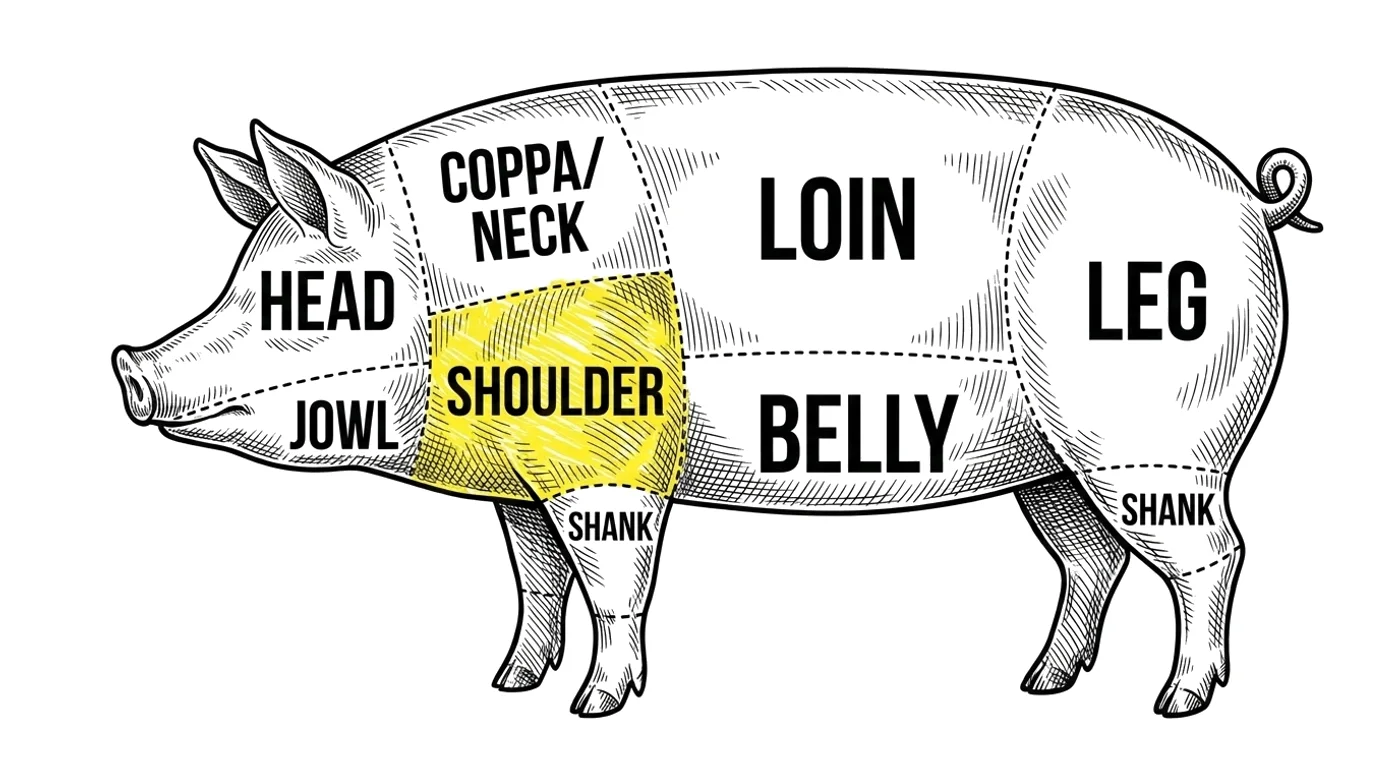
How to recognise it
A smaller cured shoulder with red lean, abundant seams of fat and a pointed compact profile. It should smell sweet and mature around the bone. A hard dry rim, wet or grey centre, rancid fat, sourness, insect damage or uncontrolled mould indicates an unsafe or uneven cure.
- Shape and size
- Bone-in shoulder, smaller than a leg ham
- Lean colour
- Deep red
- Fat and marbling
- Cream fat
- Casing
- None (whole muscle)
- Surface bloom
- Possible
Origins and history
The paletilla is the cured front shoulder of the pig, the smaller companion to Spain's celebrated leg ham. Where jamón is taken from the hind leg, the paletilla comes from the foreleg, left on the bone and in its skin, and it is worked by the very same salting, resting and air-drying. Because the shoulder carries less lean over more bone, it takes up salt and gives up moisture more readily, so it reaches maturity in roughly a year rather than the two or more that a heavy leg can demand. It has long been the more affordable everyday cut on the Spanish table, made in both Serrano and Ibérico grades, and it is never smoked, only matured in cool, dry air. The front leg was cured alongside the hind leg in Spanish household slaughter. Its higher proportion of bone and connective tissue gives a stronger flavour and a lower slicing yield, but many consumers value its concentration. The smaller foreleg matures more quickly than a hind-leg jamón and contains more bone relative to edible meat, which helps explain its intense flavour and lower carving yield.
Name. Paletilla, a diminutive of paleta, the shoulder.
- Production today
- Produced across Spain, from white-pig to Iberico.
- Protection
- The generic paletilla is unprotected; specific Iberico designations sit under the Iberico norm.
- Tradition vs modern
- Traditional salt-box curing, with modern EQ methods a safer home route.
- Seasonality
- Traditionally the winter matanza.
Compare with. Jamón Serrano
Serving and cultural significance
Carve very thin slices from the shoulder, changing knife angle as the smaller bones redirect the muscles. Serve with bread, tomato, olives or dry sherry. Include soft fat, but use the bone and trimming meat in stocks, beans and croquettes.
Recipe and cure
This is not a finished recipe. It is a window into how this meat is traditionally cured. Before you follow any process, please run it through one of our curing calculators, so the salt, cure and timings are right and safe for your own batch.
Make this — the measured Curesmith version →The cure below is the traditional reference. “Make this” opens the measured Curesmith home recipe, scaled to your batch.
Traditional or protected production
Paletilla is the cured front shoulder of the pig. It is smaller, more muscular and generally matures faster than a hind-leg jamón. Where a product is sold under an Ibérico or regional protected designation, the applicable breed, feed and process rules must be followed separately.
- Meat
- pork
- Cut
- bone-in front shoulder (paleta), skin-on
- Salt (%)
- 3.75
- Curing salt
- Optional Cure #2 for the long dry
- Fermented
- No
- Smoked
- No
- Target aW or weight loss
- substantial weight loss over months
- Temperature (°C)
- cool cellar drying
- Humidity (%)
- 70 to 80
- Maturation
- several months, quicker per kilo than a leg
- Basis
- per 1000 g green meat
- Style
- Salt-box dry cure, pimenton-and-lard seal
Ingredients
- coarse sea salt3.75% · 37.5 g/kg
- sugar1.25% · 12.5 g/kg
- Cure #2 (optional)0.3% · 3 g/kg
- pimentón dulce (finishing seal)2.5% · 25 g/kg
- lard/manteca (finishing seal)10% · 100 g/kg
Method
- Weigh the shoulder and record its green weight.
- Rub with the salt cure and pack in coarse salt.
- Rest, rinse, then begin the long dry.
- Seal the exposed face with pimenton and lard.
- Dry for several months to the target weight loss.
Notes
- A more efficient way of curing this product is using the EQ Method. No more than 2.5% salt to meat weight is required. To follow the EQ method, please use our whole-muscle EQ curing calculator to work out proper ratios and curing times.
- After curing, the exposed face is sealed with a pimenton-and-lard coat, which is a surface seal rather than part of the ingoing cure.
In the Codex
What this product teaches, and where to read more.
Temple. Roof, Water Activity