
Pancetta de l’Île de Beauté / Panzetta de l’Île de Beauté
Also known as Pancetta de l'Île de Beauté, Pancetta de l’Île de Beauté, Panzetta de l’Île de Beauté
Corsica (regional), Corsica, France
Aromatic and firm, a Corsican cured belly with pepper and a hint of island smoke.
Overview
Pancetta de l'Île de Beauté is the protected Corsican belly cure registered in 2023. The belly is salted, peppered and matured, sometimes with light smoke according to the protected style. In ordinary Corsican cooking it is commonly fried, grilled or used as a seasoning meat.
Where it's from
Climate. Corsica, the 'Ile de Beaute', with clean mountain and maquis air.
Altitude. Corsican hills
The cut
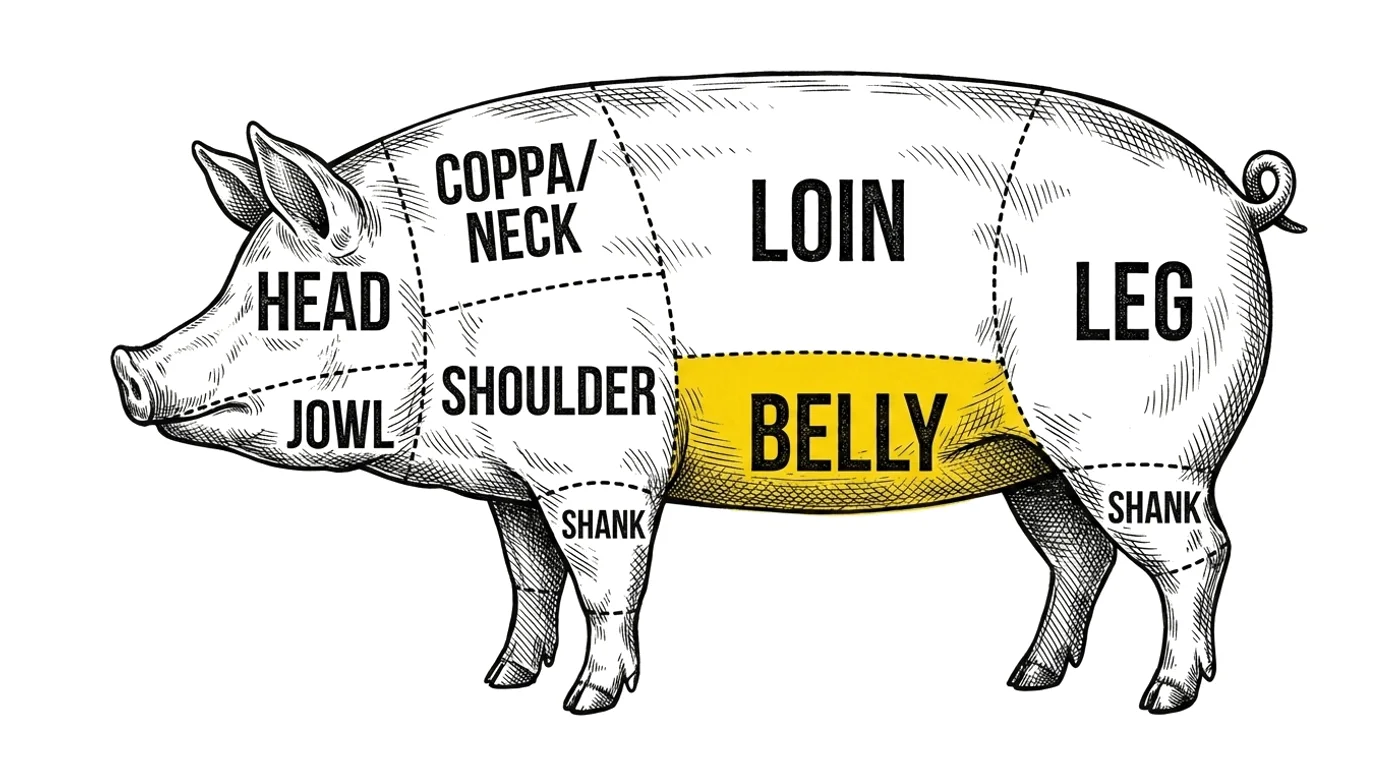
How to recognise it
The belly shows alternating red lean and white fat beneath a dry seasoned surface. Pepper and restrained smoke may appear. Fat should smell sweet and clean. Yellow rancidity, sourness, wet internal pockets or a hard dry shell are faults.
- Shape and size
- Cured belly, flat or rolled
- Lean colour
- Red streaks
- Fat and marbling
- White layers
- Casing
- None (rind-on slab); a large casing if rolled
- Surface bloom
- Possible
Origins and history
Corsican households depended on pork fat as both food and cooking medium. Belly could be cured in slabs or shaped pieces, hung after the winter slaughter and used gradually in soups, eggs, beans and vegetable dishes. The broader Île de Beauté protection project emerged because much Corsican-style charcuterie used island processing but did not meet the narrower Nustrale-breed rules of the older AOPs. Producers organised a traceable regional chain and secured European PGI registration for Pancetta, Figatelli, Bulagna and Saucisson sec on 26 July 2023. The new designation protects a real Corsican tradition while keeping it legally distinct from the breed-specific Coppa, Lonzo and Prisuttu AOP system.
Name. Pancetta, belly; Ile de Beaute, 'island of beauty', a name for Corsica.
- Production today
- Corsican producers.
- Protection
- IGP (Ile de Beaute), distinct from the Corsican AOPs.
- Tradition vs modern
- Island pigs, pepper and a light chestnut smoke.
- Seasonality
- Winter slaughter.
Compare with. Pancetta Piacentina
Serving and cultural significance
Fry or grill slices with eggs, potatoes, chestnuts, beans or greens, or cut the belly into lardons for stews. Gentle rendering preserves the pepper and avoids scorching the lean. The cured fat can season an entire pan, so begin with a small amount and add extra salt only after tasting the finished dish.
Recipe and cure
This is not a finished recipe. It is a window into how this meat is traditionally cured. Before you follow any process, please run it through one of our curing calculators, so the salt, cure and timings are right and safe for your own batch.
Curesmith home adaptation — not designation-compliant
Make this — the measured Curesmith version →The cure below is the traditional reference. “Make this” opens the measured Curesmith home recipe, scaled to your batch.
Traditional or protected production
The PGI controls Corsican production, raw-material traceability, salting, seasoning, optional smoke and maturation. It was registered on 26 July 2023 as a separate Île de Beauté product.
Sea salt and black pepper, sometimes lightly smoked over chestnut wood; no fixed percentage.
- Meat
- pork
- Cut
- belly, rind on
- Salt (%)
- traditional, no fixed %
- Curing salt
- Sea salt and pepper; sometimes a light chestnut smoke
- Fermented
- No
- Starter or mould
- Natural cellar mould possible
- Smoked
- Yes
- Target aW or weight loss
- At least 30% weight loss for cooking use; at least 38% if eaten uncooked
- Temperature (°C)
- cold salting, then 10 to 15
- Humidity (%)
- 70 to 80
- Maturation
- a few weeks to months
- Basis
- percentage of green meat weight
- Style
- Traditional dry salting (salt-box), lightly smoked
Method
- Salt and season the cut by the traditional method and rest cold so the salt draws through.
- Wash or brush off surface salt and begin the slow dry.
- Case or hang as the style requires. Apply a light smoke where traditional.
- Age to the target loss, judging by weight.
Notes
- The official protected specification controls the named product. Any Curesmith EQ, starter-culture, curing-salt or home-scale adaptation is a separate method and must not be presented as designation-compliant.
- A more efficient way of curing this product is using the EQ Method. No more than 2.5% salt to meat weight is required. To follow the EQ method, please use our whole-muscle EQ curing calculator to work out proper ratios and curing times.
In the Codex
What this product teaches, and where to read more.
Temple. Foundation, Time