
Overview
Parówki are small Polish cooked sausages with a fine, nearly uniform texture, a narrow casing and a mild cured-meat flavour. They are commonly warmed in hot water for breakfast or a simple meal, but they are already cooked when sold. The name identifies a specific fine-link tradition rather than the entire universe of Polish kiełbasa. A well-made parówka is moist and springy, with no visible coarse fat mosaic and only restrained smoke.
Where it's from
The cut
Identity and terminology
Parówka is singular and parówki plural. The term is associated in popular explanation with para, meaning steam, but the product's real identity is clearer in its technical position: a narrow, finely comminuted, scalded sausage. It should not be collapsed into Kiełbaski Porcjowe Parzone, which historical standards treat as a separate portion-sausage formula, or into serdelki, which are broader and have their own composition. Frankfurter and hot dog are useful comparisons, not exact translations.
Composition and characteristics
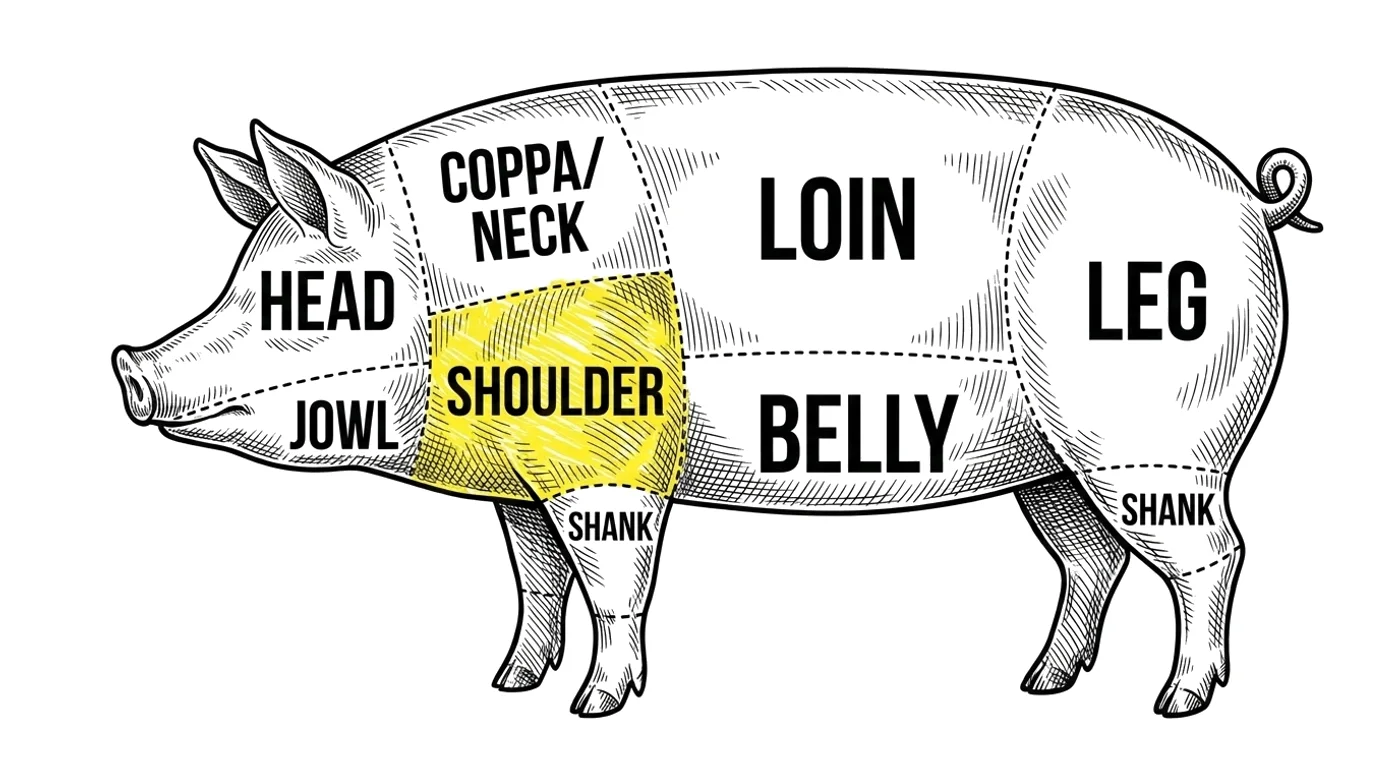
Pork gives body and fat, while beef can strengthen colour, bind and flavour. The meat is ground repeatedly and fine-cut with ice, salt and curing salt until the extracted proteins hold water and fat in a smooth matrix. White pepper, nutmeg and garlic keep the flavour light. The cut face should be even and cured pink, without smeared fat pockets, cereal lumps or voids. A sheep casing gives the narrow diameter and clean snap expected from the style.
Production and process
Cold meat and sharp plates are essential because a fine batter fails quickly if its fat warms. The meats are ground separately, rechilled and comminuted with ice while the batter stays below ten degrees Celsius. After stuffing, the surface is dried under cool control, lightly smoked and then scalded to a verified centre. Rapid chilling arrests cooking and protects the fine texture. Cure and smoke do not make the moist link shelf stable.
History and regional forms
Parówki belong both to Polish industrial meat technology and to ordinary home eating. Post-war standards recorded fine scalded sausage categories in a detailed national vocabulary, while current Polish inspection material shows that the market name alone does not guarantee a fixed meat percentage or composition. That gap between historical technical identity and modern commercial variation is important: the Atlas can describe the traditional structure without pretending every contemporary packet follows one canonical formula.
Use, storage and related products
Warm parówki gently in water below a hard boil and serve with bread, mustard, horseradish or ketchup. The narrow round shape is a choking risk for young children and should be cut appropriately. Store refrigerated and protect opened packs from cross-contamination. Compared with Kiełbaski Porcjowe, parówki are finer and narrower; compared with English saveloy they are less cereal-led; compared with frankfurters they sit within a specifically Polish naming and eating context.
The recipe for this product is in preparation and will be published once it has been verified.
Safety. Keep the batter cold, measure Cure #1 on the animal block, verify the cooked centre, chill promptly and refrigerate.