
Overview
Pâté en croûte is a French charcuterie family in which a seasoned forcemeat and selected garnishes are baked inside a pastry case. After cooling, some versions receive aspic through openings in the crust. The identity lies in the integration of pastry, filling, baking and chilled slicing, not in any single competition or restaurant formula.
Where it's from
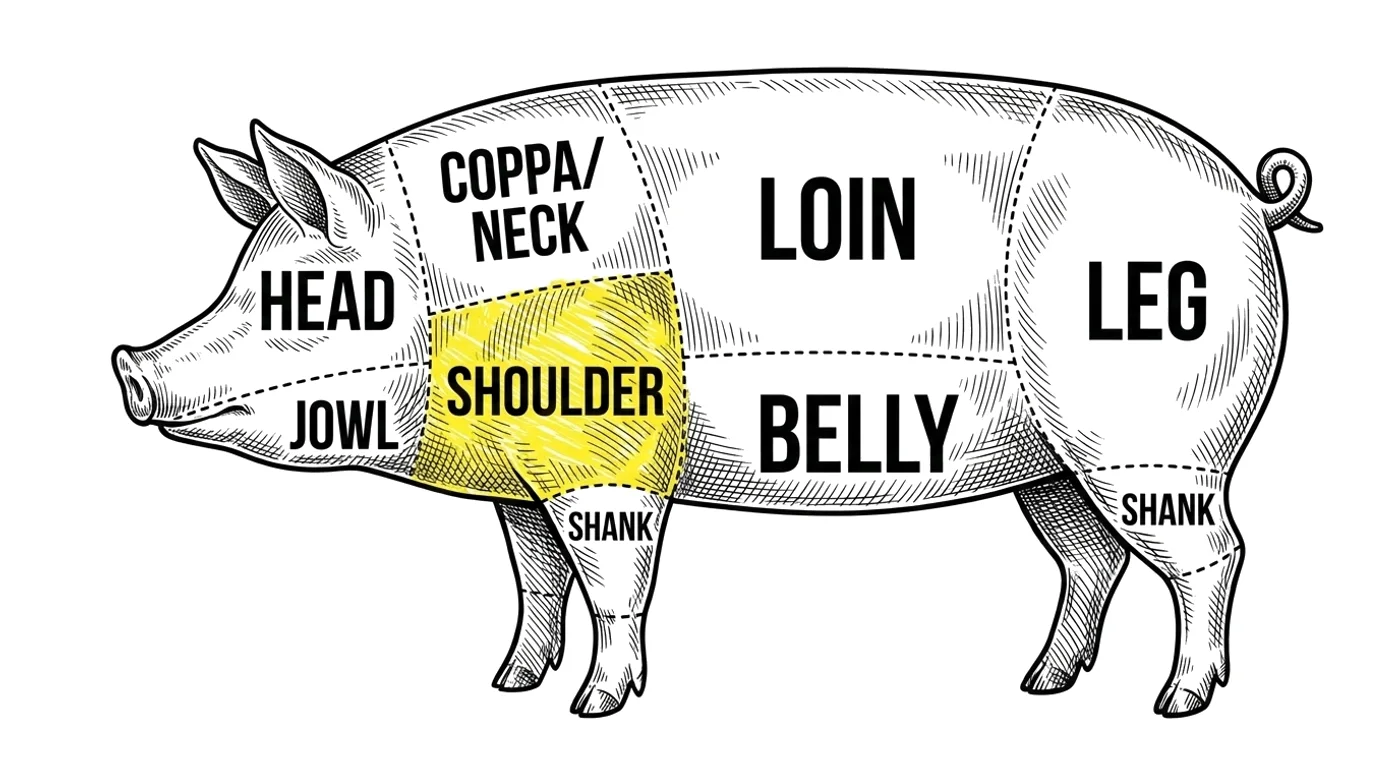
The cut
Identity and boundaries
The pastry enclosure is fundamental. An uncrusted pâté, mould-cooked terrine or ordinary meat pie may use related forcemeats but is not automatically pâté en croûte. Species, garnish, mould shape, pastry style and aspic practice vary by maker. Decorative modern forms and championship entries are examples of the family rather than universal definitions.
Composition and characteristics
The case may be built from a sturdy savoury dough designed to hold its form during baking. Inside, coarse or fine forcemeat can be combined with whole-muscle strips, liver, poultry, game, nuts, mushrooms or other inclusions. A well-made slice has a crisp or firm crust, cohesive filling, deliberate pattern and a controlled aspic layer without sogginess.
Production method
Dough and filling are prepared under temperature control. The lined mould is packed carefully, closed and fitted with chimneys or vents before baking. The centre must reach 74°C without burning the pastry. The product is then cooled rapidly. If aspic is added, it is introduced hygienically after baking and allowed to set under refrigeration.
History and cultural context
Pastry-enclosed forcemeats are old European preservation and presentation forms, but pâté en croûte became a distinct emblem of French charcuterie. Professional curricula treat it as a core fabrication requiring proportion, seasoning, binding and assembly skills. Recent competitions have revived elaborate mosaics while traditional butcher-shop versions remain practical, sliceable retail products.
Culinary use and relationships
Pâté en croûte is served cold in slices as a starter, buffet item or charcuterie-course centrepiece, often with pickles, mustard, salad or fruit condiments. It should link to meat terrine, liver pâté, galantine and English pork pie. Those pages share techniques but retain different structural and cultural identities.
Recipe and cure
This is not a finished recipe. It is a window into how this meat is traditionally cured. Before you follow any process, run it through one of our curing calculators so the salt, cure and timings are right and safe for your own batch.
Make this — the measured Curesmith version →“Make this” opens the same cure as a measured recipe, scaled to your batch.
- Meat
- Pork shoulder
- Cut
- Pork shoulder
- Salt (%)
- 1.75
- Curing salt
- Cure #1/#2 as specified
- Fermented
- No
- Smoked
- No
- Basis
- per 1,000 g pork shoulder
- Style
- Cooked cured pork-and-liver filling in pastry with aspic.
Ingredients
- Pork shoulder100% · 1000 g
- Chicken liver35% · 350 g
- Pork back fat35% · 350 g
- Fine salt1.7% · 29 g
- Cure #1 containing 6.25% sodium nitrite0.25% · 4 g
- Black pepper0.19% · 3.5 g
- Pâté spice0.15% · 2.5 g
- Brandy2.9% · 50 g
- Plain flour49% · 833.5 g
- Butter24.5% · 416.5 g
- Whole egg9.8% · 166.5 g
- Strong stock24.5% · 416.5 g
- Gelatine1.2% · 20 g
Safety. The pastry can insulate a dense filling and hide undercooked seams. Validate the cold-point bake, control the time filling spends warm, introduce aspic hygienically, cool rapidly and refrigerate. The baked crust and set jelly do not establish ambient shelf stability.