
Pinkelwurst
Also known as Pinkel, Oldenburger Pinkel, Bremer Pinkel
Lower Saxony and Bremen, Germany
Overview
Pinkelwurst is a coarse north-west German cooked gruel sausage made from fatty pork, beef suet, oat or barley groats, onion and warm spices. The cereal remains perceptible rather than disappearing into a fine emulsion. It is strongly associated with winter kale meals around Oldenburg, Bremen and Osnabrück and is commonly reheated with the greens rather than served as a cold slicing sausage.
Where it's from
The cut
Identity and terminology
The product is widely shortened to Pinkel. Competing folk explanations link the word to a stuffed casing or bodily language, but the checked official sources do not settle one etymology. Regional qualifiers such as Oldenburger and Bremer describe living variants. They should not be converted into protected-origin claims unless a separate verified legal specification supports that use.
Composition and characteristics
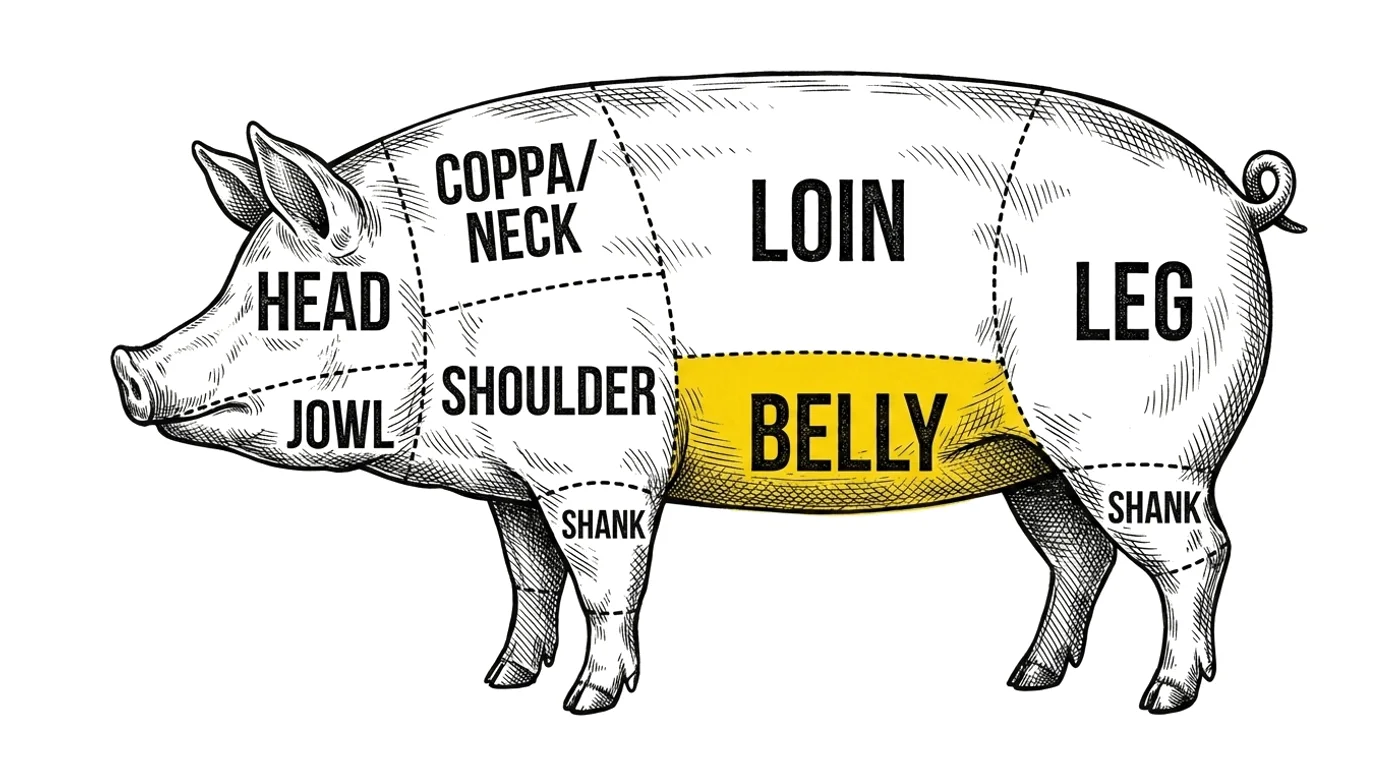
Pork belly and back fat supply richness; firm beef suet adds a distinctive waxier fat character. Steel-cut oats or barley groats absorb cooking liquid and onion flavour while preserving a coarse grain. Pepper and allspice lead, with cinnamon and clove in the background. Lower Saxony's food authority identifies the cereal groats as the practical distinction from Bregenwurst.
Production and process
The groats are hydrated in a measured quantity of hot water and chilled completely. Onion is softened and cooled, while the animal materials are minced coarsely. The mixture is stuffed with expansion room and poached until both the centre and cereal are fully cooked. Rapid cooling follows because the large, moist, cereal-rich link remains a perishable meat product.
History and regional forms
Pinkel belongs to the winter culture of Kohlfahrten, communal excursions that end with kale, potatoes and preserved pork. Bremen publishes a home version of the complete dish, while Oldenburg tourism treats kale with Pinkelwurst as a regional classic. These civic records show cultural continuity without requiring an invented medieval origin or a single canonical spice formula.
Use, storage and related products
Reheat the sausage gently on top of kale and serve it with potatoes, mustard and, where customary, Kasseler or another cooked sausage. The casing is often opened so the soft filling can be spooned out. Oats or barley must be declared as applicable. Pinkelwurst stays refrigerated and should not be mistaken for a dry cereal sausage.
Recipe and cure
This is not a finished recipe. It is a window into how this meat is traditionally cured. Before you follow any process, run it through one of our curing calculators so the salt, cure and timings are right and safe for your own batch.
Make this — the measured Curesmith version →“Make this” opens the same cure as a measured recipe, scaled to your batch.
- Meat
- Pork belly
- Cut
- Pork belly
- Salt (%)
- 2.5
- Curing salt
- None
- Fermented
- No
- Starter or mould
- None; this product is not fermented
- Smoked
- No
- Maturation
- Refrigerate at 0–4°C; use within 4 days or freeze promptly
- Basis
- per 1,000 g pork belly
- Style
- coarse cooked gruel sausage with pork, suet, oats and onion
Ingredients
- Pork belly100% · 1000 g
- Pork back fat35% · 350 g
- Beef kidney suet35% · 350 g
- Steel-cut oats, dry weight43.1% · 733.5 g
- Hot water for controlled oat hydration64.7% · 1100 g
- Onion, finely diced29.4% · 500 g
- Fine salt2.5% · 42.5 g
- Ground black pepper0.59% · 10 g
- Ground allspice0.19% · 3.5 g
- Ground cinnamon0.1% · 1.5 g
- Ground cloves0.1% · 1.5 g
Method
- Pour measured hot water over steel-cut oats, cover for thirty minutes, then spread shallow and chill to 4°C or below.
- Sweat onion gently in a small rendered portion of the pork fat, then chill fully.
- Chill belly and fats to 0–2°C and grind with the cold onion through 5 mm.
- Mix the ground animal material with salt and spices, then fold in the cold hydrated oats.
- Fill the broad casing moderately and form 20 cm links.
- Poach at 78–80°C until the cold point reaches 74°C and the oats are fully tender.
Safety. Control cereal hydration, cool oats and onion before mixing, allow expansion, verify the centre cook and refrigerate promptly.