
Overview
Poličan is a Czech durable salami made for slicing and direct consumption. It belongs to the regulated Czech family of fermented or matured meat products and has a stable national identity rather than being a generic international salami name.
Where it's from
The cut
Identity and terminology
Current Czech meat-product regulation continues to list Poličan as a named product. This confirms that the name carries compositional and sensory expectations. It should not be used as an interchangeable label for Paprikáš, Herkules, Lovecký salám or any salami made near Polička.
Composition and characteristics
The sausage is made from beef and pork with fat, curing ingredients and seasoning according to the applicable Czech framework. The interior is cohesive and evenly grained, with a red cured colour and a matured, slightly acidic and smoky aroma. Exact analytical limits should remain tied to the current decree.
Its identity is supported by a combination of regulated composition, durable-salami manufacture and expected sensory properties. A product that copies only the name or paprika colour but lacks the regulated structure should not be treated as canonical Poličan.
Production and process
Meat and fat are chilled, comminuted and mixed with salt, cure, seasoning and the selected fermentation system. The sausage is stuffed, fermented or conditioned, smoked where required and dried to a validated endpoint. Product identity depends on both the formulation and finished sensory profile.
History and regional forms
Poličan became established within Czech industrial and artisan salami production and was retained through successive national standards. The name may have geographic origins, but current status is regulatory rather than an EU geographical indication. Poličan remains familiar in Czech retail and cold-meat culture. No exact invention date or single original manufacturer is documented. The regulatory identity and present-day use are what can be relied on.
Use, storage and related products
Poličan is sliced for bread, sandwiches and cold platters. Storage follows measured water activity, packaging and manufacturer instructions. Related Czech entries include Herkules, Paprikáš and Lovecký salám, which require separate pages and should not be consolidated.
Recipe and cure
This is not a finished recipe. It is a window into how this meat is traditionally cured. Before you follow any process, run it through one of our curing calculators so the salt, cure and timings are right and safe for your own batch.
Make this — the measured Curesmith version →“Make this” opens the same cure as a measured recipe, scaled to your batch.
- Meat
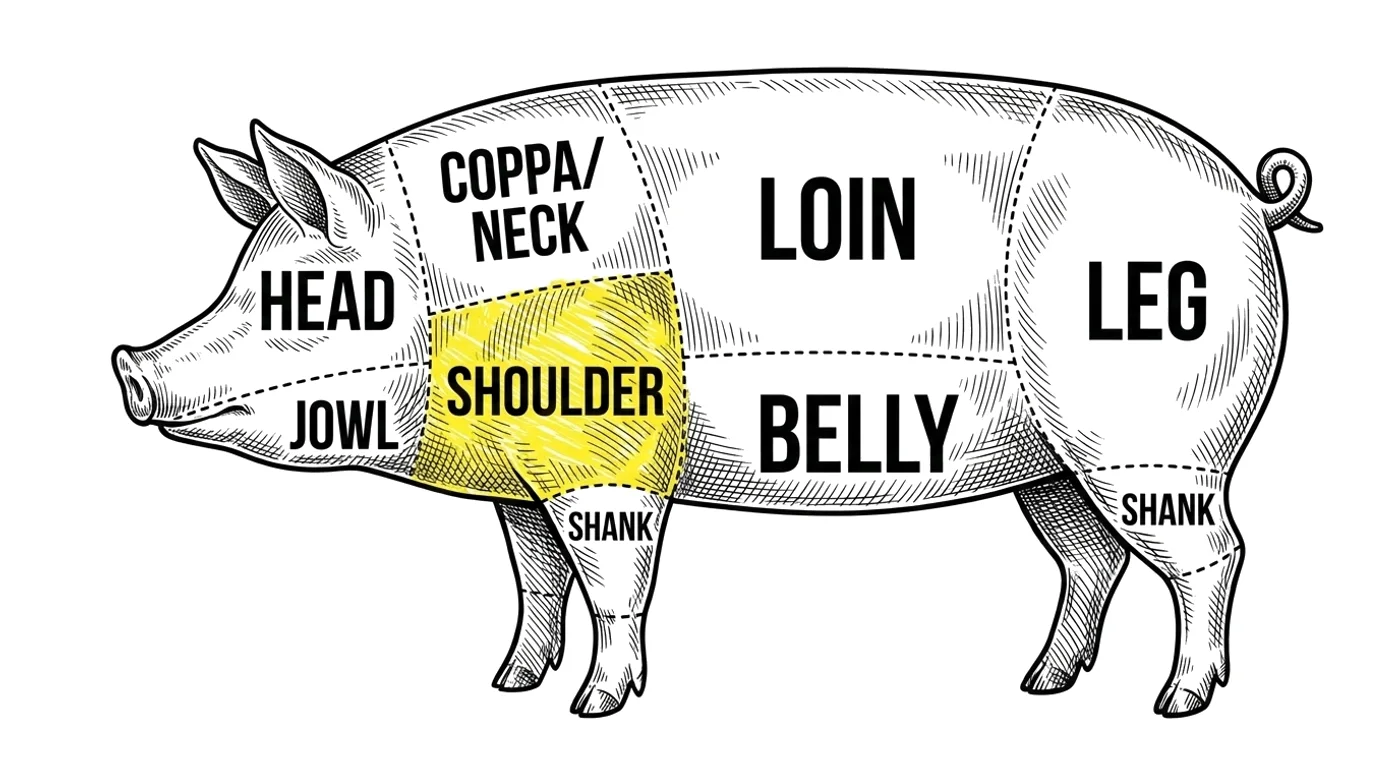
- Pork shoulder
- Cut
- Pork shoulder
- Salt (%)
- 2.5
- Curing salt
- Cure #1/#2 as specified
- Fermented
- Yes
- Target pH
- 5.3 or lower
- Smoked
- Yes
- Basis
- per 1,000 g pork shoulder
- Style
- Czech-style fermented, smoked and dried salami.
Ingredients
- Pork shoulder100% · 1000 g
- Lean beef60% · 600 g
- Pork back fat40% · 400 g
- Fine salt2.5% · 50 g
- Cure #2 containing 6.25% sodium nitrite0.25% · 5 g
- Dextrose0.4% · 8 g
- Black pepper0.3% · 6 g
- Garlic0.3% · 6 g
- Sweet paprika0.15% · 3 g
- Flora Italia LC or equivalent starter culture0.03% · 0.5 g
Safety. The Czech regulated name does not by itself validate a process. Production requires correct cure, controlled fermentation or acidification, measured drying and a final release endpoint. The identity should not be extended to unrelated paprika or hunter-style salamis.