
Polish Mortadela
Also known as Mortadela polska, Mortadela cielęca, Polish mortadella
Poland
Overview
Polish Mortadela is a broad cooked sausage with a fine cured matrix, produced in pork-and-beef and veal-dominant forms. The ordinary version often shows small white cubes of firm pork fat, while mortadela cielęca is usually emulsified to a more uniform pale-pink paste without a deliberate fat mosaic. Both are moist refrigerated sausages intended for slicing, sandwiches and simple hot preparations rather than long maturation.
Where it's from
The cut
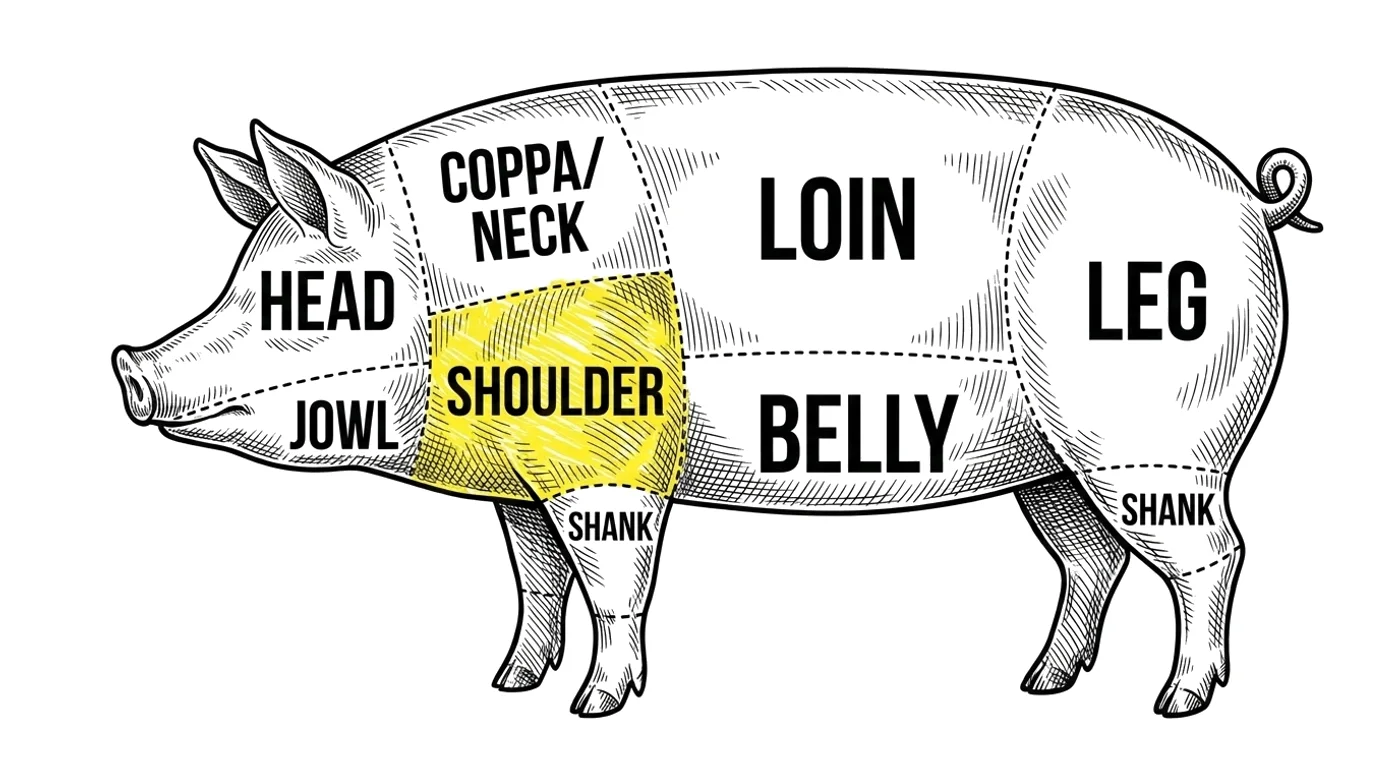
Identity and terminology
Polish spelling normally uses one final l: mortadela. The borrowed name signals the historical spread of the mortadella idea beyond Italy, but it does not make the Polish product Mortadella Bologna PGI. Polish state trade documents from the early 1960s list mortadela and mortadela cielęca among recognised sausage assortments and classify them with non-durable cooked sausages. That documentary record supports a Polish technical identity without implying a protected geographical name.
Composition and characteristics
The pork-and-beef form combines fine-cut lean meat with fat or jowl and may carry visible back-fat cubes. White pepper, nutmeg, sugar and whole white mustard seed give a mild, slightly aromatic profile. The veal form replaces the mixed base with veal and fatty pork tissue, using ice to achieve a homogeneous emulsion. A correct slice is smooth, elastic but not rubbery, evenly pink and free from greasy cavities or separated water.
Production and process
Chilled meat is ground finely and emulsified with salt, nitrite cure, seasonings and ice. For the mosaic form, clean fat cubes are folded in after the paste is stable; the veal form keeps all fat finely dispersed. The batter is filled into a broad fibrous or cellulose casing, smoked where the branch requires it, cooked below boiling and rapidly chilled. Mustard seed must be declared even when it appears only as small pale flecks.
History and regional forms
The Polish records place mortadela inside the standardised meat-industry assortment of the post-war period. They do not establish a single inventor or town of origin, and the modern official protected-food registers do not confer a PDO, PGI or TSG on the name. Its significance lies instead in adaptation: a European fine cooked sausage became a familiar Polish lunch meat, sold in economical pork versions and more delicate veal-labelled variants.
Use, storage and related products
Serve cold in sandwiches, with pickles, mustard or tomato, or cut into thicker slices, dipped in egg and crumbs and fried. Keep it refrigerated and minimise time at room temperature after slicing. The family is related to Polish bologna-style sausages but remains distinct from Spanish Mortadela Bolonia, German Norddeutsche Mortadella and the protected Italian products. The veal branch should remain attached as a recipe variant, not a duplicate article.
Recipe and cure
This is not a finished recipe. It is a window into how this meat is traditionally cured. Before you follow any process, run it through one of our curing calculators so the salt, cure and timings are right and safe for your own batch.
Make this — the measured Curesmith version →“Make this” opens the same cure as a measured recipe, scaled to your batch.
- Meat
- Pork shoulder
- Cut
- Pork shoulder
- Salt (%)
- 1.8
- Curing salt
- Cure #1 as specified in the recipe
- Fermented
- No
- Starter or mould
- None; this product is not fermented
- Smoked
- Yes
- Maturation
- Refrigerate at 0–4°C; use within 4 days or freeze promptly
- Basis
- per 1,000 g pork shoulder
- Style
- Polish cooked-smoked fine sausage with visible back-fat cubes
Ingredients
- Pork shoulder100% · 1000 g
- Beef chuck40% · 400 g
- Pork back fat25% · 250 g
- Crushed ice15.2% · 250 g
- Fine salt1.8% · 30 g
- Cure #1, 6.25% sodium nitrite0.24% · 4 g
- Ground white pepper0.2% · 3.5 g
- Ground nutmeg0.1% · 1.5 g
- Whole white mustard seed0.1% · 1.5 g
- Sugar0.2% · 3.5 g
Method
- Part-freeze the back fat, cut 6 mm cubes and refrigerate; chill lean meats and equipment to 0–2°C.
- Grind pork and beef through 3 mm and rechill.
- Fine-cut lean meats with salt, Cure #1, sugar, pepper, nutmeg and crushed ice until smooth and tacky.
- Fold in back-fat cubes and mustard seed evenly.
- Fill the broad casing without air and refrigerate 8–12 hours.
- Dry the casing under controlled conditions, apply hot smoke for flavour, then poach at 78–80°C until the cold point reaches 71°C.
Safety. Use an accurately measured cure, keep the fine batter cold, declare mustard, cook the broad chub to a verified centre temperature, chill quickly and refrigerate.