
Polony
Also known as British polony, South African polony, Polonie
United Kingdom
Overview
Polony is a large-diameter cooked sausage with a fine, cohesive texture, commonly sliced as a cold cut. The British source branch uses pork shoulder, connective pork, lean beef and beef suet, seasons the batter with white pepper, allspice, sage and garlic, and applies smoke before cooking. In South Africa the name identifies a major ready-to-eat processed-meat category with its own regulatory and cultural importance.
Where it's from
The cut
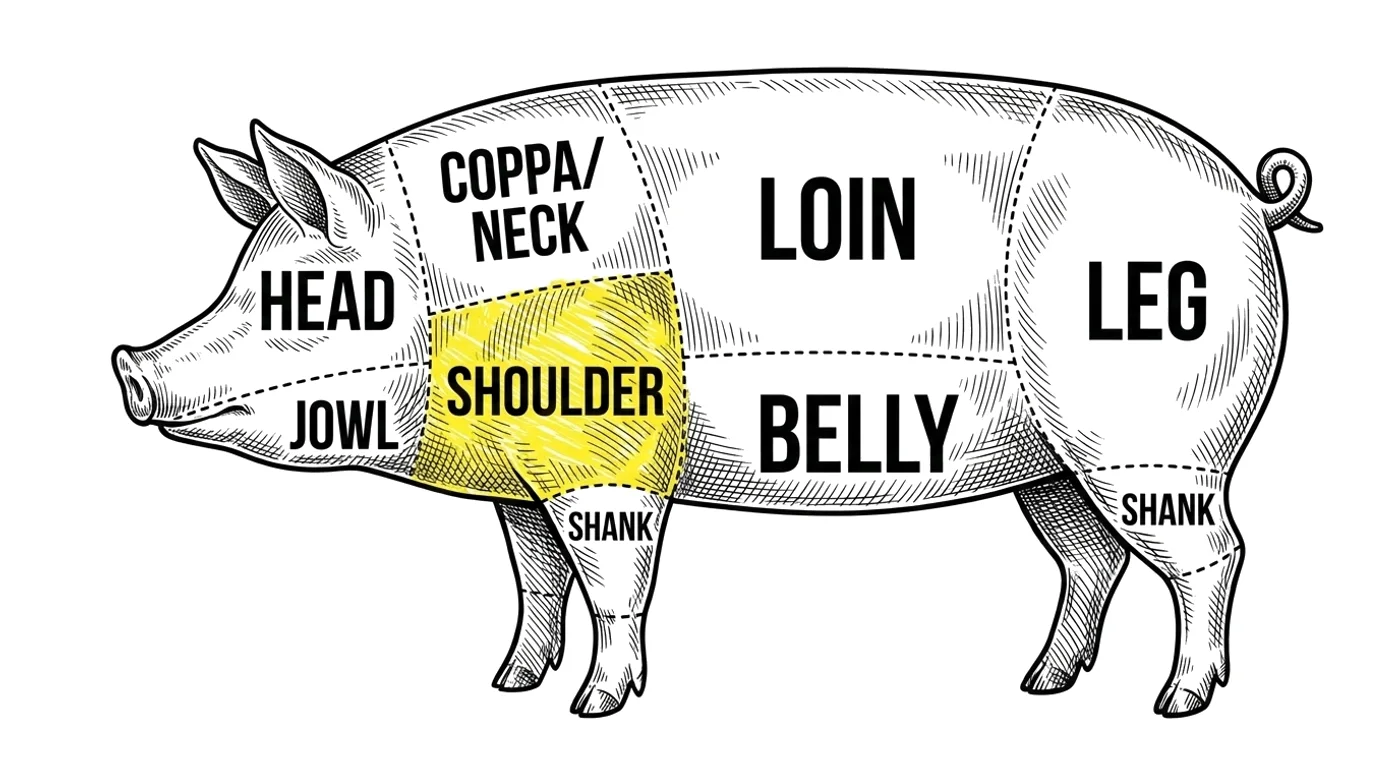
Identity and terminology
The name is often linked linguistically to Bologna, though similarity of sound does not make polony equivalent to Mortadella Bologna PGI or American bologna. British food law has long treated polony as a sausage description, while South African regulations specify product-class requirements. Polony is its own identity with distinct national forms, not a general term for every broad emulsified sausage.
Composition and characteristics
A typical polony has a cylindrical chub, a pink to pink-grey fine cut and a firm but yielding slice. The British branch's beef suet gives a distinctive dense richness compared with pork-back-fat bologna. Smoke may be present or absent by style. Commercial South African formulations and permitted ingredients are governed separately and should not be inferred from this home recipe, which uses an explicit pork-and-beef animal block and no colour additive.
Production and process
Cold meats and fat are ground by function, then the binding fractions are fine-cut with ice, salt, cure and seasoning. The remaining meat and suet are incorporated without overheating the batter. A broad casing demands careful air removal and cold-point probing. Smoking occurs before the final cook. Rapid two-stage chilling is crucial because a large chub cools slowly, and slicing later creates a ready-to-eat surface vulnerable to contamination.
History and regional forms
Polony has a long British documentary presence and became especially embedded in southern African everyday food, where it is used in sandwiches, lunch boxes and cooked dishes. Its public-health significance is equally important: South Africa's 2017–2018 listeriosis outbreak was linked to ready-to-eat processed meat including polony. That history belongs in the identity article because it explains why environmental hygiene, cold chain and post-cook handling are not optional details.
Use, storage and related products
Slice polony cold for sandwiches, cube it for salads or fry thicker pieces, depending on regional practice. Keep the intact chub and all opened slices refrigerated, use clean equipment and avoid extended room-temperature display. Pregnant people, older adults and immunocompromised consumers should follow current local advice for ready-to-eat meats. A home British-style branch is not represented as compliant commercial South African polony.
Recipe and cure
This is not a finished recipe. It is a window into how this meat is traditionally cured. Before you follow any process, run it through one of our curing calculators so the salt, cure and timings are right and safe for your own batch.
Make this — the measured Curesmith version →“Make this” opens the same cure as a measured recipe, scaled to your batch.
- Meat
- Pork shoulder
- Cut
- Pork shoulder
- Salt (%)
- 1.8
- Curing salt
- Cure #1 as specified in the recipe
- Fermented
- No
- Starter or mould
- None; this product is not fermented
- Smoked
- Yes
- Maturation
- Refrigerate at 0–4°C; use within 4 days or freeze promptly
- Basis
- per 1,000 g pork shoulder
- Style
- large smoked fine-textured British-style polony chub
Ingredients
- Pork shoulder100% · 1000 g
- Pork shank15% · 150 g
- Beef chuck15% · 150 g
- Beef kidney suet35% · 350 g
- Crushed ice6.1% · 100 g
- Fine salt1.8% · 30 g
- Cure #1, 6.25% sodium nitrite0.24% · 4 g
- Ground white pepper0.2% · 3.5 g
- Ground allspice0.05% · 0.8 g
- Ground sage0.1% · 0.8 g
- Fresh garlic, crushed0.35% · 6 g
Method
- Trim, weigh and chill all animal materials and equipment to 0–2°C.
- Grind shoulder and suet through 6 mm; grind beef and shank trim through 3 mm.
- Fine-cut beef and shank trim with ice, salt, Cure #1 and spices; add shoulder and suet gradually and stop below 10°C.
- Stuff firmly into 90–100 mm heat-stable fibrous casing, remove air pockets and refrigerate 8–12 hours.
- Dry the broad casing and apply moderate warm smoke for up to two hours.
- Poach, steam or finish in the smokehouse until the cold point reaches 72°C.
Safety. Probe the broad centre, chill rapidly, prevent post-cook contamination, refrigerate opened slices and treat the product as a Listeria-sensitive ready-to-eat meat.