
Polska Kiełbasa Wędzona
Also known as Polish Hot Smoked Sausage, Polska kiełbasa wędzona, Polish smoked sausage
Poland
Overview
Polska Kiełbasa Wędzona is used in the Atlas for the familiar hot-smoked Polish pork-sausage pattern: a medium natural casing, a moderately coarse cut, garlic and black pepper, optional marjoram, a cured pink interior and a brown smoke-developed surface. It is a useful family identity for a straightforward formula, but it is not Poland's single canonical sausage and should never displace the country's many named regional and technical products.
Where it's from
The cut
Identity and terminology
Kiełbasa means sausage and wędzona means smoked. Polska simply identifies the broad national style. Outside Poland, Polish sausage or Polska kielbasa is often used as a marketing umbrella for any garlic-forward ring, sometimes with little regard to composition. Curesmith keeps this descriptive family separate from protected Kabanosy Staropolskie, Kiełbasa Myśliwska Staropolska, Kiełbasa Lisiecka and other products whose names carry specific legal or historical boundaries.
Composition and characteristics
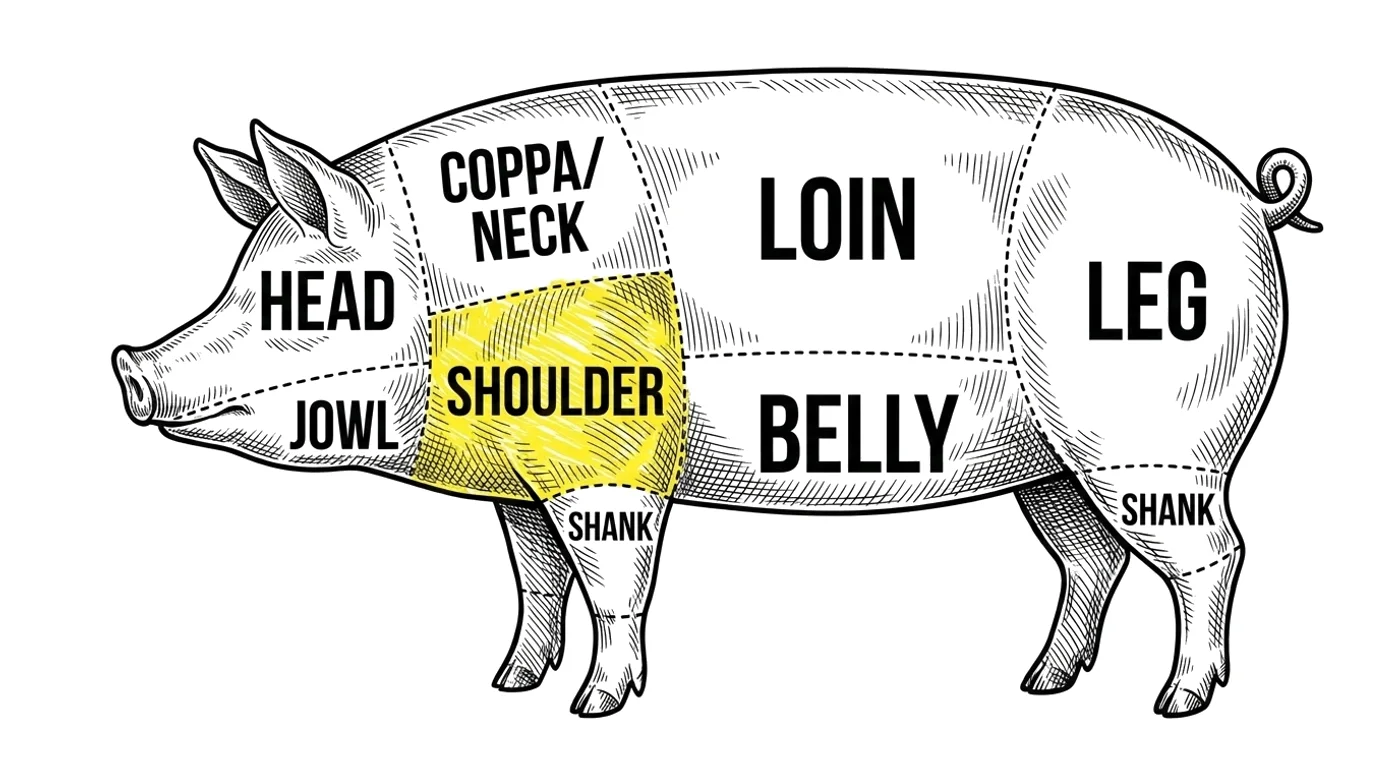
The home branch uses pork shoulder divided into leaner and fattier portions. Coarser lean particles provide bite, smaller fatty particles distribute succulence, and mixing with ice develops enough protein bind to hold the link together. Garlic and pepper are essential signals; marjoram is customary but not universal. The casing should be taut and evenly browned, while the slice remains moist, cohesive and visibly ground rather than emulsified.
Production and process
Cold pork is ground by class, mixed with salt and curing salt until tacky, stuffed into hog casings and cured under refrigeration. Surface drying prepares the casing to accept smoke cleanly. Hot smoke builds colour and aroma before a final controlled heat treatment. Because smokehouse temperatures and link diameters vary, a calibrated centre reading determines completion, followed by rapid chilling and refrigerated storage.
History and regional forms
Smoking has long been central to Polish domestic and commercial meat preservation, but the phrase Polish smoked sausage covers many processes. Historical standards distinguished sausages by raw-material class, particle size, heat treatment and durability. Modern ministry registers add local products with their own narratives. This is a practical family article. One simplified pork recipe does not exhaust the Polish sausage tradition.
Use, storage and related products
Eat the sausage cold, simmer it gently, brown it in a pan or serve it with bread, mustard, horseradish, sauerkraut, beans or potatoes. Avoid hard boiling, which can split the casing and expel fat. The product remains perishable after smoking and cooking. It must not be marketed as a protected regional sausage unless the relevant specification and certification requirements are actually met.
Recipe and cure
This is not a finished recipe. It is a window into how this meat is traditionally cured. Before you follow any process, run it through one of our curing calculators so the salt, cure and timings are right and safe for your own batch.
Make this — the measured Curesmith version →“Make this” opens the same cure as a measured recipe, scaled to your batch.
- Meat
- Pork shoulder, lean and medium-fat portions separated
- Cut
- Pork shoulder, lean and medium-fat portions separated
- Salt (%)
- 1.8
- Curing salt
- Cure #1 as specified in the recipe
- Fermented
- No
- Starter or mould
- None; this product is not fermented
- Smoked
- Yes
- Maturation
- Refrigerate at 0–4°C; use within 4 days or freeze promptly
- Basis
- per 1,000 g pork shoulder, lean and medium-fat portions separated
- Style
- descriptive Polish hot-smoked pork sausage
Ingredients
- Pork shoulder, lean and medium-fat portions separated100% · 1000 g
- Crushed ice10% · 100 g
- Fine salt1.8% · 18 g
- Cure #1, 6.25% sodium nitrite0.25% · 2.5 g
- Ground black pepper0.2% · 2 g
- Dried marjoram0.1% · 1 g
- Fresh garlic, crushed0.35% · 3.5 g
Method
- Trim, weigh and chill all animal materials and equipment to 0–2°C.
- Separate lean and fattier shoulder portions; grind the lean through 10 mm and the fattier portion through 5 mm.
- Mix pork with salt, Cure #1, pepper, marjoram, garlic and ice until tacky.
- Stuff firmly into 32–36 mm hog casing, remove air pockets and refrigerate 8–12 hours.
- Surface-dry, apply clean hot smoke, then raise the chamber gradually for an even brown casing.
- Poach, steam or finish in the smokehouse until the cold point reaches 71°C.
Safety. Calculate cure on the pork block, dry the casing before smoke, cook to a verified cold point, chill quickly and refrigerate.