
Overview
Pormonier is a regional Savoyard sausage associated with the Beaufortain and Tarentaise valleys. It combines pork, fat and vegetables, traditionally with lung or other edible offal. The result is coarse, moist and mottled, with green, brown, grey and pink tones rather than a uniform cured appearance.
Where it's from
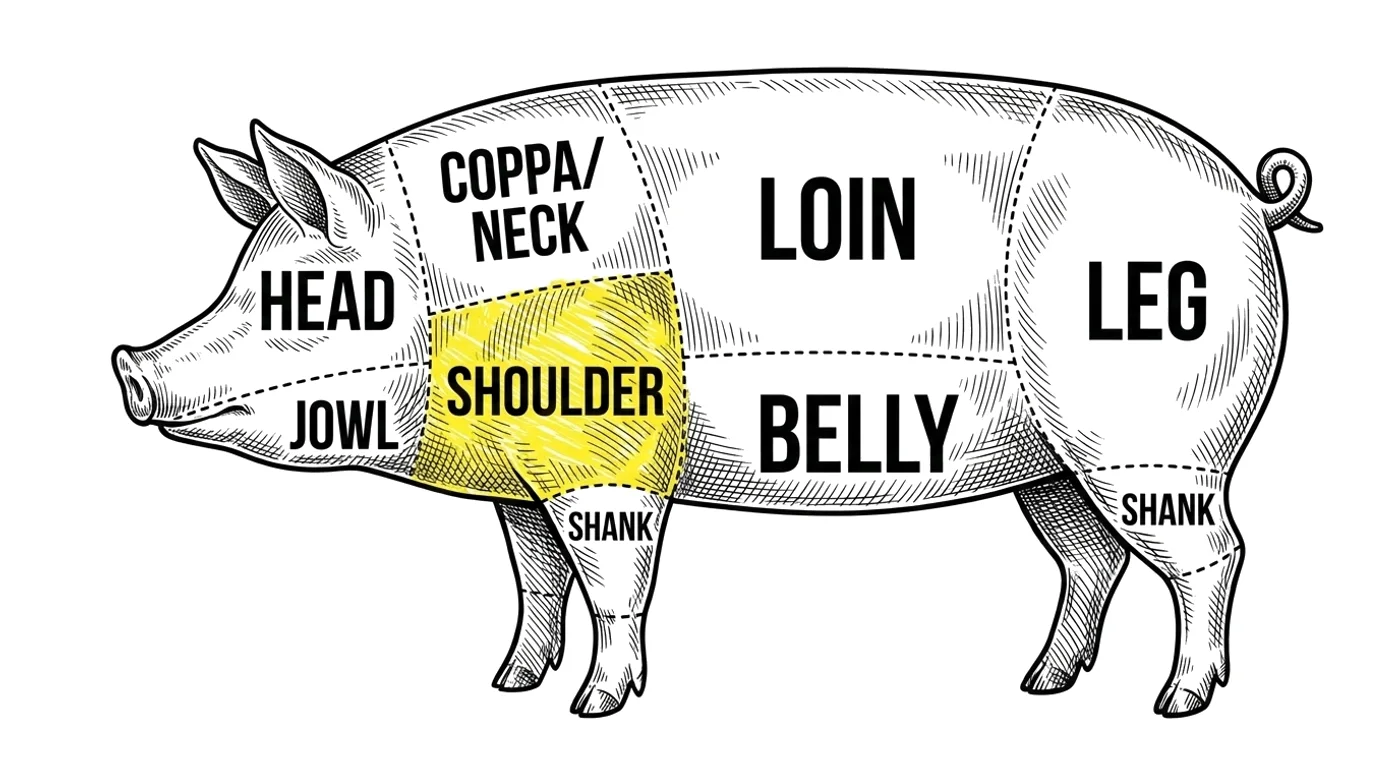
The cut
Identity and boundaries
The name is linked to pormon, a local word for lung, but household recipes vary substantially. Chard, cabbage, leek, spinach, garlic and other garden vegetables may appear in different proportions. A lung-free modern version can be valid as an adaptation, but should not erase the traditional offal branch. The proportion and choice of greens are part of the regional variation, so no single household mixture is the canonical one.
Composition and characteristics
Heritage descriptions record pork meat, lard, lung and mixed greens, while later commercial forms may use head meat, heart, liver, rind and firm fat. The sausage is generally thick and oblong with a coarse grain. Vegetable moisture gives a softer texture than a conventional meat-only sausage.
Production and cooking
Prepared pork, edible offal and vegetables are chopped, seasoned and stuffed into casings. Some vegetables are blanched or precooked to control texture and moisture. The product is sold fresh or cooked and is commonly simmered gently or grilled. It is not a fermented or shelf-stable sausage by default. Because vegetables contribute water and structure, preparation and cooking must account for their condition instead of treating them as dry seasoning.
History and context
Pormonier emerged from mountain household economy, using the pig comprehensively and incorporating vegetables remaining in the garden. The official Savoyard heritage study records both stable regional identity and striking family variation, making diversity part of the tradition rather than evidence of a defective recipe.
Culinary use and relationships
It is served with steamed potatoes, purée, polenta, crozets or in a potée. Pormonier relates to vegetable sausages and offal-rich farmhouse products but remains distinct from boudin, diot and generic herb sausage. Its regional name should stay tied to Savoyard context. Commercial versions should identify material departures, particularly the omission of lung or the substitution of a markedly different offal and vegetable balance.
Recipe and cure
This is not a finished recipe. It is a window into how this meat is traditionally cured. Before you follow any process, run it through one of our curing calculators so the salt, cure and timings are right and safe for your own batch.
Make this — the measured Curesmith version →“Make this” opens the same cure as a measured recipe, scaled to your batch.
- Meat
- Pork shoulder
- Cut
- Pork shoulder
- Curing salt
- None
- Fermented
- No
- Smoked
- No
- Basis
- 1,000 g prepared filling
- Style
- Cooked pork, leek and leafy-green regional branch.
Ingredients
- Pork shoulder100% · 1000 g
- Pork jowl50% · 500 g
- Blanched spinach or chard, well squeezed62.5% · 625 g
- Cooked leek and onion17.6% · 375 g
- Fine salt2.1% · 45 g
- Black pepper0.35% · 7.5 g
- Ground nutmeg0.06% · 1.5 g
- Garlic0.24% · 5 g
Safety. Pormonier contains pork, vegetables and often edible offal. All offal must come from inspected food animals, the sausage must be cooked through using a validated process, and cooked product must be cooled rapidly and refrigerated. Lung-free adaptations must be labelled as variants.