
Prosciutto di Sauris
Sauris (Udine), Friuli-Venezia Giulia, Italy
Delicately smoky and sweet, an Alpine ham with a quiet whisper of beechwood over a tender, rosy lean.
Overview
Prosciutto di Sauris is a sweet mountain ham with a delicate beech-smoke note. It comes from an isolated Alpine community whose food combines northern smoking with the salt-curing tradition of Italy. Garlic and pepper appear in the protected process, but smoke remains gentle rather than dominant.
Where it's from
Climate. Sauris high in the Carnia mountains of Friuli, where a light smoke joins the cure.
Altitude. Carnic Alps, high
The cut
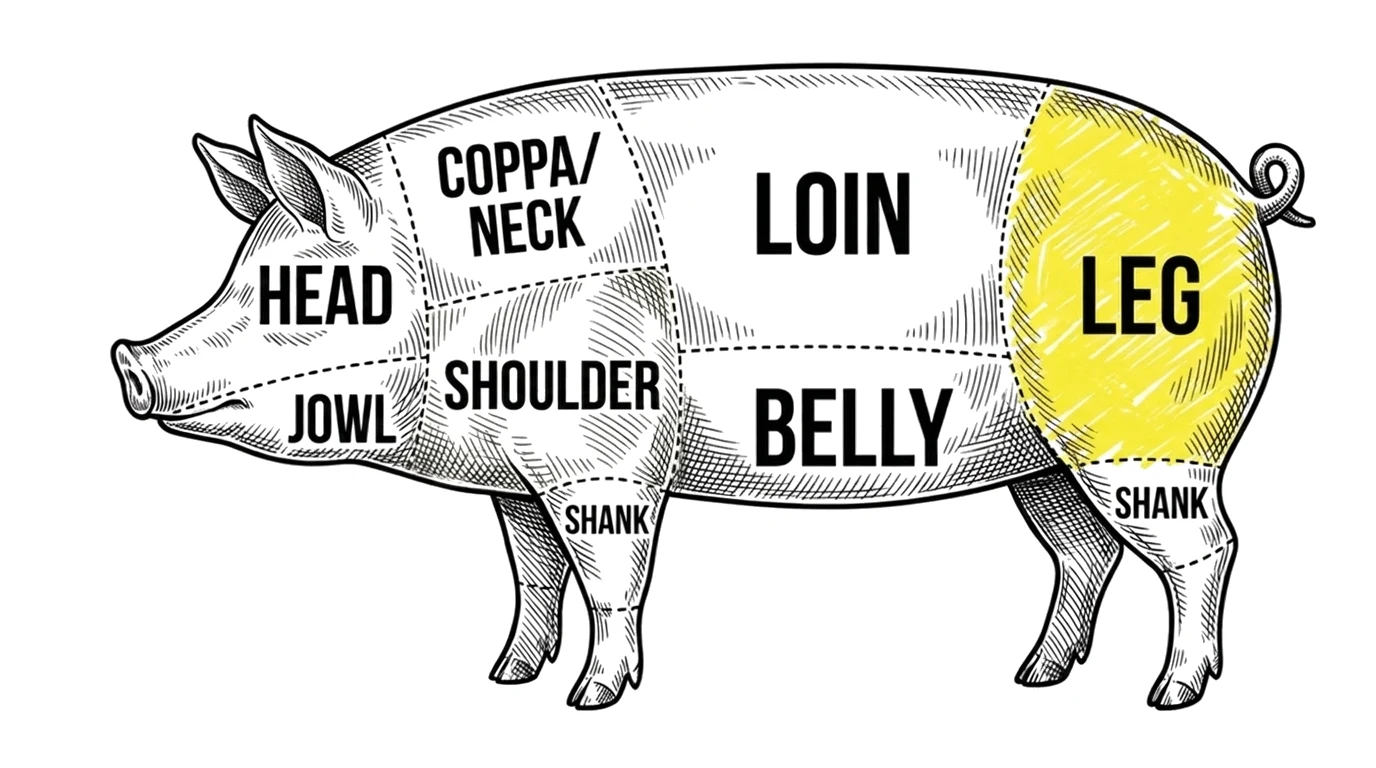
How to recognise it
The whole ham has an amber-brown exterior from smoke, while the slice is uniform pink-red with white to pinkish fat. The aroma is sweet, lightly garlicky and clearly but gently smoky. Texture should be soft and compact. Tar, bitterness, black soot, rancid fat or a hard outer shell are defects.
- Shape and size
- Whole leg, faint amber smoke colour
- Lean colour
- Rosy red
- Fat and marbling
- White
- Casing
- None
- Surface bloom
- None
Origins and history
Sauris is a high, historically isolated settlement reached through difficult Alpine routes. Its inhabitants preserved meat with techniques shaped by both Germanic and Italian cultural influence. Salted pork legs were exposed to beech smoke, then left to mature in the cool mountain air. This combination helped families keep meat through long winters and created a product unlike the unsmoked hams of the Po plain. Roads and tourism eventually connected the village with wider markets, but the small place retained its linguistic and culinary distinctiveness. Prosciutto di Sauris received PGI protection in 2009. The protected narrative is often summarised as Nordic smoking meeting Latin salting, a useful description of the product's position between cultures.
Name. Prosciutto, 'thoroughly dried'; Sauris (Zahre in the local dialect) names the village.
- Production today
- A small number of Sauris producers.
- Protection
- IGP; light beech cold-smoke.
- Tradition vs modern
- The gentle smoke is the mountain signature.
- Seasonality
- Year-round.
Compare with. Speck Alto Adige
Serving and cultural significance
Slice thinly and serve with cumin or poppy-seed bread, cheese, dried fruit, pepper preserves or mountain beer. It can flavour potatoes, dumplings and eggs, but should be added briefly or near the end. Strong cooking easily overwhelms the delicate beech smoke and sweet pork.
Recipe and cure
This is not a finished recipe. It is a window into how this meat is traditionally cured. Before you follow any process, please run it through one of our curing calculators, so the salt, cure and timings are right and safe for your own batch.
Curesmith home adaptation — not designation-compliant
Make this — the measured Curesmith version →The cure below is the traditional reference. “Make this” opens the measured Curesmith home recipe, scaled to your batch.
Traditional or protected production
PGI production uses fresh legs from permitted Italian pig breeds. The hams are salted with pepper and garlic, lightly smoked over beech and matured in Sauris for the required minimum period, at least about ten months. The protected product relies on village production, mountain air and restrained smoke rather than heavy hot smoking.
Sea salt, salt-box method; no fixed percentage.
- Meat
- pork
- Salt (%)
- traditional, no fixed %
- Curing salt
- Sea salt, lightly cold-smoked over beech
- Fermented
- No
- Smoked
- Yes
- Target aW or weight loss
- ~28 to 30% weight loss
- Temperature (°C)
- cold salting, then 12 to 15
- Humidity (%)
- 70 to 80
- Maturation
- 12 to 18 months and up
- Basis
- percentage of green meat weight
- Style
- Traditional dry salting (salt-box), lightly smoked
Method
- Salt the leg by feel in the traditional method and rest cold so the salt draws through.
- Wash off the surface salt and begin the slow dry.
- Seal the exposed face with sugna once a crust forms.
- Age to the target weight loss, judging by weight and aroma.
Notes
- The official protected specification controls the named product. Any Curesmith EQ, starter-culture, curing-salt or home-scale adaptation is a separate method and must not be presented as designation-compliant.
- A more efficient way of curing this product is using the EQ Method. No more than 2.5% salt to meat weight is required. To follow the EQ method, please use our whole-muscle EQ curing calculator to work out proper ratios and curing times.
In the Codex
What this product teaches, and where to read more.
Temple. Roof, Microclimate