
Overview
Regensburger is a Bavarian cooked sausage made from beef, pork and bacon in a fine cured matrix with small visible pieces. It is usually short, thick and slightly curved or ring-shaped, with a smoked aroma and firm bite.
Where it's from
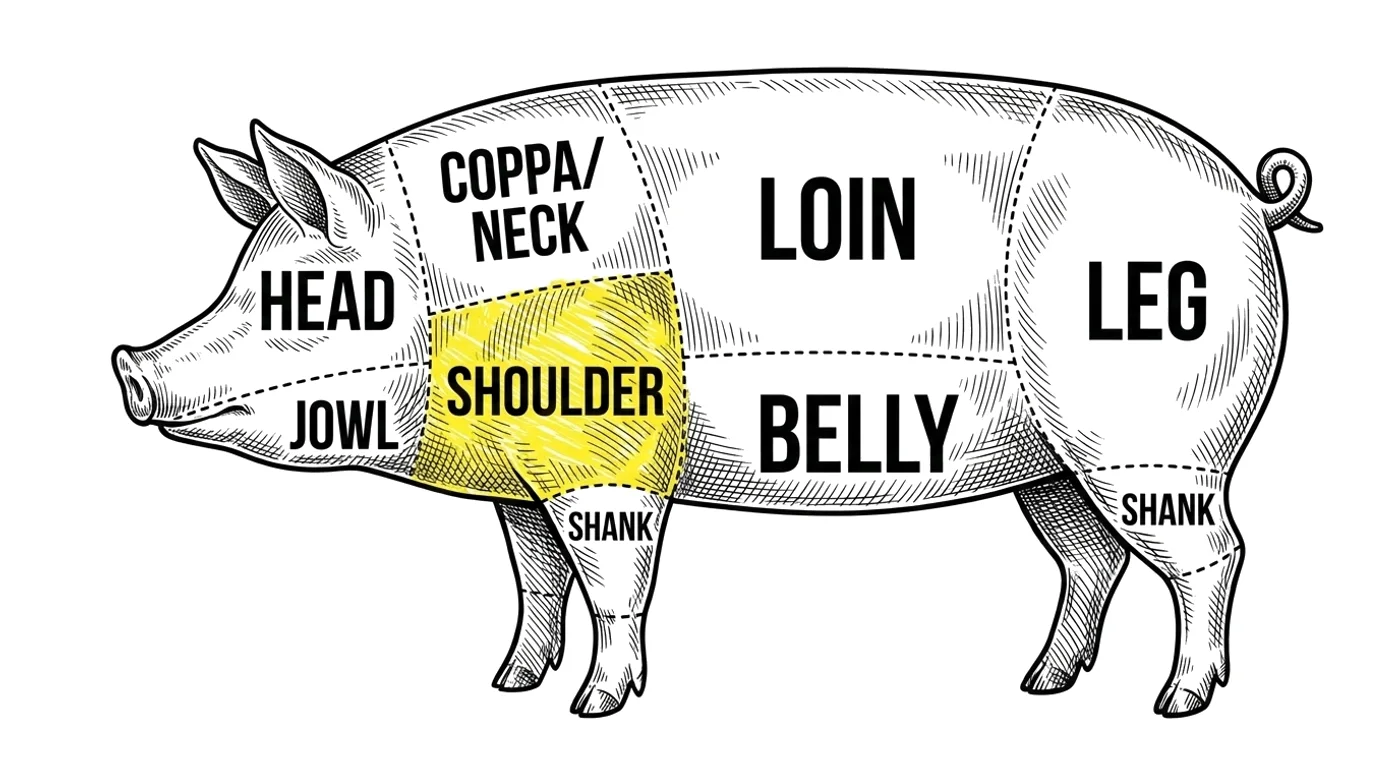
The cut
Identity and terminology
The German Food Book places Regensburger in a cured cooked-sausage group and records its fine matrix and small inclusions. The name refers specifically to the Regensburg tradition. It may be compared with Knackwurst or other compact smoked sausages, but these are not automatic aliases. Regensburger Knacker is another name encountered in trade and local usage, but any alias should be tied to a reliable regional source. The sausage's compact form and cooked-smoked process distinguish it from raw regional sausages with similar names.
Composition and characteristics
The batter commonly combines beef, pork and bacon with curing salt and mild spices. The main matrix is fine, while inclusions remain small, generally no larger than pea size. The finished slice is pink, cohesive and moderately firm.
Production and process
Chilled meat and fat are comminuted into a fine batter, mixed with small prepared inclusions and stuffed into compact casings. The sausage is smoked where the style requires and cooked until the centre reaches 71°C. It is then cooled rapidly and refrigerated.
History and regional forms
Regensburg has a long sausage-making tradition, and the Regensburger form became part of Bavarian cooked-sausage culture. Local service traditions include sliced sausage salads and simple hot snacks. Commercial production has spread beyond the city while retaining the regional name. Local food culture treats the sausage as both a butcher product and a prepared-food ingredient. The Regensburger Wurstsalat tradition, in which the sausage is sliced and dressed, reinforces its identity as a firm cooked sausage rather than a soft emulsified frankfurter.
Use, storage and related products
Regensburger may be heated, grilled lightly or eaten cold. It is used in Wurstsalat, served with mustard and bread or included in Bavarian snacks. It remains refrigerated. Related products include Knackwurst and Bierwurst, but the regional name and texture should remain distinct.
Recipe and cure
This is not a finished recipe. It is a window into how this meat is traditionally cured. Before you follow any process, run it through one of our curing calculators so the salt, cure and timings are right and safe for your own batch.
Make this — the measured Curesmith version →“Make this” opens the same cure as a measured recipe, scaled to your batch.
- Meat
- Pork shoulder
- Cut
- Pork shoulder
- Salt (%)
- 1.75
- Curing salt
- Cure #1/#2 as specified
- Fermented
- No
- Smoked
- Yes
- Basis
- per 1,000 g pork shoulder
- Style
- Representative lightly smoked Bavarian cooked-sausage branch.
Ingredients
- Pork shoulder100% · 1000 g
- Lean beef or veal40% · 400 g
- Pork back fat25% · 250 g
- Fine salt1.8% · 29 g
- Cure #1 containing 6.25% sodium nitrite0.24% · 4 g
- White pepper0.2% · 3.5 g
- Ground mace0.07% · 1 g
- Ground ginger0.05% · 0.8 g
- Garlic0.15% · 2.5 g
- Crushed ice12.1% · 200 g
Safety. Regensburger is a cooked and refrigerated sausage. The product requires cold batter control, validated lethality, rapid cooling and accurate storage. It should not be treated as a synonym for every Knockwurst or Knackwurst.