
Overview
Rohe Knoblauchwurst is a German and Austrian raw garlic-sausage family. It is normally sliceable, cured and matured, with garlic as a defining flavour rather than the sole basis of identity. National formulations differ, so there are branches rather than one universal recipe.
Where it's from
The cut
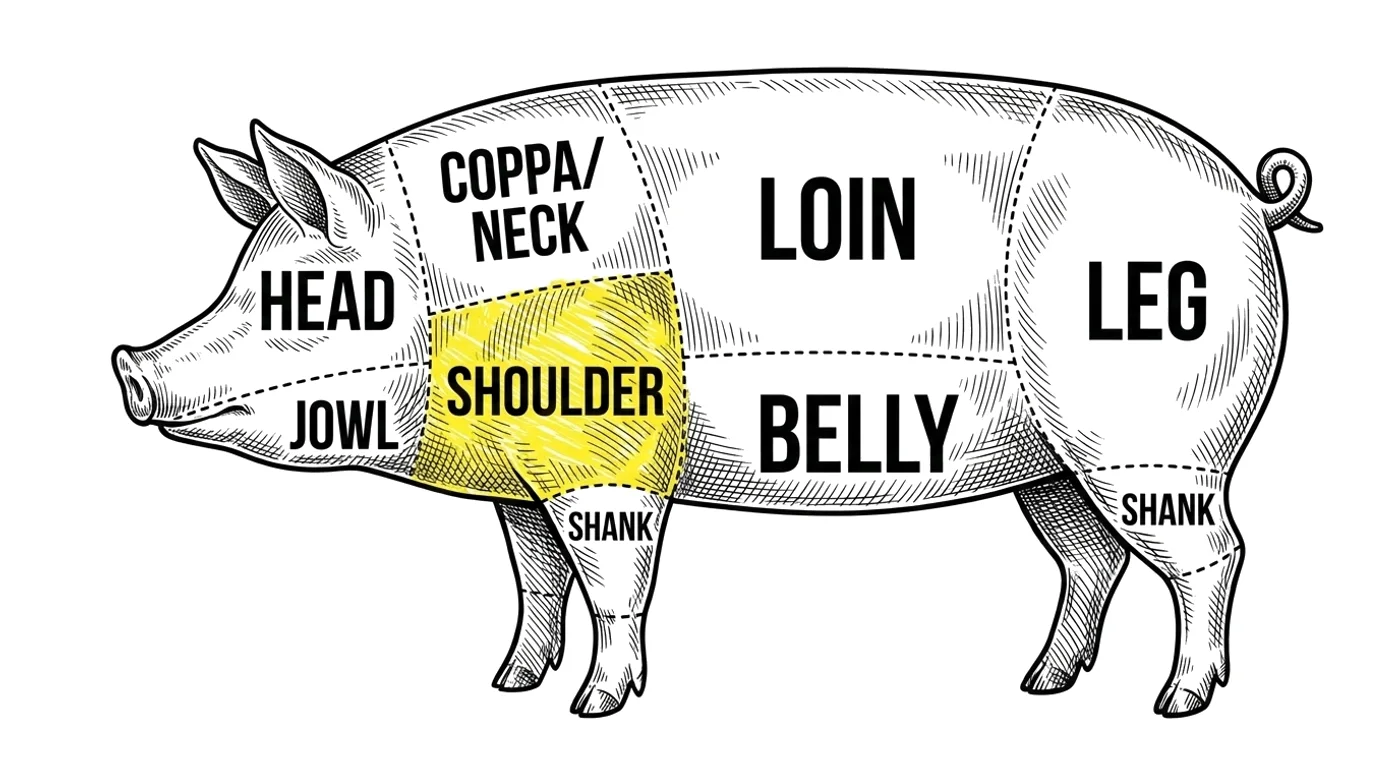
Identity and boundaries
The adjective rohe distinguishes this family from cooked or scalded Knoblauchwurst. Garlic appears in many sausages, but a garlic note does not convert salami, mettwurst or cooked sausage into Rohe Knoblauchwurst. The national standard, meat class and preservation route must be stated. Garlic here is a characteristic of a defined raw sausage, not a category covering every garlic-flavoured link.
Composition and characteristics
German guidance places the product among medium- to fine-grained raw sausages using beef, fatty pork and fat. Austrian rules place raw garlic sausage with sliceable raw sausage classes and specify casing and drying expectations. The finished sausage should be cohesive, aromatic and clearly garlic-led without harsh raw-garlic bitterness.
Production and maturation
The process begins with chilled meat and fat, complete-batch cure and controlled grinding. Garlic, spices and culture are distributed evenly before stuffing. Fermentation or maturation, cold smoking where traditional, and gradual drying develop flavour and stability. Calibre, casing and national branch determine the appropriate schedule and release criteria. Smoke intensity, calibre and firmness may vary, but the product must reach the intended raw-sausage stability rather than relying on garlic or smoke for preservation.
History and context
Garlic sausage developed across German-speaking regions as a strongly flavoured household and butcher product. The same name migrated into cooked sausage catalogues, creating a persistent classification problem. Modern reference work therefore needs to preserve the raw branch while linking, not merging, the cooked forms.
Culinary use and relationships
Rohe Knoblauchwurst is eaten sliced with rye bread, mustard, pickled vegetables or beer. It relates closely to raw Touristenwurst, Mettenden and other ring-form raw sausages. Cooked Knoblauchwurst, fresh garlic sausage and garlic-seasoned salami remain separate products with different handling requirements. National branches should be named in recipes and product labels because apparently similar sausages may differ materially in meat block, maturation and service state.
Recipe and cure
This is not a finished recipe. It is a window into how this meat is traditionally cured. Before you follow any process, run it through one of our curing calculators so the salt, cure and timings are right and safe for your own batch.
Make this — the measured Curesmith version →“Make this” opens the same cure as a measured recipe, scaled to your batch.
- Meat
- Pork shoulder
- Cut
- Pork shoulder
- Salt (%)
- 2.5
- Curing salt
- Cure #1/#2 as specified
- Fermented
- Yes
- Target pH
- 5.3 or lower
- Smoked
- Yes
- Basis
- per 1,000 g pork shoulder
- Style
- German/Austrian-style fermented raw garlic sausage.
Ingredients
- Pork shoulder100% · 1000 g
- Lean beef20% · 200 g
- Pork back fat20% · 200 g
- Fine salt2.5% · 35 g
- Cure #2 containing 6.25% sodium nitrite0.25% · 3.5 g
- Dextrose0.41% · 5.5 g
- Fresh garlic0.61% · 8.5 g
- Black pepper0.31% · 4.5 g
- Marjoram0.1% · 1.5 g
- Flora Italia LC or equivalent starter culture0.03% · 0.4 g
Safety. Garlic does not make a raw sausage safe. Rohe Knoblauchwurst requires a validated cure, starter culture where applicable, measured fermentation, controlled drying and a verified final endpoint. Cooked garlic sausage must use its own lethality and refrigeration controls.