
Overview
Rohe Touristenwurst is the German raw branch of a name that appears in several unrelated sausage traditions. It is a sliceable raw sausage, generally medium to fine in grain and often filled in ring casings. Its identity depends on maturation and drying, not merely on seasoning or shape.
Where it's from
The cut
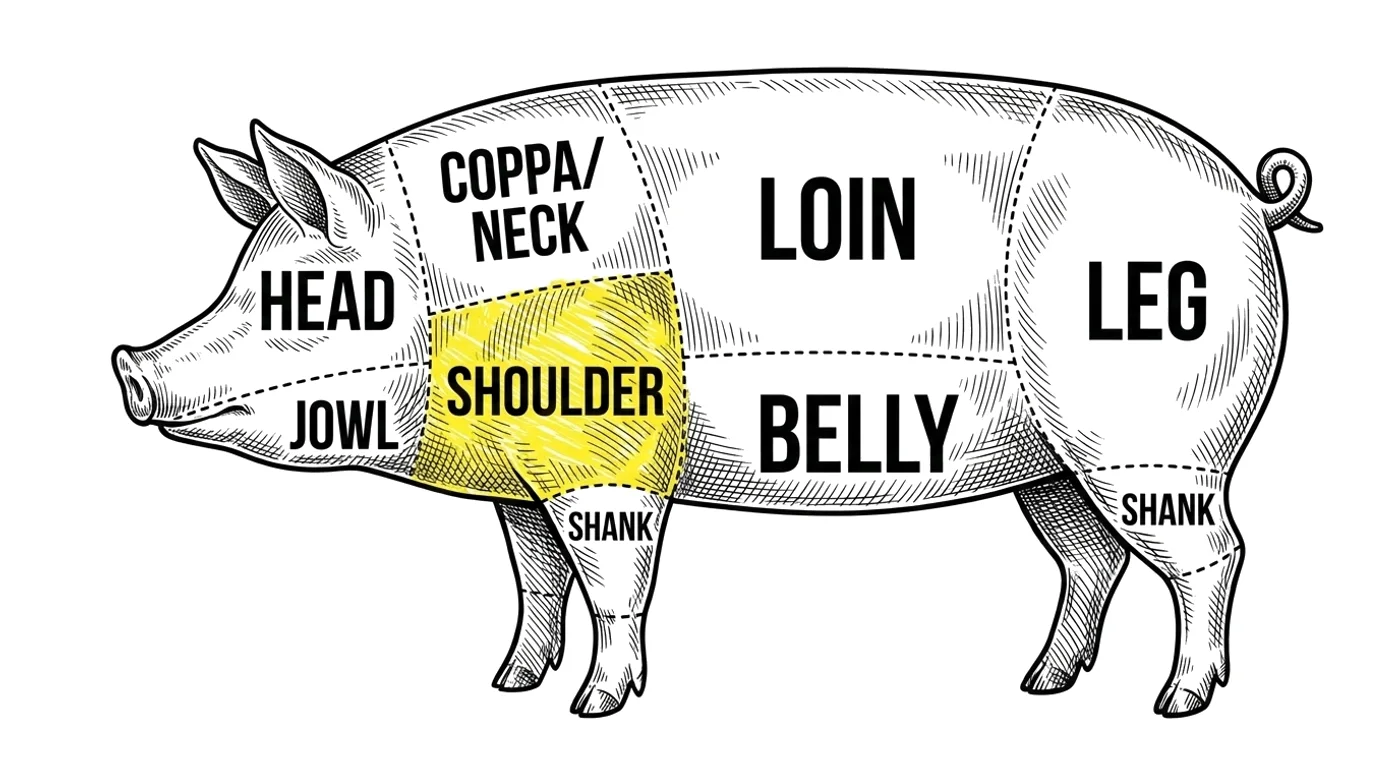
Identity and boundaries
The word rohe is essential. German standards also recognise cooked Touristenwurst, while Russian Tourist Sausage is a separate small-format GOST family. These products may share a translated travel theme, but they differ in meat block, heat treatment, preservation route and expected eating texture.
Composition and characteristics
The German category uses beef, fatty pork and added fat within defined raw-sausage quality limits. The cut surface should be cohesive and evenly coloured, with a medium-to-fine particle structure and no free fat. Smoke may contribute aroma, but smoke alone does not establish the identity. Casing form and finished diameter affect drying behaviour, but neither is sufficient to establish the identity without the raw-sausage composition and maturation branch.
Production and maturation
Production follows a controlled raw-sausage route: chilled trimming, grinding, complete-batch cure and seasoning, starter culture where the selected process requires it, stuffing, fermentation or maturation, optional cold smoking and measured drying. Ring form and calibre influence drying rate and must be reflected in chamber control.
History and context
Touristenwurst belongs to a nineteenth- and twentieth-century Central European tradition of portable sausages intended for travel, work and outdoor eating. The German food framework preserved both raw and cooked branches, which explains why the unqualified name is unreliable in translation and product catalogues. The familiar travel-oriented name therefore describes a use tradition, while the modern article must be anchored in the current German product classification.
Culinary use and relationships
Rohe Touristenwurst is served thinly sliced with bread, cheese, pickles or beer. It belongs beside other German sliceable raw sausages such as Mettenden and raw garlic sausage, but remains separate from cooked ring sausage, blood sausage and the Russian dry or semi-dry tourist sticks. When displayed beside its namesakes, the language and country should always be visible so readers do not infer a shared specification.
Recipe and cure
This is not a finished recipe. It is a window into how this meat is traditionally cured. Before you follow any process, run it through one of our curing calculators so the salt, cure and timings are right and safe for your own batch.
Make this — the measured Curesmith version →“Make this” opens the same cure as a measured recipe, scaled to your batch.
- Meat
- Pork shoulder
- Cut
- Pork shoulder
- Salt (%)
- 2.5
- Curing salt
- Cure #1/#2 as specified
- Fermented
- Yes
- Target pH
- 5.3 or lower
- Smoked
- Yes
- Basis
- per 1,000 g pork shoulder
- Style
- German-style sliceable fermented raw sausage.
Ingredients
- Pork shoulder100% · 1000 g
- Lean beef40% · 400 g
- Pork back fat25% · 250 g
- Fine salt2.5% · 41.5 g
- Cure #2 containing 6.25% sodium nitrite0.24% · 4 g
- Dextrose0.41% · 6.5 g
- Black pepper0.3% · 5 g
- Garlic0.2% · 3.5 g
- Ground coriander0.1% · 1.5 g
- Flora Italia LC or equivalent starter culture0.02% · 0.4 g
Safety. Rohe Touristenwurst is a raw fermented or matured sausage. It requires controlled curing, culture-led acidification where used, drying and a verified release endpoint. The name must never be used to imply that an unvalidated raw sausage is ready to eat.