
Russian Cooked-Smoked Sausage
Also known as Russian Hot Smoked, Russian Hot-Smoked Sausage, Русская варёно-копчёная колбаса
Russia
Overview
Russian Cooked-Smoked Sausage is the bounded Atlas identity for an archive-derived pork, beef and diced-fat formula labelled in English as Russian Hot Smoked. It has a medium-coarse meat matrix, conspicuous small fat cubes and a warm spice profile built from cardamom, allspice and black pepper. Madeira or brandy adds aroma. The sausage is smoked and then cooked, giving a brown-red casing and a firm, juicy slice rather than the dense texture of a long-dried salami.
Where it's from
The cut
Identity and terminology
The source title is descriptive but too broad to stand for every Russian sausage. Russian and Soviet standards use specific product names and compositional classes, and current cooked-smoked standards distinguish named sausages by raw material and quality requirements. The Atlas therefore treats this recipe as a documented branch, not as the national Russian sausage. It remains separate from Moskovskaya, Doktorskaya and raw-smoked products with their own identities and process rules.
Composition and characteristics
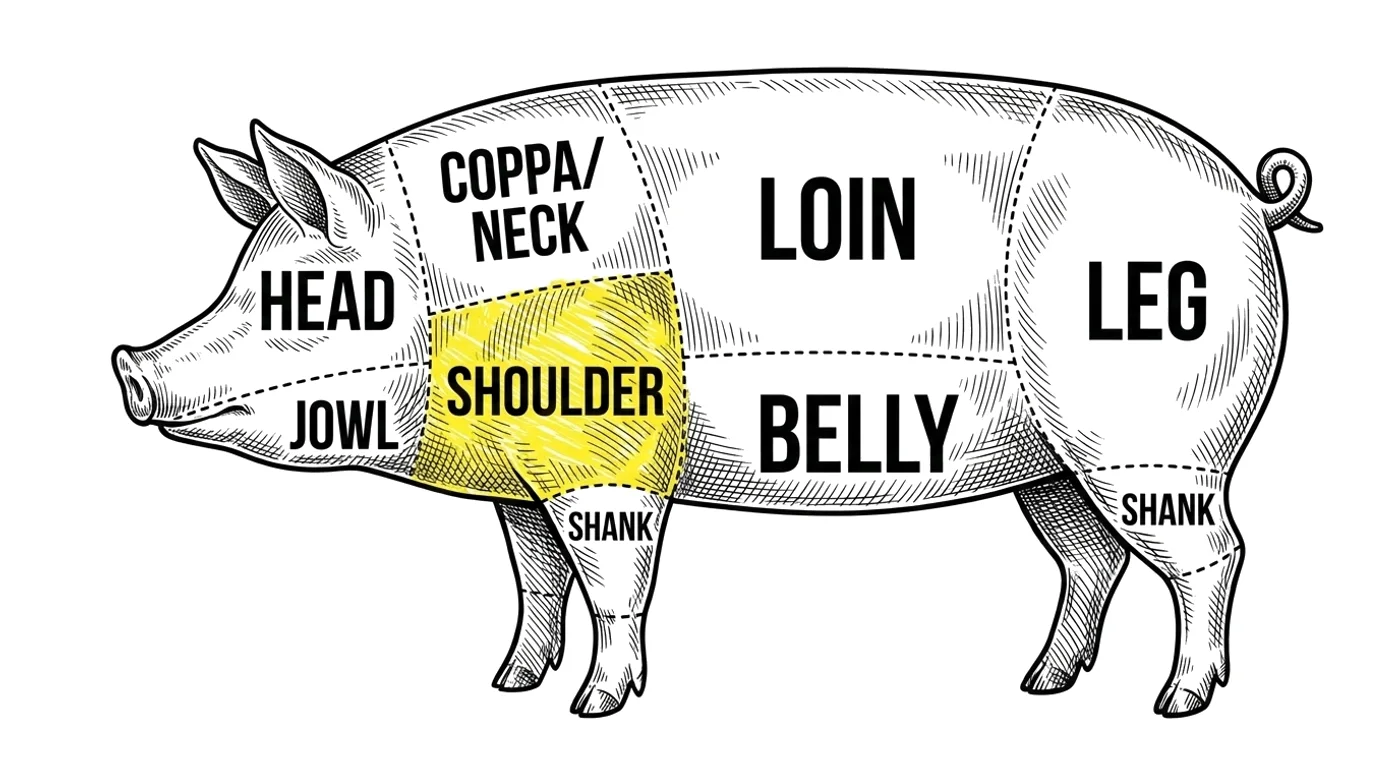
Lean pork supplies the main meat fraction, beef strengthens colour and bind, and firm back fat produces the pale mosaic. Cardamom and allspice are unusually prominent, placing the flavour closer to older eastern European luxury sausage profiles than to garlic-led everyday kielbasa. Wine or brandy contributes volatile fruit and oak notes but does not preserve the product. The meat and fat remain visibly particulate; this is not an emulsified frankfurter or smooth boiled kolbasa.
Production and process
Chilled pork and beef are ground at a medium plate while part-frozen fat is diced more finely. The lean meats are mixed with curing salt, sugar, spices, ice and the alcoholic ingredient until cohesive, then the fat is folded in without smearing. Broad casings are cured under refrigeration, surface-dried, smoked and cooked to a measured cold point. Controlled chilling prevents the large chub from lingering through temperatures favourable to bacterial growth.
History and regional forms
Cooked-smoked sausages became an important industrial category in Soviet meat technology because they combined cured flavour and smoke with a heat-treated ready-to-eat format. Formula names, grades and permitted materials changed across standards and periods. That history supports the technical category but does not validate a vague national label as a legal identity. Curesmith preserves the source wording as an alias and makes the evidence boundary part of the article itself.
Use, storage and related products
Slice the sausage thinly for rye bread, cold plates and pickles, or cut thicker pieces for eggs and warm dishes. It is related by process to Moskovskaya cooked-smoked sausage, but the cardamom, allspice, wine and meat proportions justify a separate source branch. Refrigerate after cooking, avoid cross-contamination during slicing and use opened product promptly. No shelf-stability or present-day GOST conformity is claimed for the home formula.
The recipe for this product is in preparation and will be published once it has been verified.
Safety. Keep the identity source-bounded, distribute cure through the entire animal block, probe the broad chub, chill rapidly and do not claim GOST conformity.